THE RECORD · ARCHIVE PLAYER
MP4
■ PAUSED
1940s Do/More Seating Service Ergonomic Chair Vintage AdvertisementANALOG ARCHIVE
1940s Do/More Seating Service Ergonomic Chair Vintage Advertisement (1940) — Class A vintage Lifestyle & Vice
CLASS A
1 of 5

1940s Do/More Seating Service Ergonomic Chair Vintage Advertisement

Category|Lifestyle & Vice
Year|1940
Rarity Class|CLASS A
Archive Views|6

Last updated: 10 May 2026

Historical Context

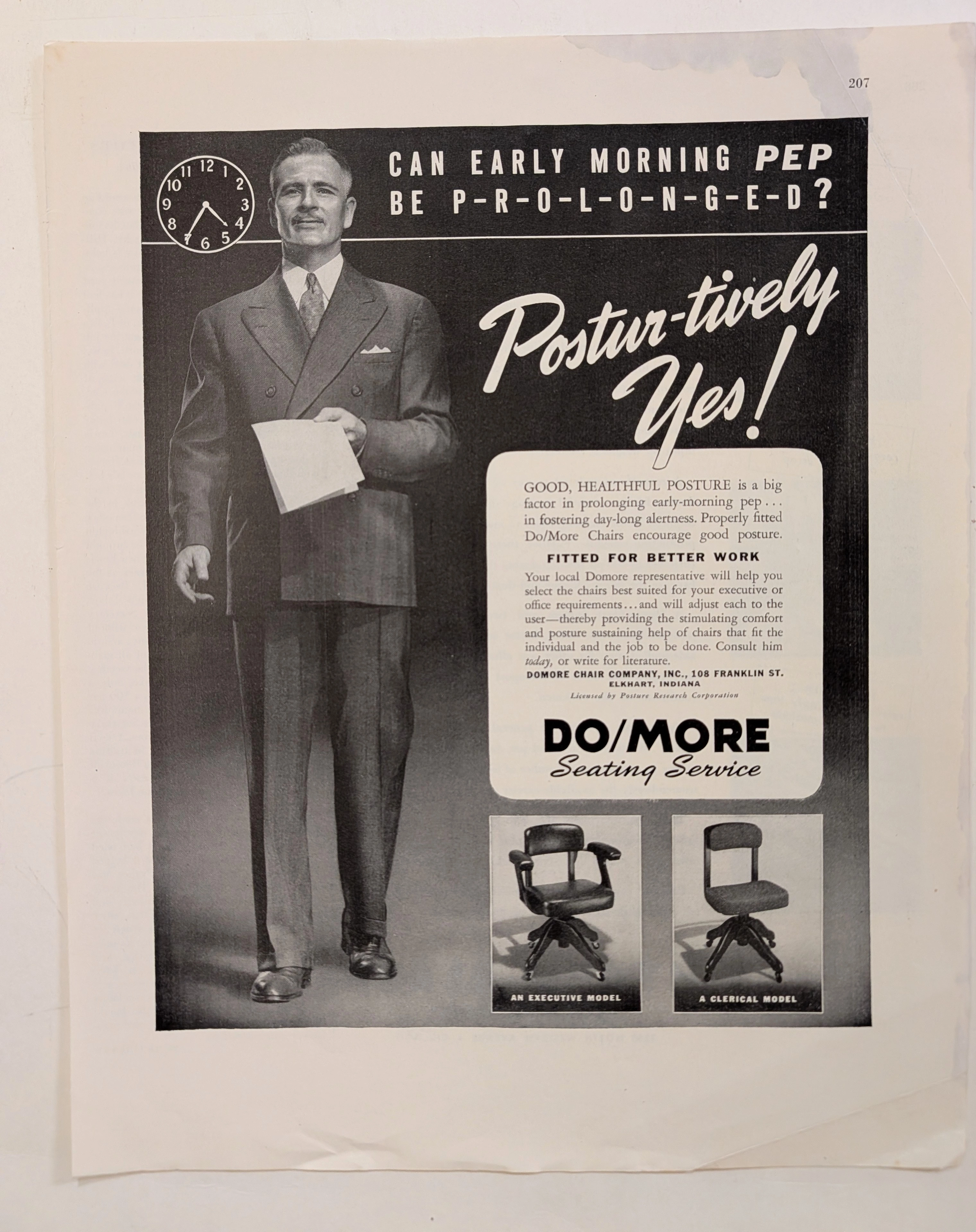
1940s Do/More Seating Service "Postur-tively Yes!" Vintage Advertisement During the mid-20th century, the modern corporate office was rapidly expanding, bringing with it a new awareness of occupational health and worker efficiency. The Domore Chair Company, based in Elkhart, Indiana, was a pioneer in what we now recognize as the field of ergonomics. This circa 1940s advertisement highlights the brand's core philosophy: that physical posture directly impacts mental alertness and day-long productivity. By posing the question, "Can early morning pep be prolonged?", the ad brilliantly targets the mid-century executive's desire for sustained energy throughout the grueling workday. The clever pun "Postur-tively Yes!" anchors the campaign, marrying the concepts of a positive attitude with proper physical alignment. The visual layout contrasts the sharply dressed, idealized businessman with objective, technical depictions of the "Executive" and "Clerical" chair models, emphasizing that seating was not merely furniture, but a specialized industrial tool "Fitted for Better Work." Furthermore, the prominent mention of being "Licensed by Posture Research Corporation" lent crucial scientific authority to their claims, showcasing an early and sophisticated example of using biomechanical backing in B2B (business-to-business) marketing.

Paper & Print Condition

This artifact is printed on standard uncoated commercial magazine stock typical of mid-century trade or business publications. The halftone lithography effectively captures the nuanced, almost charcoal-like shading of the executive's suit and the structural, industrial details of the metal and leather chairs. The black ink remains dense, providing excellent contrast against the slightly oxidized paper. There is uniform natural edge toning and minor handling wear present, which is entirely consistent with a functional, ephemeral business document of this age. Crucially, the text remains crisp and highly legible, preserving the sophisticated typography of the period.

Provenance & Rarity

Likely sourced from a prominent American business periodical such as Fortune or Business Week during the 1940s, this advertisement reflects the specialized nature of B2B marketing of the era. While consumer advertisements for fashion or automobiles were widely preserved, highly specific trade and office equipment ads were frequently discarded, making surviving examples moderately rare. The significance of this piece lies in its historical documentation of early corporate wellness and the nascent science of ergonomics, providing valuable insight into how mid-century manufacturers legitimized their products through scientific language ("Posture Research Corporation").

Rarity & Condition Summary

A highly informative and well-preserved document of mid-century industrial design and B2B advertising. This artifact bridges the gap between furniture manufacturing and the emerging science of ergonomics in the 1940s American workplace. It stands as a vital resource for archivists and historians of corporate culture, demonstrating early strategies for marketing productivity through physical wellness.
Share This Archive

From the Journal

Related Articles

The Time Traveller's Dossier: The Architecture of Slumber – The 1967 Simmons Golden Value — related article
Read Article

The Time Traveller's Dossier: The Architecture of Slumber – The 1967 Simmons Golden Value

The evolution of the American domestic interior during the mid-twentieth century was heavily influenced by the golden age of travel and the rapid expansion of the luxury hospitality industry. The historical artifact elegantly secured upon the analytical table of The Record Institute today is a large-format, two-page centerfold print advertisement for the Simmons Mattress Company, copyrighted in 1967. This document transcends standard consumer goods marketing; it operates as a sophisticated sociological mirror, reflecting a highly specific moment when industrial sleep engineering and the aspirational luxury of the modern hotel were explicitly packaged and sold to the suburban American household. This world-class, comprehensive dossier conducts a meticulous, profound, and historically objective examination of the artifact, operating under the absolute most rigorous parameters of sociological and material science evaluation. We will decode the brilliant marketing psychology embedded within the "First Public Sale" messaging, analyze the iconic "Good Housekeeping" endorsement, and dissect the rich semiotics of the heraldic quilt patterns alongside the modernist architectural illustrations. Furthermore, as we venture deeply into the chemical and physical foundations of this analog printed ephemera, we will reveal the precise mechanical fingerprints of the CMYK halftone rosettes and the graceful, natural oxidation of the paper substrate. This precise intersection of visual nostalgia, mid-century commercial artistry, and the immutable chemistry of time cultivates a serene wabi-sabi aesthetic—a natural, irreversible phenomenon that serves as the primary engine driving up its market value exponentially within the elite global spheres of Vintage Commercial Ephemera and Mid-Century Lifestyle Archives collecting.

The Time Traveller's Dossier : 1968 Libbey - The Luxury Shift — related article
Read Article

The Time Traveller's Dossier : 1968 Libbey - The Luxury Shift

The year is 1968. The American middle class is vast, established, and affluent. The suburbs have become the new kingdom. But kingdoms require regalia. Historically, fine glassware was inherited. It was crystal, cut by hand, passed down through generations of European aristocracy. Then, a pivot occurs. The industrial machine turns its gaze toward the dining table. Owens-Illinois, through its Libbey division, changes the paradigm of possession. They do not sell simple liquid receptacles. They sell instant heritage. They sell "The Giftables". This is not merely a catalog page for tumblers. It is a documented shift in social currency. A deliberate move to commodify nobility, mass-producing 22-karat gold heraldry for the everyday consumer. The problem was a society hungry for status but disconnected from aristocratic lineage. The solution was a seven-dollar-and-fifty-cent box of manufactured royalty.

The Time Traveller's Dossier: The Zenith of the American Living Room – Admiral Rectangular Color TV — related article
Read Article

The Time Traveller's Dossier: The Zenith of the American Living Room – Admiral Rectangular Color TV

The evolution of the American domestic interior during the mid-twentieth century was fundamentally redefined by the introduction and subsequent democratization of color television. The historical artifact elegantly and securely positioned upon the analytical table of The Record Institute today is a majestic, full-page print advertisement for Admiral Color TV, originating from the transitional technological era of the late 1960s. This document completely transcends the traditional boundaries of consumer electronics marketing. It operates as a highly sophisticated, multi-layered cultural and historical mirror, reflecting the exact moment when the magic of color broadcasting collided with the rigorous aesthetic demands of suburban domestic styling on a single printed page. This world-class, comprehensive dossier conducts a meticulous, unyielding, and exceptionally deep examination of the artifact, operating under the absolute most rigorous parameters of historical, sociological, and material science evaluation. With our analytical focus dedicated heavily to its historical gravity, we will decode the brilliant marketing psychology embedded within the "rectangular" tube innovation, analyze the space-age luxury of the "Sonar" remote control, and dissect the rich semiotics of disguised technology through "genuine walnut veneers". Furthermore, as we venture deeply into the chemical and physical foundations of this analog printed ephemera, we will reveal the precise mechanical fingerprints of the CMYK halftone rosettes and the graceful, natural oxidation of the paper substrate. This precise intersection of visual nostalgia, mid-century commercial artistry, and the immutable chemistry of time cultivates a serene wabi-sabi aesthetic—a natural, irreversible phenomenon that serves as the primary engine driving up its market value exponentially within the elite global spheres of Vintage Commercial Ephemera, Consumer Electronics Archives, and Mid-Century Lifestyle collecting.

The Time Traveller's Dossier : VW Scirocco - The Democratization of Velocity — related article
Read Article

The Time Traveller's Dossier : VW Scirocco - The Democratization of Velocity

We measure automotive history by the architectures that define it. For decades, the global standard for accessible mobility was curved, air-cooled, and rear-engined. The Volkswagen Beetle was an institution of utilitarian survival. But by the mid-1970s, survival was no longer sufficient. The world demanded forward momentum. The global fuel crisis of 1973 had altered the economic atmosphere. The American muscle car was dying under the weight of its own inefficiency. The Japanese imports were rewriting the rules of reliability. Volkswagen faced an existential precipice. Their solution was a violent pivot in engineering philosophy. This artifact documents that exact, definitive rupture in their timeline. It is not merely a car advertisement. It is a public declaration that the era of the air-cooled curved line was dead. The problem was an aging product line trapped in an obsolete paradigm. The solution was a water-cooled, front-wheel-drive wedge, validated on the racetrack and sold to the public.