THE RECORD · ARCHIVE PLAYER
MP4
■ PAUSED
1970s Canadian Lord Calvert Whisky "Merry Christmas" Vintage AdvertisementANALOG ARCHIVE
1970s Canadian Lord Calvert Whisky "Merry Christmas" Vintage Advertisement (1970) — Class B vintage Lifestyle & Vice
CLASS B
1 of 3

1970s Canadian Lord Calvert Whisky "Merry Christmas" Vintage Advertisement

Category|Lifestyle & Vice
Subcategory|Alcohol
Year|1970
Rarity Class|CLASS B
Archive Views|9

Last updated: 07 May 2026

Historical Context

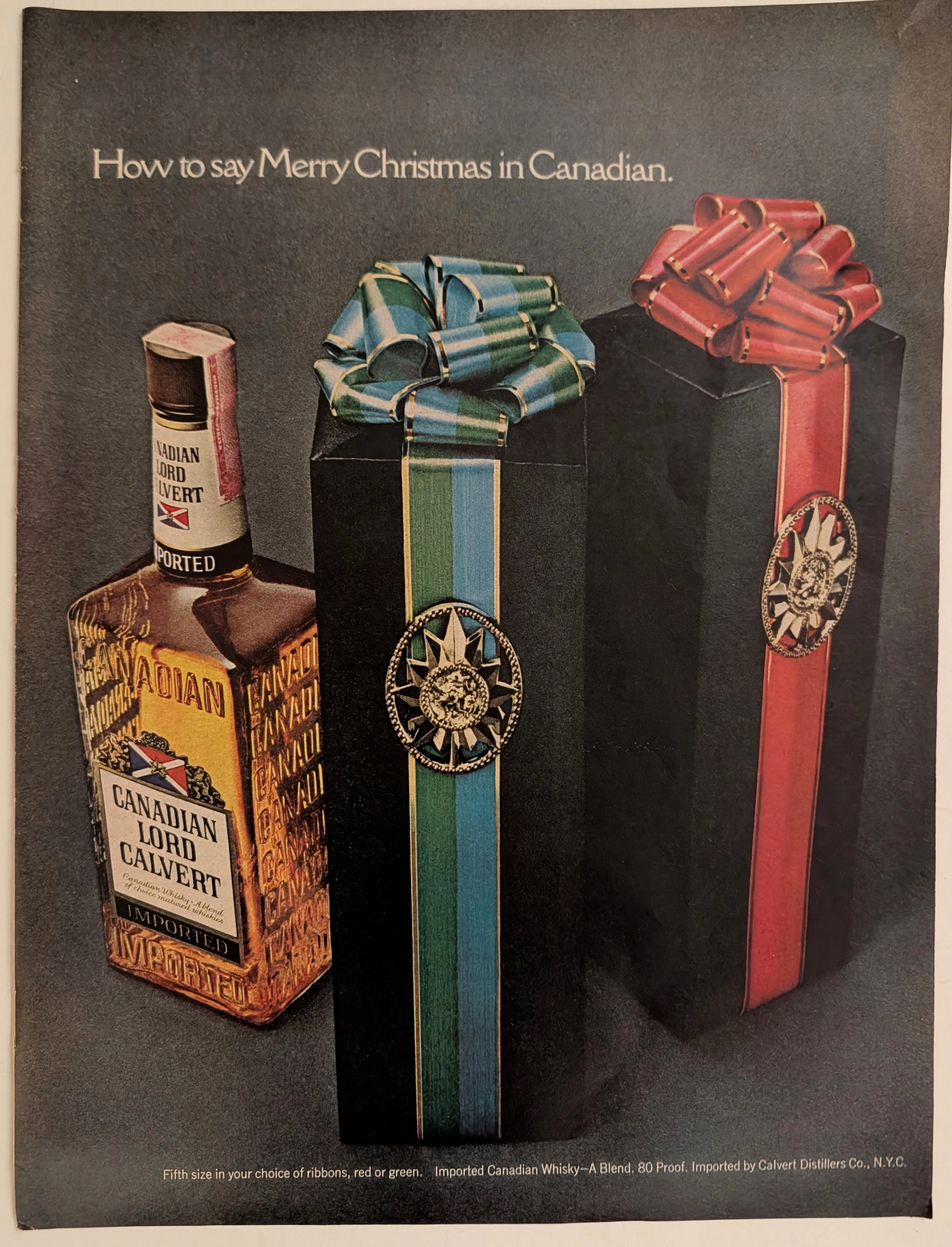
1970s Canadian Lord Calvert Whisky "Merry Christmas in Canadian" Vintage Advertisement During the mid-to-late 20th century, the North American distilled spirits market was highly competitive, particularly during the crucial fourth-quarter holiday sales season. Calvert Distillers Company, operating out of New York City, leveraged this lucrative period by positioning their Canadian Lord Calvert brand not just as a beverage, but as a complete, ready-to-give luxury present. This specific campaign, anchored by the memorable tagline "How to say Merry Christmas in Canadian," successfully marries the product's national origin with seasonal goodwill. Canadian whiskies were historically marketed to American consumers as smoother, lighter alternatives to domestic straight bourbons or heavier, peat-forward Scotch whiskies. By emphasizing the "Imported" status prominently on the bottle's label, the neckband, and the ad copy, Calvert tapped into the mid-century American consumer's association of imported goods with higher quality and prestige. The visual composition of the advertisement is a masterclass in "product-as-hero" commercial studio photography. Set against a dark, textured, almost velvet-like backdrop, the lighting is meticulously staged to accentuate the rich amber hue of the whisky and the metallic sheen of the foil ribbons. The inclusion of the ornate, multi-pointed star medallion—affixed directly to the distinctively tall, rectangular gift boxes—serves a dual purpose. First, it acts as a striking visual anchor that breaks up the vertical lines of the packaging. Second, it subliminally communicates a sense of heraldry, deep tradition, and aristocratic quality, elevating the perceived value of an accessible, mass-market blend. Furthermore, the fine print at the bottom of the page reveals a fascinating logistical detail of historical liquor marketing: "Fifth size in your choice of ribbons, red or green." By offering the "Fifth" (a standard volume of alcohol equivalent to one-fifth of a gallon, or roughly 750ml today) pre-wrapped in varying festive colors, Calvert provided a frictionless solution for consumers. Shoppers could acquire convenient, visually impressive holiday gifts straight from the liquor store shelf, bypassing the need for additional wrapping. This strategy highlights the era's growing shift towards convenience packaging within the luxury goods and spirits sector, cementing Canadian Lord Calvert as a staple of holiday corporate and personal gifting.

Paper & Print Condition

This artifact is printed on medium-weight, coated commercial magazine stock characteristic of high-circulation American periodicals from the 1970s. The artifact demonstrates the technical proficiency of four-color (CMYK) offset lithography of the era. The halftone ink application remains remarkably stable, retaining excellent color saturation and contrast. This is particularly evident in the deep, velvety black backgrounds, the luminous amber tones of the whisky, and the vibrant, metallic hues of the red and green foil ribbons. Minimal ink oxidation has occurred, preserving the sharp delineations of the typography and the intricate details of the star medallion. While there is minor, expected surface wear and slight micro-abrasions along the outer margins consistent with a paper document of its age, the structural integrity of the paper remains sound. There is no significant yellowing, foxing, or deterioration of image fidelity, allowing the original commercial photography to be appreciated exactly as intended by the art directors of the period.

Provenance & Rarity

This artifact originates from the golden era of North American print media, specifically sourced from a high-circulation consumer lifestyle magazine distributed during the late autumn or early winter of the 1970s. Print advertisements of this nature are inherently ephemeral—designed for temporary consumer engagement and subsequent disposal. Because of this intended obsolescence, while millions of copies were originally printed, the survival rate of individual pages in such pristine, exhibit-quality condition is surprisingly low. The rarity of this specific artifact does not stem from a limited initial production run, but rather from the high rate of attrition caused by time, environmental degradation, and the historical lack of institutional preservation for everyday commercial ephemera. For archives like The Record Institute, as well as specialized collectors of distilled spirits memorabilia and mid-century advertising history, the true value of this piece lies in its intact preservation. It serves as an unblemished primary source document detailing 20th-century holiday marketing strategies, the evolution of luxury convenience packaging, and the specific visual culture of the North American liquor industry.

Rarity & Condition Summary

In summary, this 1970s Canadian Lord Calvert advertisement stands as a remarkable surviving specimen of mid-century commercial ephemera. Its rarity is defined not by its original print run, which was vast, but by its exceptional state of preservation decades later. The vibrant, unoxidized offset lithography beautifully captures the era's sophisticated "product-as-hero" photography, highlighting the textural interplay between the dark velvet background, the luminous amber whisky, and the metallic holiday ribbons. Free from significant structural degradation, foxing, or color fading, this artifact transcends its original purpose as a disposable seasonal advertisement. It is now a museum-grade archival document that offers profound insights into 20th-century luxury marketing, the evolution of holiday convenience packaging, and North American graphic design. It remains a pristine visual record, highly prized by historians, archivists, and collectors of vintage distilled spirits advertising.
Share This Archive

From the Journal

Related Articles

The Treaty of Two Empires: Deconstructing the 1982 Bacardi & Coca-Cola Vintage Ad (Class S) — related article
Read Article

The Treaty of Two Empires: Deconstructing the 1982 Bacardi & Coca-Cola Vintage Ad (Class S)

Dive into the history of American consumerism with this museum-grade analysis of the iconic 1982 Bacardi and Coca-Cola co-branding advertisement. This Class S archival piece captures the definitive shift from the Golden Age of Illustration to 1980s commercial studio photography. Explore the geopolitical legacy of the "Cuba Libre" and the analog practical effects behind the immortal condensation on the Coca-Cola contour bottle.

Vintage 70s Crown Royal Ad: Vanishing Analog Art | The Record — related article
Read Article

Vintage 70s Crown Royal Ad: Vanishing Analog Art | The Record

An in-depth look at the priceless 1970s Crown Royal "Have you ever seen a grown man cry?" advertisement. A masterpiece of authentic analog photography on degrading vintage paper, driving up the value of this original print as global supply inevitably shrinks.

Vintage Chivas Regal x Charles Saxon Ad: The Vanishing Playboy Art | The Record — related article
Read Article

Vintage Chivas Regal x Charles Saxon Ad: The Vanishing Playboy Art | The Record

An in-depth look at the Chivas Regal ad from Playboy magazine, illustrated by legendary artist Charles Saxon. A magazine-sized piece of authentic analog art on degrading vintage paper, driving up its value as an alternative asset.

THE TIME TRAVELER'S DOSSIER: OLD CROW - THE MYTHOLOGY OF AMERICAN BOURBON — related article
Read Article

THE TIME TRAVELER'S DOSSIER: OLD CROW - THE MYTHOLOGY OF AMERICAN BOURBON

The artifact currently subjected to our uncompromising, museum-grade analysis is a profoundly preserved Historical Relic excavated from the golden age of American print media. This Primary Art Document is a full-page, magazine-sized advertisement for OLD CROW Kentucky Straight Bourbon Whiskey. Functioning as a "Forensic Blueprint of American Myth-Making," the document masterfully weaponizes political heritage and historical titans to validate the aristocratic taste and unparalleled quality of the bourbon. ​Its historical context is irrefutably anchored by the embossed text physically molded into the glass bottle itself—the most powerful and undeniable forensic evidence available in mid-century liquor advertising. Grounded by extreme macro details of the label, the microscopic golden monogram embroidered on the coat, and the breathtaking wabi-sabi chemical degradation of the highly acidic, magazine-sized paper, this artifact commands an irreplaceable status. It firmly cements its Rarity Class A designation as an absolute masterpiece of historical marketing engineering and analog preservation.