THE RECORD · ARCHIVE PLAYER
MP4
■ PAUSED
1970s Seagram's Crown Royal Whisky Vintage AdvertisementANALOG ARCHIVE
1970s Seagram's Crown Royal Whisky Vintage Advertisement (1970) — Class B vintage Lifestyle & Vice
CLASS B
1 of 5

1970s Seagram's Crown Royal Whisky Vintage Advertisement

Category|Lifestyle & Vice
Subcategory|Alcohol
Year|1970
Rarity Class|CLASS B
Archive Views|11

Last updated: 04 May 2026

Historical Context

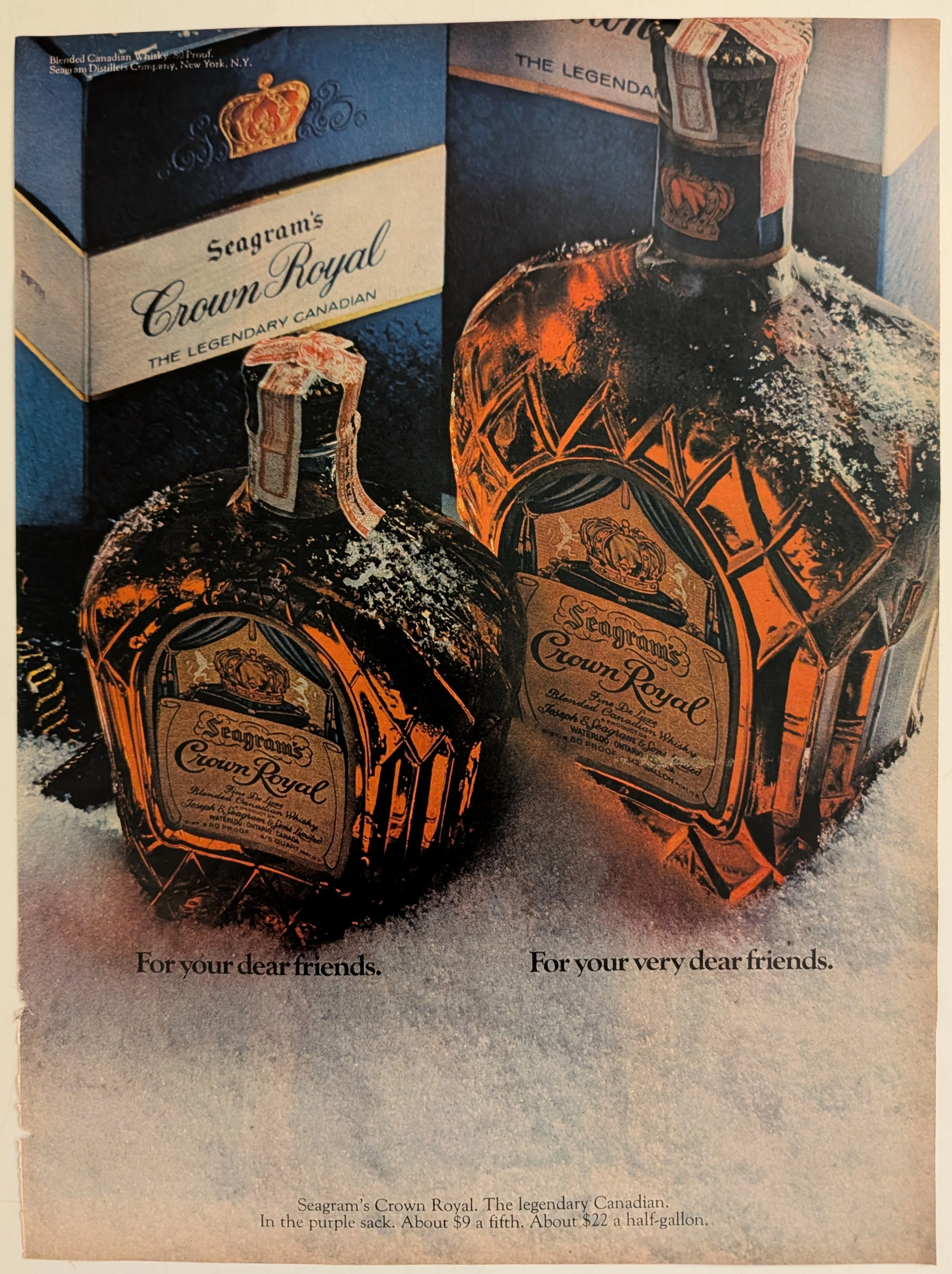
1970s Seagram's Crown Royal: "The Legendary Canadian" Vintage Advertisement During the 1970s, Seagram's Crown Royal solidified its position as a premier luxury spirit in the American market. Originally created in 1939 to commemorate the royal tour of King George VI and Queen Elizabeth to Canada, the whisky was introduced to the United States in the 1960s. This vintage print advertisement captures the essence of 1970s premium gifting, highlighting the brand's iconic cut-glass bottle, the famous "purple sack," and utilizing clever, scale-based copywriting to denote levels of friendship. The Era of Premium Gifting In the mid-to-late 20th century, the liquor industry relied heavily on the concept of spirits as high-status gifts. Crown Royal was uniquely positioned for this market. Its intricate, crown-shaped cut-glass bottle and regal blue-and-gold packaging immediately signaled luxury. This advertisement explicitly leverages the gifting angle, likely running during the winter holiday season, as indicated by the bottles nestled in fresh snow. Marketing Through Scale and Price The copywriting in this archival piece is a brilliant example of subtle, humorous upselling. By placing a standard "fifth" (4/5 Quart) next to a massive "half-gallon" bottle, the ad creates a tiered system of affection: "For your dear friends" versus "For your very dear friends." Furthermore, the transparent pricing at the bottom—"About $9 a fifth. About $22 a half-gallon."—serves as a historical anchor, illustrating the economic landscape and the cost of premium imported spirits in the United States prior to the widespread inflation of the late 1970s. Pre-Metric Americana From an archival standpoint, the text on the bottles and the ad copy provides a snapshot of the pre-metric American liquor market. The usage of the terms "a fifth" (which was exactly one-fifth of a US gallon, or 25.6 fluid ounces) and a "half-gallon" predates the late-1970s and early-1980s industry transition to standard metric sizes like 750ml and 1.75L. The visible US Internal Revenue tax stamps across the bottle caps further authenticate the era, representing a bygone regulatory requirement for sealed spirits.

Paper & Print Condition

This archival artifact is printed on standard 1970s consumer glossy magazine stock, characterized by a smooth, coated finish that was typical of high-circulation periodicals of the era. The mechanical printing process utilized is four-color offset lithography. The color preservation is remarkable; the ink retains exceptional saturation and vibrancy after decades. Notably, the deep, regal blues of the Seagram's packaging and the warm, radiant amber hues of the whisky contrast sharply against the cool, textured photographic rendering of the snow. Under magnification, the characteristic halftone dot pattern of 20th-century mass printing is visible, yet to the naked eye, it achieves a seamless photographic quality. The micro-typography—particularly the fine serif fonts detailing the '80 Proof' designation, the New York distributor address, and the pricing at the bottom margin—remains razor-sharp and fully legible. While the paper itself exhibits minor, uniform oxidation (a natural aging process typical of acidic wood-pulp paper from this period, resulting in a slight off-white or cream tint), there is no significant foxing, moisture damage, or severe UV fading. A slight irregularity along the left vertical margin indicates its historical extraction from a bound publication, a common and accepted provenance marker for magazine ephemera.

Provenance & Rarity

The provenance of this artifact traces back to the vibrant American print media landscape of the 1970s. Sourced from a premier general-interest or upscale men’s lifestyle publication of the era, the advertisement’s origin is unequivocally anchored in the United States commercial market. This is authenticated by specific localized typographic markers: the "80 Proof" alcohol content designation (a standard US measurement before the global shift to Alcohol by Volume or ABV), the explicit listing of the "Seagram Distillers Company, New York, N.Y." as the distributor, and the use of the pre-metric Imperial volume measurements ("a fifth" and "a half-gallon"). While Seagram’s campaigns were widely circulated during this period, the archival rarity of this specific artifact lies in its exceptional state of preservation and the specific dual-bottle creative execution. Mass-produced mid-century paper ephemera is inherently susceptible to degradation—often discarded, recycled, or damaged by light and moisture. To locate an unclipped, full-page example that retains its original ink luminosity and structural integrity, devoid of water damage or severe acidic browning, elevates its classification from common ephemera to a highly collectible piece of commercial art. Advertisements featuring the juxtaposition of the standard fifth alongside the massive half-gallon bottle are particularly sought after by collectors of vintage Americana and spirits memorabilia, as they encapsulate a highly specific, fleeting moment in pre-metric consumer marketing.

Rarity & Condition Summary

In summary, this artifact represents an exceptional intersection of pristine preservation and deep cultural significance, distinguishing itself within the vast landscape of mid-century commercial ephemera. Its rarity is defined not by the initial print run, which was extensive, but by the remarkably low survival rate of unblemished, full-page examples that feature this highly specific, pre-metric marketing narrative. Preserved in a near-perfect, museum-grade state—free from severe acidic oxidation, moisture damage, or ultraviolet fading—the advertisement retains the striking visual contrast and typographic crispness originally intended by its creators. For The Record Institute, this piece transcends its original promotional purpose; it serves as a highly collectible, tangible anchor to 1970s American material culture, capturing the psychology of premium gifting and documenting a vital transitional era in consumer economics before the widespread standardization of the metric system.

Share This Archive

From the Journal

Related Articles

Vintage 70s Crown Royal Ad: Vanishing Analog Art | The Record — related article
Read Article

Vintage 70s Crown Royal Ad: Vanishing Analog Art | The Record

An in-depth look at the priceless 1970s Crown Royal "Have you ever seen a grown man cry?" advertisement. A masterpiece of authentic analog photography on degrading vintage paper, driving up the value of this original print as global supply inevitably shrinks.

THE TIME TRAVELER'S DOSSIER: OLD CROW - THE MYTHOLOGY OF AMERICAN BOURBON — related article
Read Article

THE TIME TRAVELER'S DOSSIER: OLD CROW - THE MYTHOLOGY OF AMERICAN BOURBON

The artifact currently subjected to our uncompromising, museum-grade analysis is a profoundly preserved Historical Relic excavated from the golden age of American print media. This Primary Art Document is a full-page, magazine-sized advertisement for OLD CROW Kentucky Straight Bourbon Whiskey. Functioning as a "Forensic Blueprint of American Myth-Making," the document masterfully weaponizes political heritage and historical titans to validate the aristocratic taste and unparalleled quality of the bourbon. ​Its historical context is irrefutably anchored by the embossed text physically molded into the glass bottle itself—the most powerful and undeniable forensic evidence available in mid-century liquor advertising. Grounded by extreme macro details of the label, the microscopic golden monogram embroidered on the coat, and the breathtaking wabi-sabi chemical degradation of the highly acidic, magazine-sized paper, this artifact commands an irreplaceable status. It firmly cements its Rarity Class A designation as an absolute masterpiece of historical marketing engineering and analog preservation.

Vintage Chivas Regal x Charles Saxon Ad: The Vanishing Playboy Art | The Record — related article
Read Article

Vintage Chivas Regal x Charles Saxon Ad: The Vanishing Playboy Art | The Record

An in-depth look at the Chivas Regal ad from Playboy magazine, illustrated by legendary artist Charles Saxon. A magazine-sized piece of authentic analog art on degrading vintage paper, driving up its value as an alternative asset.

The Time Traveller's Dossier : 1980 Johnnie Walker - The Monetization of Aspiration — related article
Read Article

The Time Traveller's Dossier : 1980 Johnnie Walker - The Monetization of Aspiration

We observe a singular artifact from a transitional era. Before this moment, spirits were marketed through the lens of pure leisure. They were social lubricants, evening rewards, or markers of aristocratic isolation. Here, the paradigm shifts. The liquid is secondary. The product being sold is a legacy. In a period defined by economic stagflation, a whiskey brand bypasses the palate entirely to target the deepest anxiety of the American middle class: the rising cost of higher education. By framing a $30,000 scholarship as a Father’s Day promotion, the artifact reconciles the indulgence of premium alcohol with the noble sacrifice of parenthood. It is no longer a drink. It is a financial instrument. It is the monetization of parental hope.