The Time Traveller's Dossier : 1968 Coleman - The Domestication of the Wild
The History
The artifact before us requires an exhaustive, unyielding contextualization.
To comprehend this piece of printed ephemera, we must dissect the socio-political, infrastructural, and psychological anatomy of the world that necessitated its creation.
The year 1968 is a historical centrifuge, spinning the American populace into a state of profound disorientation.
The urban centers are volatile.
The geopolitical landscape is defined by the grim realities of the Cold War and the escalating conflict in Vietnam.
The nightly news broadcasts scenes of dense, hostile jungles and burning city blocks.
In direct psychological response to this overwhelming external chaos, the American middle class seeks sanctuary.
They seek a return to innocence.
They seek the purity of the natural world.
However, the post-war American consumer has been fundamentally altered by two decades of unprecedented domestic comfort.
They are accustomed to climate control, refrigeration, and instant illumination.
They want to escape into the woods, but they absolutely refuse to suffer while doing so.
In the decades prior to the mid-20th century, camping was a pursuit defined by austerity.
It was the domain of hunters, hardened outdoorsmen, and military surplus gear.
It involved heavy canvas, unpredictable wood fires, and the genuine threat of cold and darkness.
It was an exercise in enduring the elements.
The Coleman Company recognized that to unlock the massive economic potential of the post-war family, they had to eradicate the hardship.
They had to engineer comfort.
They had to domesticate the wild.
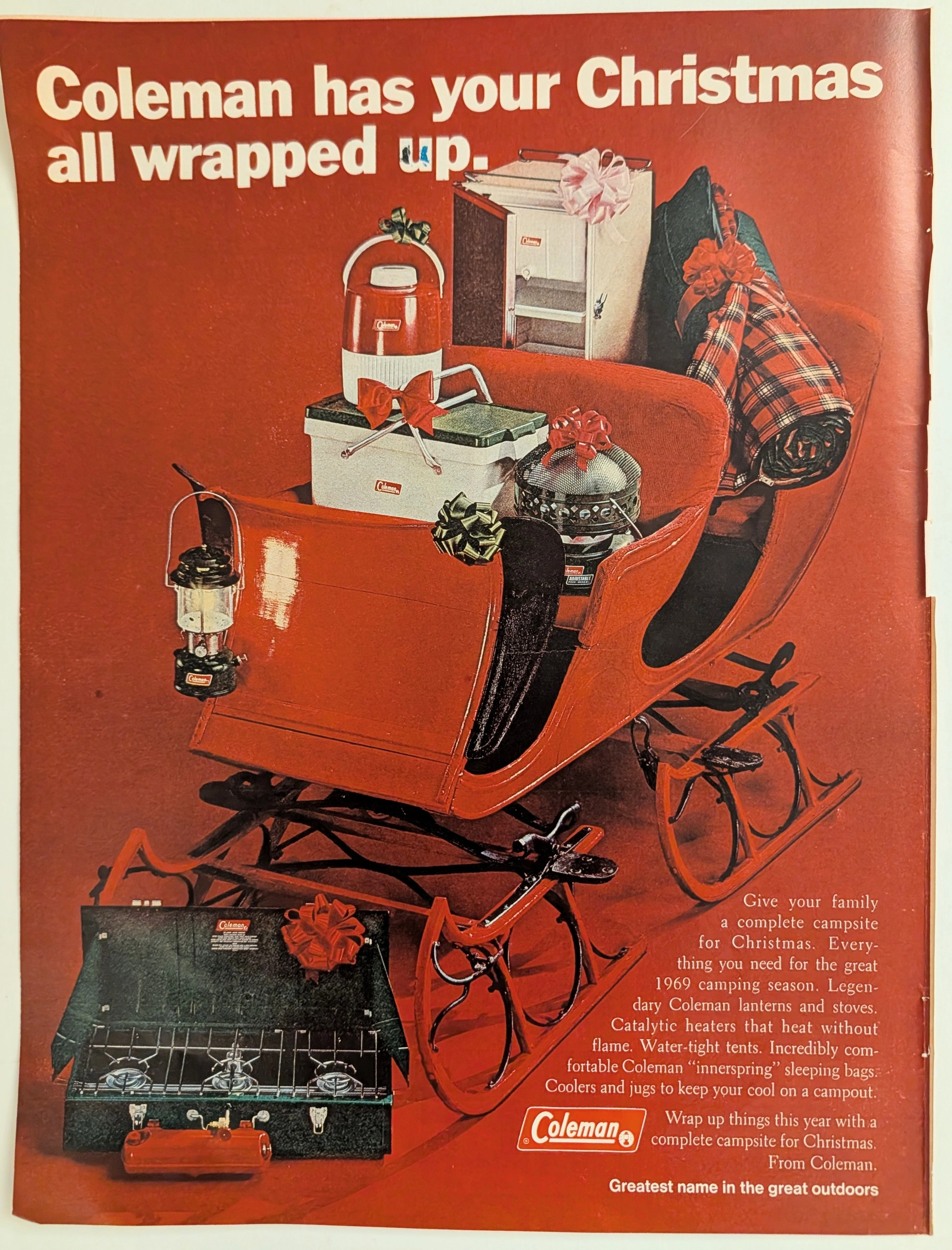
This advertisement, preparing consumers for the "great 1969 camping season," is the ultimate manifesto of that domestication.
Let us analyze the specific machinery of this conquest, proudly displayed in the red sleigh.
The anchor of this visual cornucopia is the classic green Coleman two-burner stove.
This is not merely a cooking appliance; it is a profound technological intervention.
Historically, the campfire was the volatile, smoky, unpredictable center of outdoor life.
It required labor to build and constant vigilance to maintain.
The Coleman stove replaced the ancient hearth with the mechanics of the suburban kitchen.
It utilizes liquid "white gas," pressurized by a hand-operated pump, forced through a heated generator tube, and vaporized to produce a clean, consistent, infinitely adjustable blue flame.
It represents absolute mastery over fire.
It allows the housewife—who was still the primary target of domestic marketing in 1968—to effortlessly transpose her culinary domain from the linoleum kitchen to the dirt of the state park.
Flanking the stove in the sleigh is the Coleman lantern.
This, too, is a masterpiece of psychological engineering.
The wilderness is fundamentally dark.
Darkness breeds primal fear.
The Coleman lantern, utilizing the same pressurized liquid fuel system, forces vaporized gas into a fragile, thorium-infused silk mantle.
When ignited, this mantle incandesces with a blinding, brilliant white light.
It does not merely illuminate a tent; it actively pushes back the ancient, terrifying dark.
It creates a sterilized, brightly lit bubble of civilization in the middle of the absolute void.
It is the portable conquest of the night.
Further up the sleigh, we observe the "catalytic heaters that heat without flame."
This is a direct technological response to the fear of carbon monoxide and uncontrolled fire within the enclosed space of a canvas tent.
By utilizing a platinum catalyst to create a low-temperature, flameless combustion of fuel vapors, Coleman offered safe, radiant heat.
It is the equivalent of bringing the suburban radiator into the wilderness.
Beside it sits the cooler and the jug.
Before the widespread availability of highly insulated, portable polyurethane coolers, perishable food in the wild was a severe liability.
The cooler severed the camper's reliance on dry goods and foraging.
It allowed the transportation of fresh milk, ground beef, and cold beer into the heart of the forest.
It was the final logistical link required to replicate the suburban diet outdoors.
Finally, the copy mentions "Incredibly comfortable Coleman 'innerspring' sleeping bags."
This is the ultimate semantic and physical fusion of the domestic and the wild.
The sleeping roll, historically a symbol of rugged frontier life, has been redesigned to mimic the architecture of a Sealy Posturepedic mattress.
The infrastructural landscape of America in 1968 perfectly supported this engineered escapism.
The Interstate Highway Act of 1956 had funded a massive, continent-spanning network of paved arteries.
Simultaneously, the American automotive industry was producing the station wagon—a massive, steel-bodied vessel capable of transporting a nuclear family and hundreds of pounds of gear.
The combination of the interstate, the station wagon, and Coleman gear birthed a new demographic: the automotive camper.
They did not hike into the wilderness; they drove into it.
The National Park Service and state governments responded by building thousands of drive-in campsites.
These were highly manicured patches of nature, featuring paved parking pads, standardized concrete picnic tables, and designated steel fire rings.
The wilderness had been divided into manageable, rentable parcels.
The messaging of this specific advertisement is a brilliant psychological subversion.
It is a Christmas advertisement for outdoor survival gear.
"Coleman has your Christmas all wrapped up."
By placing these industrial, green-enameled steel machines inside a nostalgic, Victorian red sleigh and adorning them with massive red velvet bows, the advertising agency has completely neutralized any lingering perception of rugged hardship.
They have framed a gasoline-powered stove as a warm, family-oriented holiday gift.
They have taken the cold reality of the American wilderness and wrapped it in the safe, familiar iconography of Santa Claus.
"Give your family a complete campsite for Christmas."
They are not selling individual tools; they are selling a holistic, pre-packaged lifestyle.
They are selling the concept that nature is something you purchase, pack in the trunk of a Ford Country Squire, and unpack on a weekend in July.
This historical shift is monumental.
We moved from a society that viewed nature as an adversary to a society that viewed nature as a recreational commodity.
This advertisement paved the exact path for the multi-billion-dollar outdoor recreation industry of the 21st century.
From the ultra-lightweight titanium stoves of today to the "glamping" resorts offering Wi-Fi in the woods.
The blueprint was forged right here, in this red sleigh.
Take the brutal, unforgiving elements of the earth.
Apply mid-century industrial engineering.
Package it in a recognizable brand aesthetic.
The human brain, desiring the romanticism of the wild but requiring the safety of the suburb, will eagerly purchase the compromise.
This artifact is a primary source document of that grand, sociological negotiation between man and nature.
The Paper
The physical medium is a testament to the high-fidelity mass printing capabilities of the late 1960s.
We are examining a magazine tear sheet, printed via high-speed web offset lithography.
The paper stock is a medium-weight, glossy coated sheet.
The coating is critical; it is a layer of clay and binders applied to the paper to prevent the ink from wicking into the cellulose fibers.
This allows the ink to sit on top of the surface, resulting in the deep, highly saturated reds of the sleigh and the crisp, mechanical greens of the stove.
Under macro examination, the mechanical truth behind the festive illusion is exposed.
The rich red paint of the sleigh, the intricate plaid of the sleeping bag, and the metallic glint of the lantern hood are reduced to a precise, calculated matrix.
The image is constructed entirely of overlapping Cyan, Magenta, Yellow, and Key (Black) halftone dots.
The illusion of depth, shadow, and holiday warmth is a cold, mathematical arrangement of pigmented droplets.
The stark white of the "Coleman" typography is not printed ink; it is the negative space of the paper itself, allowed to show through the dense matrix of surrounding color.
The physical aging of the artifact tells its own story of entropy.
The edges of the page are brittle and micro-fractured, showing the physical trauma of its removal from the binding.
The paper is oxidizing.
The chemical composition of the paper—likely containing acid-producing wood pulp—ensures its eventual, slow degradation.
The areas of white text are beginning to shift toward a warm, aged amber as the lignin within the fibers reacts with oxygen and light.
It is an artifact recording its own slow destruction.
The mechanical reproduction of outdoor durability is slowly being reclaimed by the natural, unstoppable law of decay.
The Rarity
Classification: Class B.
In November and December of 1968, this advertisement was inserted into national, mass-market publications across the United States.
The sheer volume of the initial production run means the raw material itself is not inherently scarce.
However, its survival rate is statistically microscopic.
Holiday magazine issues were highly ephemeral; they were consumed in December and discarded in January.
Finding an intact page, free from severe moisture damage, fading, or total structural failure, significantly elevates its status.
The true value of this artifact is entirely divorced from its monetary appraisal.
Its value is deeply contextual and sociological.
It is a pristine Rosetta Stone for understanding mid-century consumer psychology and the evolution of American leisure.
Its rarity lies in its flawless utility as a historical mirror, reflecting the exact moment the wilderness was successfully packaged and sold as a domestic holiday gift.
Visual Impact
The composition is a masterclass in color psychology and directed focus.
The dominant visual force is the overwhelming use of red.
The red background, the red sleigh, the red bows, and the red Coleman jug create a monochromatic sea of holiday warmth and urgency.
Red stimulates excitement, appetite, and consumer desire.
It establishes the seasonal context before a single word is read.
Against this sea of red, the "Coleman Green" of the stove and cooler acts as a powerful visual anchor.
Green is the complementary color to red, creating maximum visual contrast.
This contrast forces the eye directly to the products.
The green also subliminally communicates the outdoors, nature, and durability, cutting through the festive artifice.
The arrangement of the gear within the sleigh mimics the classical artistic motif of the cornucopia—the horn of plenty.
The sleigh is overflowing with bounty.
It is not packed logically for transport; it is arranged theatrically for display.
The lantern hangs precariously off the back; the sleeping bag spills luxuriously over the side.
It is an orchestrated explosion of preparedness.
The typography is bold and unapologetic.
The heavy sans-serif font of the headline, "Coleman has your Christmas all wrapped up," is authoritative and confident.
The eye is guided from the headline, down the cascading waterfall of camping gear, resting finally on the open, inviting two-burner stove at the bottom left, and moving across to the instructional body copy on the bottom right.
It is a complete, closed-loop visual narrative of acquisition and adventure.
Exhibition Halls
Tags
The Archive Continues
Continue the Exploration

์Niagara · Travel
The Time Traveller's Dossier : Niagara Carpet - The Dawn of Extreme Torture Testing Adverts
Before this artifact. Domesticity was a fragile construct. Textiles were vulnerable. Rugs were confined to parlors. They feared the rain. They feared the mud. They feared the chaotic elements of the outside world. Then came the synthetic revolution. Polymers breached the sacred threshold of the home. The industrial promise was simple. Indestructibility. But a promise on paper is weak. The proof required absolute spectacle. This advertisement documents a structural pivot in consumer communication. From merely telling the consumer. To aggressively showing the consumer. A room-sized textile. Rigged to steel cables. Tossed directly into an apocalyptic deluge. This is not mere marketing collateral. It is a historical document of material science attempting to conquer the forces of nature.

Chrysler · Automotive
The Time Traveller's Dossier: The Architecture of Command and Authority – The 1956 Chrysler "PowerStyle" Manifesto
History is not merely chronicled through written texts; it is forged in cold steel, sculpted in gleaming chromium, and dictated by the absolute, ruthless triumph of industrial design. Long before the modern world was infected and subdued by sterile digital algorithms and soulless autonomous vehicles, there was an era where the guttural roar of a V-8 engine was the ultimate symphony of American prosperity. In this bygone epoch, automotive architecture was a literal weapon—a physical manifestation used to declare a man’s absolute sovereignty over space and time. The historical artifact that stands before us is not merely a decaying magazine advertisement ravaged by the decades. It is an absolute "Blueprint of Victory." It is the visual manifesto utilized by Chrysler in 1956 to violently obliterate the mundane complacency of its rivals, aggressively establishing the "Era of Pushbutton Command" as the mandatory new standard for the American elite. This museum-grade academic archival dossier will execute an exhaustive, uncompromising deconstruction of the 1956 Chrysler New Yorker "PowerStyle" campaign—the absolute zenith of the legendary "Forward Look" design philosophy. Through the highly specialized lens of visual forensics and commercial semiotics, we will expose how every single brushstroke, every shadow, and every line of copywriting was deployed in a calculated psychological war to transform the ordinary "driver" into a sovereign "pilot." This document serves as an undeniable testament to how Chrysler artificially engineered "America's most smartly different car," weaponizing the zeitgeist of the Jet Age to monopolize consumer desire. This is a Class S marketing relic that has survived the destructive progression of time to validate its supremacy in your hands today.

The Treaty of Two Empires: Deconstructing the 1982 Bacardi & Coca-Cola Vintage Ad (Class S)
Dive into the history of American consumerism with this museum-grade analysis of the iconic 1982 Bacardi and Coca-Cola co-branding advertisement. This Class S archival piece captures the definitive shift from the Golden Age of Illustration to 1980s commercial studio photography. Explore the geopolitical legacy of the "Cuba Libre" and the analog practical effects behind the immortal condensation on the Coca-Cola contour bottle.