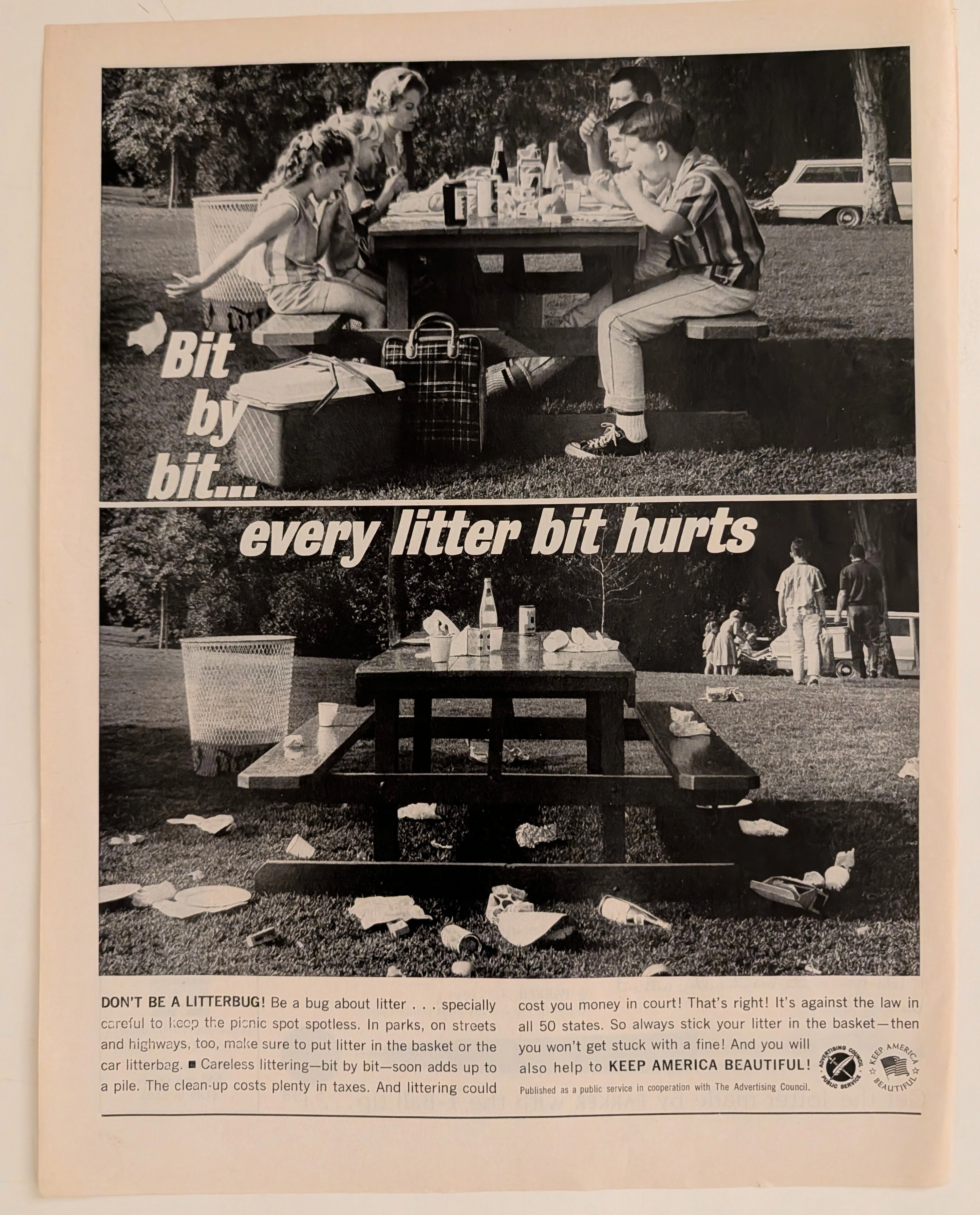
The Time Traveller's Dossier : Keep America Beautiful - Invention of the Litterbug
The History
The Post-War Packaging Boom and the Crisis of Convenience
To decode the profound historical shift embedded within this artifact, one must analyze the industrial landscape of the mid-twentieth century.
Following the conclusion of the Second World War, the American economic engine required perpetual consumption to maintain its unprecedented momentum.
The mechanisms of mass production, honed during wartime, were redirected toward domestic convenience.
This era witnessed the mass introduction of single-use plastics, aluminum cans, and disposable paper packaging.
The previous paradigm of the deposit-return system—where glass bottles were heavy, durable, and inherently part of a localized, closed-loop economy—was dismantled.
It was replaced by the ethos of the disposable.
However, this sudden influx of single-use packaging generated an immediate, highly visible consequence: the American landscape began to drown in refuse.
Highway systems, public parks, and suburban streets became repositories for the detritus of convenience.
The structural reality was that the nation lacked the municipal infrastructure to handle this abrupt explosion of permanent waste.
A crisis of optics emerged.
If the public associated the blight of trash with the corporations producing the packaging, legislative action—such as bans on disposable containers—was a genuine threat to corporate bottom lines.
The Corporate Deflection Strategy
This artifact represents one of the most successful public relations maneuvers in the history of global commerce.
Faced with the threat of systemic regulation, a consortium of packaging manufacturers, beverage companies, and related industries formed a coalition.
Entities such as the American Can Company, Owens-Illinois Glass Company, and major beverage conglomerates pooled their resources to create the organization stamped on this document: "Keep America Beautiful" (KAB), founded in 1953.
The strategic brilliance of KAB was its absolute deflection of responsibility.
They did not address the volume of disposable packaging being manufactured.
Instead, they addressed the behavior of the end-user.
The campaign fundamentally redefined the problem of waste.
Waste was no longer framed as an industrial byproduct; it was framed as a failure of individual character.
By focusing the national conversation entirely on the act of littering, the architects of this campaign effectively shielded the production pipeline from scrutiny.
They engineered a narrative where the corporation was a neutral provider of convenience, and the citizen was the sole agent of environmental degradation.
The Invention and Anatomy of the "Litterbug"
The text of the artifact commands the reader: "DON'T BE A LITTERBUG!"
This terminology is a masterclass in behavioral conditioning.
The coinage of the term "Litterbug" was a deliberate linguistic tool designed to shame and marginalize.
By appending the suffix "-bug," the campaign associated the act of dropping trash with pests, infestations, and uncleanliness.
It dehumanized the offender, reducing them to a societal nuisance.
Prior to this campaign, discarding an item on the ground was often a thoughtless, culturally unexamined habit, a holdover from an era where most waste was biodegradable organic matter.
The KAB campaign forcefully categorized it as an anti-social, deviant act.
The artifact goes further, demanding the citizen become a hyper-vigilant enforcer of this new moral code: "Be a bug about litter... specially careful to keep the picnic spot spotless."
It asks the public to police themselves and their neighbors, embedding the surveillance of waste disposal into the fabric of suburban civic duty.
The Nuclear Family as the Moral Baseline
The visual narrative relies entirely on the archetype of the mid-century American nuclear family.
In the upper panel, we observe the ideal.
A father, a mother, and three children partaking in the quintessential post-war leisure activity: the public park picnic.
The styling is immaculate.
The father is engaged, the mother is attentive, the children are well-groomed, wearing clean canvas sneakers and crisp patterned shirts.
A plaid thermos and a woven basket sit on the grass, symbols of middle-class stability and wholesome outdoor recreation.
They are the ultimate representation of the American Dream in its most sanitized form.
This establishes the moral baseline.
The viewer is meant to identify with them, to aspire to their level of domestic tranquility.
This identification is crucial for the psychological trap sprung in the second panel.
The Betrayal of the Commons
The lower panel is a brutal subversion of the established ideal.
The diptych format functions as a "Before and After" sequence, a heaven and hell of suburban conduct.
The family is seen retreating into the distance, heading toward their station wagon—the chariot of the suburban sprawl.
Left behind is absolute ruin.
The wooden picnic table, previously the altar of family communion, is now a monument to their apathy.
Crushed paper cups, discarded wrappers, a tossed newspaper, and empty bottles litter the manicured grass.
The most damning element of the composition is the presence of the white wire trash receptacle situated just to the left of the table.
It is entirely empty.
It stands as a silent, geometrical judge of their moral failure.
The message is clear: these are not uneducated or impoverished people; these are respectable citizens who have committed a crime of convenience.
They have betrayed the public commons.
The juxtaposition forces the viewer to confront the ugly reality that the perpetrators of this blight are not 'others'—they are us.
The Threat of Law and the Shield of Patriotism
The copy within the artifact does not rely solely on moral persuasion; it pivots sharply to the threat of state violence and financial penalty.
"Careless littering—bit by bit—soon adds up to a pile. The clean-up costs plenty in taxes. And littering could cost you money in court! That's right! It's against the law in all 50 states."
The transition from the emotional guilt of ruining a park to the cold reality of taxation and legal prosecution is abrupt and calculated.
It monetizes the guilt.
This is immediately followed by the presentation of the two logos, which serve as the dual authorities authorizing the message.
The Advertising Council logo, featuring a crossed sword and quill, represents the weaponization of communication for public service.
It signals that this is not a commercial advertisement, but a decree of national importance.
Beside it, the Keep America Beautiful logo utilizes the ultimate shield: the American flag.
By wrapping the anti-littering message in the flag, the campaign successfully equated environmental cleanliness with patriotism.
To litter was not just messy; it was un-American.
This combination of corporate deflection, individual shame, legal threat, and patriotic duty solidified a behavioral shift that remains the dominant framework for environmental responsibility in the modern era.
The Paper
The physical substrate of this artifact is highly indicative of mid-century mass-market print distribution.
It is printed on standard, un-coated newsprint or low-grade magazine stock.
The absence of color is a deliberate economic choice.
Public Service Announcements (PSAs), often placed in donated or heavily discounted media space by publishers cooperating with the Ad Council, were frequently printed in black and white to minimize production costs.
The halftone process is distinctly visible upon close inspection, particularly in the grey mid-tones of the grass and the shadows of the picnic table.
The dot matrix creates a slightly gritty, documentary-style texture, which subconsciously lends gravity and realism to the staged photography.
The paper exhibits the typical signs of natural acidification—a slight yellowing or warming of the white space, a testament to the lignin content reacting with decades of ambient light and oxygen.
It is a fragile, ephemeral piece of paper carrying a permanent psychological payload.
The Rarity
Class B.
As a mass-distributed Public Service Announcement, this specific advertisement was printed in vast quantities across numerous national and regional publications throughout the 1960s.
Physical copies of the magazines containing this ad are relatively common in archival and vintage markets.
However, its historical and contextual value is monumental.
It is a primary source document for the study of modern environmentalism, corporate public relations, and behavioral engineering.
Its rarity does not stem from a lack of surviving physical copies, but from its crystalline articulation of a major societal pivot.
It is the exact moment the burden of the disposable economy was placed squarely onto the shoulders of the consumer.
Visual Impact
The visual impact relies on the stark, unforgiving contrast of the diptych structure.
It borrows the visual language of religious morality tales—a depiction of grace followed by a depiction of the fall.
The photography is tightly controlled.
The lighting in the top panel is bright and even, highlighting the faces of the family.
In the bottom panel, the lighting seems harsher, drawing the eye to the high-contrast shapes of the white trash against the dark grass.
The typography of the headline, "Bit by bit... every litter bit hurts," utilizes a bold, slanted sans-serif font that conveys motion and urgency.
The visual path is engineered to make the viewer look at the pristine family, then read the headline, then drop their eyes to the devastation below.
The scattered debris is carefully arranged; it is not truly random but styled to ensure every type of disposable packaging is represented and clearly identifiable.
The overall impact is one of sudden, jarring disappointment, designed to trigger an immediate sense of civic shame.
Exhibition Halls
The Archive Continues
Continue the Exploration

Ahead of Its Time: The 1978 Heuer Chronosplit Manhattan GMT
Rediscover the ultimate analog-digital hybrid timepiece through a rare 1978 vintage magazine advertisement, meticulously preserved as a single sheet cut-out.

The Treaty of Two Empires: Deconstructing the 1982 Bacardi & Coca-Cola Vintage Ad (Class S)
Dive into the history of American consumerism with this museum-grade analysis of the iconic 1982 Bacardi and Coca-Cola co-branding advertisement. This Class S archival piece captures the definitive shift from the Golden Age of Illustration to 1980s commercial studio photography. Explore the geopolitical legacy of the "Cuba Libre" and the analog practical effects behind the immortal condensation on the Coca-Cola contour bottle.

THE TIME TRAVELLER'DOISSIER : SUPERMAN — The Christopher Reeve Flagpole Postcard and the Birth of the Superhero Blockbuster
The item analyzed is an official Superman movie merchandise postcard or large-format photo card, featuring Christopher Reeve as Superman clinging dramatically to a metal flagpole while a large American flag billows behind him against a pure black background. The image is framed with a bold red outer border and a thin blue inner rule — a design consistent with the official Superman: The Movie (1978) merchandising aesthetic produced under license from Warner Bros. and DC Comics. Christopher Reeve (September 25, 1952 – October 10, 2004) portrayed Superman in four films (1978, 1980, 1983, 1987) and is universally regarded as the definitive cinematic Superman. This specific image — the flagpole scene lit dramatically against black — is one of the most iconic publicity photographs from the original film's promotional campaign. The physical item shows signs of age consistent with approximately 45–47 years, with slight surface wear and minor corner softening visible. The postcard format (estimated 4×6 or 5×7 inches) and the glossy coated stock are typical of high-quality movie merchandise of the late 1970s.