The Time Traveller's Dossier : 1960s Bethlehem Steel - The Disposable Revolution
The History
The Visual Culture History of American Consumer Packaging
The mid-1960s was an era defined by a relentless pursuit of ease. The American economic engine, having achieved unprecedented domestic prosperity, began searching for friction to eliminate. In the realm of consumer goods, the greatest friction was the returnable glass bottle. It was a localized, inefficient system. National distribution demanded a vessel that was lightweight, durable, and above all, terminal.
The beverage can existed, but it was locked in a materials war. Aluminum was the rising challenger—lightweight and rust-proof. The steel industry, a towering monolith of American exceptionalism, found itself defending its territory. Bethlehem Steel, an industrial titan that provided the girders for the Golden Gate Bridge and the armor for World War II battleships, needed to convince the American public that steel belonged in their picnic baskets and on their cruise ships.
This required a radical rebranding of the material. Steel was associated with heavy industry, with soot, and with labor. It needed to be sanitized. It needed to be domesticated. The visual culture of this era tasked advertising agencies with an immense psychological undertaking: transform the perception of cold, hard steel into an enabler of warm, effortless leisure.
The Engineering of Leisure: Tin-Coated Steel
To understand the artifact, one must examine the metallurgy it promotes. Soda and fruit juices are highly acidic. They are corrosive. If placed directly into a carbon steel container, the liquid would rapidly degrade the metal, resulting in a foul-tasting, potentially hazardous product.
The technological bridge was the "Tin Coated Steel" highlighted in the lower left quadrant of the print. Through an electrolytic process, a microscopic layer of tin was bonded to the steel substrate. This created a barrier. The strength of steel combined with the inert, corrosion-resistant properties of tin. It allowed for the phrase "Such full, natural flavor! (Because cans keep out the daylight.)"
This was not merely a packaging update; it was a logistical triumph. The "No deposits, no returns" slogan was a battle cry. It meant supermarkets no longer had to dedicate square footage to sorting sticky, empty glass bottles. It meant distributors could ship the product globally without worrying about retrieving the containers. It birthed the modern, linear supply chain. The environmental ramifications of this "throwaway" culture would not be fully reconciled for decades, but in the 1960s, it was marketed purely as an expansion of personal freedom.
The Psychological Architecture of the Grace Line Era
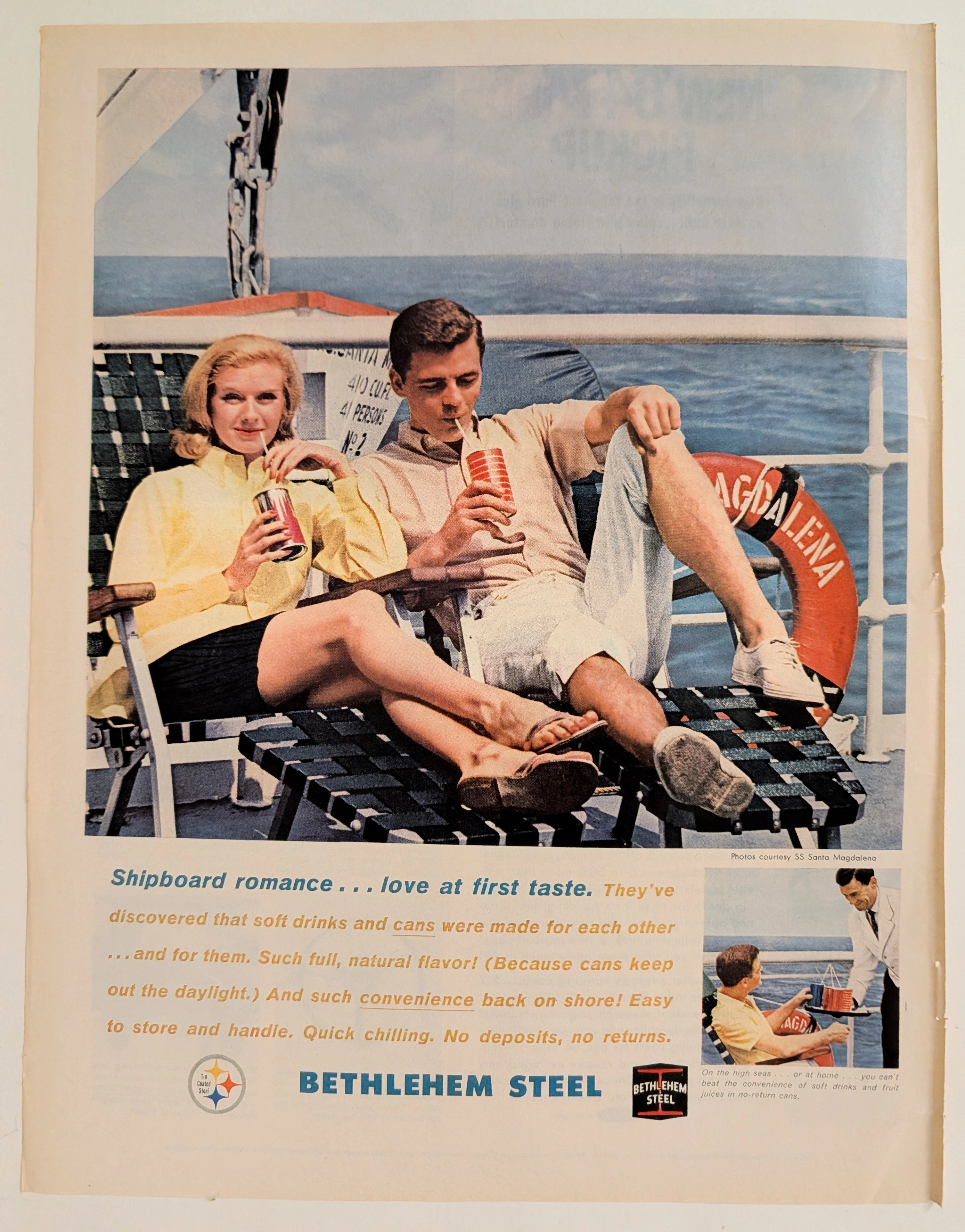
The setting of this 1960s Bethlehem Steel Historic Vintage Ad Print is not accidental. It is placed on the deck of the SS Santa Magdalena, a prominent vessel of the Grace Line. Launched in the early 1960s, the Santa Magdalena represented the democratization of the luxury cruise. It was a combination passenger and cargo ship, sailing between New York and the Pacific coast of South America.
By placing the product here, Bethlehem Steel anchored its tin-coated cans to the highest aspirations of the middle class. The couple lounging on the deck chairs is the mid-century ideal. They are relaxed, sharply dressed in casual wear, unbothered by the logistics of their beverages. The steward serving them reinforces the narrative of effortless luxury.
Notice the visual disconnect between the product's origin and its consumption. The steel was forged in the roaring, dangerous, blast furnaces of Pennsylvania. Yet, here it sits under the bright Caribbean sun, held delicately by a manicured hand. The advertisement succeeds by completely erasing the labor and heat of the steel mill, replacing it with the cool breeze of "Shipboard romance."
Why this 1960s Print is a Rare Ephemera Artifact
The survival of this artifact provides a profound irony. It is a piece of paper designed to be discarded, promoting a steel can designed to be discarded. It is a monument to transience that has stubbornly survived the decades.
During this era, massive corporations like Bethlehem Steel spent fortunes on print media. They bought full-page, full-color spreads in publications with circulations in the millions. The intent was total market saturation. They were fighting for the psychological real estate of the American consumer, aiming to make the phrase "tin-coated steel" synonymous with modern convenience.
We study this artifact today because the giant that commissioned it is gone. Bethlehem Steel, once the second-largest steel producer in America and a symbol of indestructible corporate power, went bankrupt in 2001. The blast furnaces are cold. The corporate empire is dissolved.
Yet, this fragile paper remains. It is a visual culture archive that outlived the very steel empire it promoted. When we mount this as museum-grade wall art, we are not just framing a retro image of a couple on a boat. We are preserving a critical inflection point in the history of consumerism. It is the visual record of the moment society agreed to prioritize convenience over conservation, a decision shaped by the marketing might of a fallen industrial titan.
The Paper
The substrate is a classic mid-century magazine stock, estimated at 65 to 70 GSM. It possesses the characteristic porousness of mass-market publishing from the era. It was engineered to absorb ink rapidly on high-speed web-offset presses, prioritizing volume over archival longevity.
The CMYK rosette patterns are distinctly visible under magnification. The subtle gradient of the blue ocean and the vibrant red of the life preserver are constructed entirely of these overlapping microscopic dots. The registration is remarkably precise, a testament to the skill of the pressmen operating the massive, industrial printing machinery of the time.
The aging process tells the story of the paper's chemical composition. The inherent acidity of the untreated wood pulp has caused a slow oxidation over the past sixty years. This has resulted in a uniform, warm patina across the white margins. It is a tactile artifact; the surface lacks the sterile gloss of modern digital prints, offering instead a soft, slightly textured resistance that grounds it firmly in the physical world.
The Rarity
Classification: Class B (Contextually Significant Ephemera)
This piece is categorized as Class B. While printed in the millions during its initial circulation, its survival rate is exceptionally low. The vast majority of these magazines were pulped, burned, or degraded in landfills.
Its rarity is not found in the initial print run, but in its survival and its heavy contextual value. Finding an intact, brightly colored specimen that so perfectly encapsulates the "disposable revolution" and the mid-century steel industry's pivot to consumerism is a difficult endeavor. Its value on the market is accessible, but its intellectual and historical value to a curated collection is immense. It is a definitive historical marker of the packaging industry.
Visual Impact
The composition relies on the "Z-pattern" of reading common in Western advertising. The eye is drawn first to the bright red life preserver ("MAGDALENA") and the relaxed couple, establishing the mood. It then drifts down to the product—the brightly colored cans—and finally settles on the Bethlehem Steel logo and the bold blue typography at the base.
Color psychology is employed with surgical precision. The dominant colors are nautical blue and crisp white, projecting cleanliness, fresh air, and order. The bright primary colors of the cans (red, blue, yellow) pop violently against the muted tones of the clothing and deck chairs, demanding the viewer's attention without disrupting the overall atmosphere of calm.
The typography is a study in mid-century transition. The primary copy ("Shipboard romance... love at first taste") utilizes an italicized, semi-serif font, implying elegance and a conversational tone. This contrasts sharply with the stark, brutalist, heavy sans-serif of "BETHLEHEM STEEL" at the bottom, which serves as a heavy anchor of corporate authority beneath the lighthearted scene.
Exhibition Halls
Tags
The Archive Continues
Continue the Exploration

Coca-Cola · Beverage
The Time Traveller's Dossier: Coca-Cola & The "Sprite Boy" - The Carbonated Utopia of Post-War America
Then, a beverage was simply a flavored liquid used to quench thirst. In 1950s America, it was packaged as a scientifically formulated "lift," a socially sanctioned psychological "pause" in the roaring machinery of the post-war economy. This artifact is a portal. It transports us back to the mid-1950s, an era defined by blind optimism, explosive mass consumerism, and the absolute dawn of television media. Here, we encounter a now-forgotten phantom of pop culture: the Coca-Cola "Sprite Boy." It is a vintage print advertisement, yes. But deeper than that, it is an early blueprint for cross-media corporate synergy. It perfectly captures how Coca-Cola weaponized the sensory metaphors of print (sparks, energy, tang) to herd consumers toward a nascent media format: the corporately sponsored television program. It documents how a carbonated syrup inextricably bound itself to the leisure time of the American middle class.

True Blood of the Trans-Am: The 1970 Ford Mustang Boss 302 Legacy
Experience the raw spirit of an American muscle car legend through an authentic, pre-2000 analog magazine advertisement, carefully extracted as a single sheet.

THE TIME TRAVELER'S DOSSIER: THE STRATOSPHERIC MANSION AND THE AESTHETICS OF DECAY
The artifact under exhaustive, museum-grade analysis is a flawlessly preserved Historical Relic originating from the absolute dawn of the commercial Jet Age (circa late 1950s to early 1960s). This Primary Art Document is a magnificent full-page advertisement for the Douglas DC-8, the aerospace leviathan engineered to rival the Boeing 707 and conquer the global skies. Visually anchored by an elegant, sweeping illustration of the aircraft's exterior and a highly detailed, evocative rendering of its opulent passenger lounge, the piece represents the zenith of mid-century aspirational marketing. Signed by an elusive mid-century commercial artist, the illustration captures the "Palomar Lounge"—a private club in the stratosphere where the elite played cards, smoked, and drank champagne beneath a Space-Age celestial diagram. By utilizing the ultimate authority of the era—the airline stewardess—to validate its luxury ("Stewardesses call it... The world's most luxurious jetliner!"), Douglas masterfully sold the illusion of exclusive, aristocratic segregation at 600 miles per hour. Rescued from the binding of a forgotten periodical, this pre-2000s analog artifact is an unforgeable testament to the aesthetic of wabi-sabi. Printed on inherently acidic wood-pulp paper, it exhibits a beautifully frayed right margin and a deep, warm ivory oxidation. This majestic chemical degradation transforms a mass-produced corporate propaganda piece into an irreplaceable, ready-to-frame Primary Art Document of aerospace history.