THE RECORD · ARCHIVE PLAYER
MP4
■ PAUSED
1978 Citizen The Big Timers Quartz Watches Vintage AdvertisementANALOG ARCHIVE
1978 Citizen The Big Timers Quartz Watches Vintage Advertisement (1978) — Class B vintage Lifestyle & Vice
CLASS B
1 of 7

1978 Citizen The Big Timers Quartz Watches Vintage Advertisement

Category|Lifestyle & Vice
Year|1978
Rarity Class|CLASS B
Archive Views|9

Last updated: 16 May 2026

Historical Context

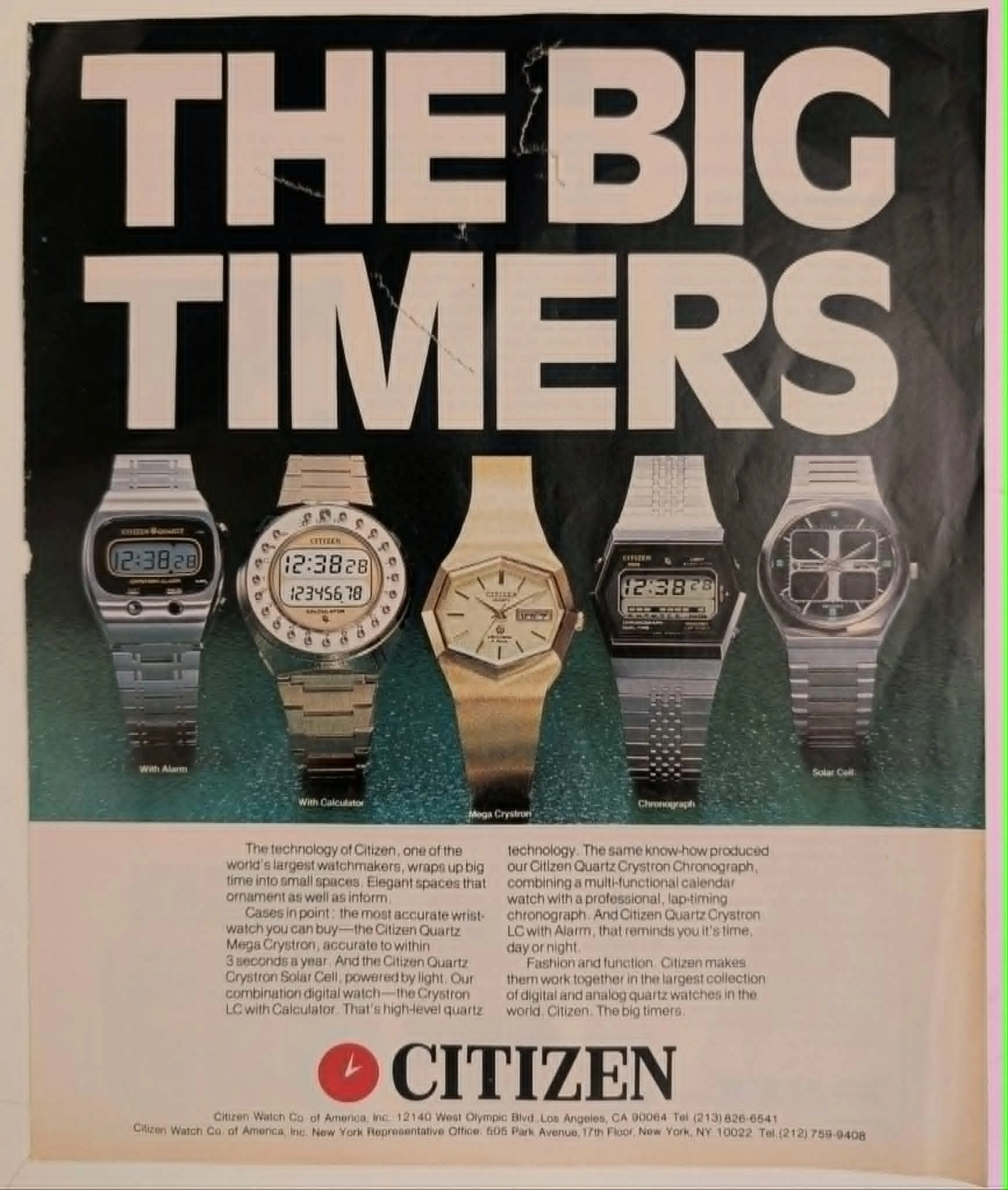
During the mid-to-late 1970s, the global watch industry underwent a seismic shift known as the Quartz Revolution. Japanese manufacturers, led by innovators like Citizen, pioneered the commercialization of quartz oscillators, drastically undercutting traditional Swiss mechanical watches in both price and unprecedented accuracy. This bold advertisement, headlined "THE BIG TIMERS," serves as a triumphal showcase of Citizen's technological supremacy during this pivotal era. The ad systematically highlights five distinct technological marvels under the "Crystron" banner. At the center sits the prestigious Mega Crystron, a technological tour-de-force boasting an extraordinary accuracy of within 3 seconds a year—a milestone that cemented Citizen's reputation for ultra-precision engineering. Flanking it are multi-functional digital models: the Crystron LC with Calculator, a quintessential symbol of 70s futuristic design; the Crystron Alarm; and the highly functional Crystron Chronograph. Rounding out the collection is the Crystron Solar Cell, an early pioneer in light-powered horology, anticipating the eco-friendly innovations (like the Eco-Drive) that would dominate later decades. Visually, the advertisement is striking in its straightforward, commanding presentation. The massive, block-letter headline anchors the page, exuding confidence and market dominance. Below, the five watches are photographed with clinical precision against a deep, textured background, emphasizing their metallic sheen and cutting-edge digital displays. The supporting copy is dense with technical details, reflecting a consumer market that was intensely captivated by the rapid miniaturization of technology. For horological historians and vintage electronics enthusiasts, this artifact is more than a simple marketing piece; it is a snapshot of a paradigm shift. It captures the exact moment when the wrist became a hub for personal computing, paving the way for the smartwatches of the 21st century.

Paper & Print Condition

Printed via color offset lithography on standard late-70s magazine stock. The bold, black typography remains deep and resolute. The dark, textured background exhibits excellent ink saturation, though large areas of dark ink on vintage paper can make minor surface handling more apparent. Overall, it retains striking contrast and visual weight.

Provenance & Rarity

Sourced from an American consumer publication from late 1978. Advertisements featuring the complete "Big Timers" line-up, particularly the ultra-rare Mega Crystron alongside early solar and calculator models, are highly prized by digital watch collectors and horological historians documenting the Quartz Crisis.

Rarity & Condition Summary

Rarity Class B: A highly significant horological document presenting an excellent, uncreased visual profile with superb typographic clarity.
Share This Archive

From the Journal

Related Articles

THE TIME TRAVELER'S DOSSIER: ARROGANCE AND INNOVATION IN THE ABYSS OF THE DEPRESSION — related article
Read Article

THE TIME TRAVELER'S DOSSIER: ARROGANCE AND INNOVATION IN THE ABYSS OF THE DEPRESSION

The artifact under rigorous, museum-grade analysis is an exceptionally preserved Historical Relic originating from the darkest economic abyss of the 20th century: the American Great Depression. Sourced from a 1931 issue of The Saturday Evening Post, this Primary Art Document features a sweeping, full-page advertisement for the Sheaffer's "Balance" Lifetime Pen. This piece is a profound sociological and industrial marker. In 1931, as the global economy collapsed, W.A. Sheaffer defiantly marketed a revolutionary, streamlined luxury writing instrument priced at an astronomical $15. The ad explicitly highlights the "White Dot" lifetime guarantee and the 14-karat solid gold "Autograph" band engraved with the owner's signature ("John Adams"). It is a masterclass in aspirational marketing during an era of mass destitution. Physically, this nearly century-old wood-pulp document is a breathtaking testament to the Japanese aesthetic of wabi-sabi. It exhibits severe, dramatic edge trauma, profound edge loss, deep amber oxidation, and prominent moisture staining along the left margin. This extreme analog decay transforms the mass-produced commercial print into an irreplaceable, highly coveted Primary Art Document that physically embodies the scars of its 90-year journey through history.

Ahead of Its Time: The 1978 Heuer Chronosplit Manhattan GMT — related article
Read Article

Ahead of Its Time: The 1978 Heuer Chronosplit Manhattan GMT

Rediscover the ultimate analog-digital hybrid timepiece through a rare 1978 vintage magazine advertisement, meticulously preserved as a single sheet cut-out.

THE TIME TRAVELER'S DOSSIER: THE GENESIS OF ARROGANCE — OMEGA, THE QUARTZ CRISIS, AND THE SPACE HERO — related article
Read Article

THE TIME TRAVELER'S DOSSIER: THE GENESIS OF ARROGANCE — OMEGA, THE QUARTZ CRISIS, AND THE SPACE HERO

An original vintage magazine cut page featuring the OMEGA Quartz Chronometer, endorsed by NASA Mercury Seven astronaut Scott Carpenter. This standard-sized ephemera captures Omega's luxurious counter-offensive during the "Quartz Crisis," elevating battery-powered movements to haute horlogerie. The natural degradation and warm patina of the pre-2000s acidic paper transform this surviving ad into a highly collectible Class A historical artifact.

The Time Traveller's Dossier : 3M Scotch Videocassettes - The Dawn of the Living Room Revolution — related article
Read Article

The Time Traveller's Dossier : 3M Scotch Videocassettes - The Dawn of the Living Room Revolution

We often memorialize the late 1970s and early 1980s through the superficial lenses of neon aesthetics, synth-pop music, and Cold War anxieties. However, strictly through the perspective of consumer technology, this era represents one of the most profound paradigm shifts in human history: "The Living Room Revolution." Prior to the commercial viability of the Video Cassette Recorder (VCR), television viewers were entirely subservient to the broadcast schedules of major networks. If you missed a Thursday night broadcast, that cultural moment was lost to the ether. The consumer was a passive receiver of scheduled programming. This artifact—a print advertisement for 3M Scotch Videocassettes—is a primary historical document capturing the exact moment the consumer was handed the power of "Time-Shifting." This advertisement is not merely selling a plastic cassette filled with magnetic tape. It is selling autonomy. It is selling the democratization of the television screen. Furthermore, hidden within its visual layout is a physical snapshot of the most aggressive corporate battlefield of the late 20th century: the infamous "Format War" between JVC’s VHS and Sony’s Betamax.