The Time Traveller's Dossier : 1968 Zippo - The Enduring Flame
The History
The Era of Impermanence and the American Psyche
To understand this document, we must first contextualize the chronological coordinates of its creation. The year 1968 was a crucible of global tension. The Tet Offensive altered the trajectory of the Vietnam War. Political assassinations shook the American foundation. The Apollo program pushed humanity toward the vacuum of space. The societal mood was anchored in uncertainty. The future felt incredibly fragile.
Simultaneously, the post-war economic boom was reaching a new phase of consumerism. Plastics were rapidly replacing metal. Mass production was prioritizing volume and turnover over longevity. The concept of "planned obsolescence"—designing products to fail or become visually outdated within a few years—was becoming the standard doctrine of American manufacturing. The disposable lighter, pioneered by companies that would soon flood the market with cheap, plastic, butane-filled cylinders, was on the horizon. The expectation was shifting: use a product, deplete its resources, discard it, and purchase another.
Against this backdrop, the Zippo Manufacturing Company of Bradford, Pennsylvania, released this Christmas campaign. It is a document of profound defiance against the prevailing economic currents. It does not sell a new, revolutionary technology. It sells the exact same mechanism George G. Blaisdell invented in 1932. The visual rhetoric here is not about the future. It is an anchor to the past. It offers the consumer something that the surrounding society could not provide: an absolute guarantee.
The Anatomy of a Windproof Flame
Look beyond the polished surfaces in the advertisement. The core of the artifact is an engineering marvel born of brutalist simplicity.
Before this design, the dominant portable fire-starters were friction matches or cumbersome, unreliable fluid lighters. Competitors like Ronson offered elegant, complex mechanisms. They were visually striking but mechanically fragile. A dropped Ronson often required a watchmaker to repair.
Blaisdell’s design was a paradigm shift in portable thermodynamics. It relied on a rectangular outer case connected by a simple barrel hinge. Inside sat an insert containing a rayon wadding soaked in naphtha-based lighter fluid. A capillary wick drew the fluid upward. A flint, pressed against a serrated striking wheel by a tension spring, created the spark.
The most critical engineering achievement, however, was the chimney. The perforated metal shield surrounding the wick disrupted the aerodynamics of incoming wind. It created a micro-environment where the vacuum of the flame drew in oxygen, but the chaotic velocity of the wind was dispersed. It was functionally absolute. It brought controlled fire to environments where fire previously could not survive. This engineering was so fundamentally correct that, by 1968, it had remained virtually unchanged for thirty-six years. The advertisement does not need to explain how it works. The cultural consciousness already knew.
The Hierarchy of Metal: Bridging the Class Divide
Analyze the catalog presented in the document. It is a precise socio-economic staircase.
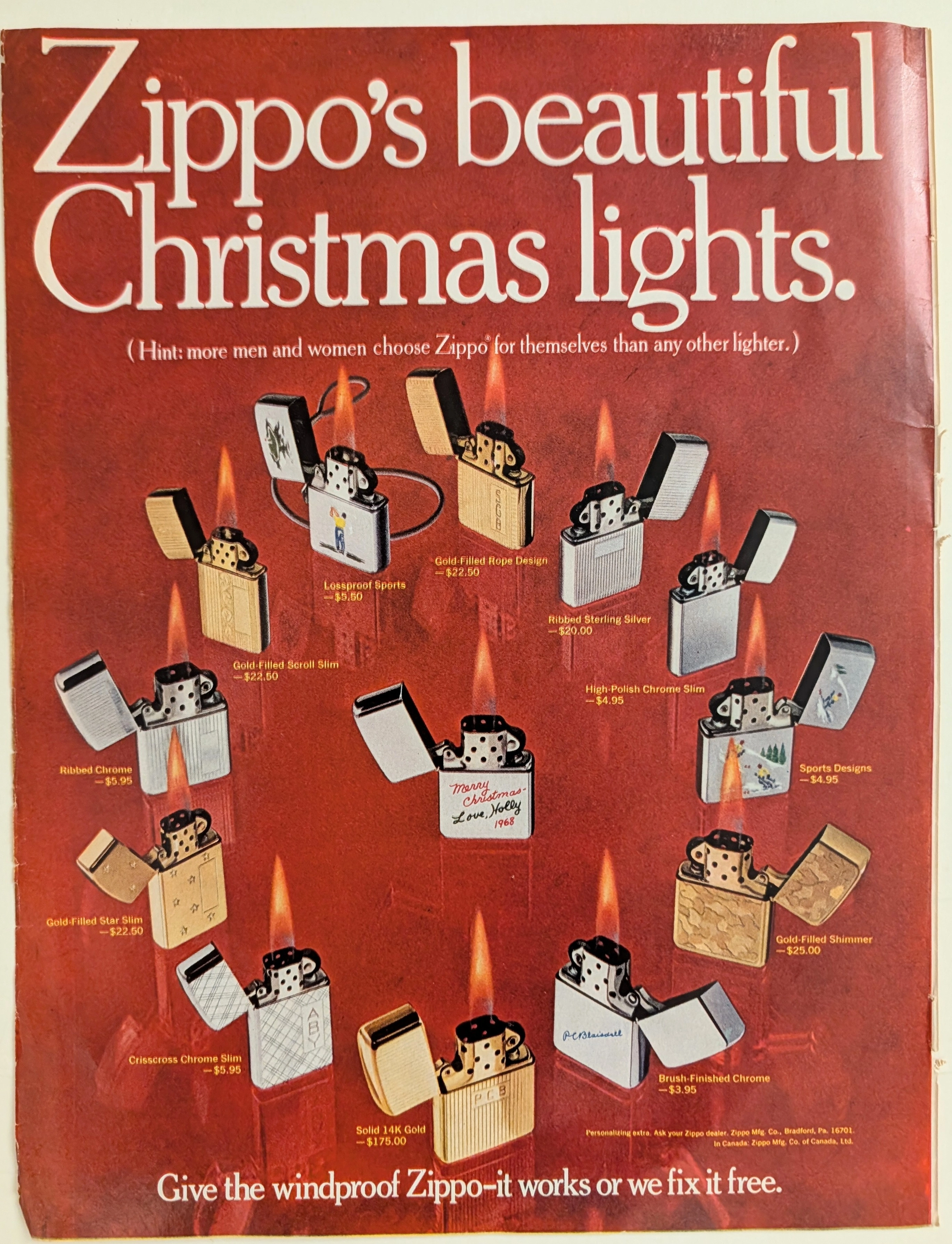
We see the "High-Polish Chrome Slim" priced at $4.95. We see the "Ribbed Sterling Silver" at $20.00. We see the "Gold-Filled Shimmer" at $25.00. And at the apex, the "Solid 14K Gold" commanding a staggering $175.00.
Adjusted for inflation, $175 in 1968 represents well over $1,500 today. Yet, the underlying engine—the insert, the wick, the flint wheel, the chimney—is completely identical across every model. The $4.95 lighter produces the exact same flame, with the exact same reliability, as the $175 lighter.
This represents a fascinating shift in consumer marketing. The brand successfully commodified the exterior shell while maintaining an egalitarian mechanical core. A factory worker and a corporate executive both carried a Zippo. The tool was the same; only the armor differed. This visual array proves that by the late 1960s, the lighter had transitioned. It was no longer strictly a utilitarian tool. It had become personal jewelry. It had become a status signifier. It was an acceptable gift for both men and women, effectively doubling the market demographic.
The Philosophy of the Unconditional Guarantee
At the bottom of the artifact lies its most vital text: "Give the windproof Zippo - it works or we fix it free."
This is not a marketing slogan. It is a radical philosophical stance.
In a capitalist framework, a business thrives on repeat purchases. By guaranteeing a product for life, regardless of its condition, age, or ownership history, Zippo fundamentally altered the traditional transactional relationship. When a consumer purchased this artifact in 1968, they were not buying a lighter. They were buying a lifelong subscription to an ignition source.
The repair clinic in Bradford became a site of mechanical resurrection. If a lighter was crushed by a tractor, recovered from a battlefield, or corroded by salt water, the company would repair it or replace the insert at no cost. This engineered an unprecedented level of brand loyalty. It shifted the psychological weight of the purchase. The consumer was not spending money; they were investing in a permanent companion. This guarantee transformed the object from a commodity into an heirloom.
The Canvas of Identity: Engraving Time
The advertisement explicitly highlights personalization. The central lighter bears the inscription: "Merry Christmas - Love, Holly 1968." Other lighters show monograms like "PCB" or "ABY".
This is the ultimate historical shift documented here. The brass and chrome surfaces were designed as blank canvases. In 1968, hundreds of thousands of young American men were deployed in Vietnam. The Zippo became an unofficial piece of military hardware. Soldiers engraved them with maps, cynical jokes, unit insignia, and fatalistic poetry.
The advertisement gently commercializes this practice for the civilian holiday market. By encouraging engraving, the manufacturer ensures the object's survival. A plain lighter might be lost and forgotten. A lighter engraved with "Love, Holly 1968" becomes deeply tied to human emotion. It becomes a biographical record. It ceases to be an industrial product and becomes a unique historical artifact the moment the engraving tool cuts into the metal. The emotional gravity prevents it from being discarded.
The Final Assessment of the Era
This document is a snapshot of an analog world making its final, confident assertions before the digital revolution and the rise of ultra-cheap, disposable plastics. It speaks of a time when things were built to be kept. It is a testament to an era where an American manufacturer could look at the consumer and promise absolute, eternal functionality, knowing the engineering could support the weight of that promise.
The Paper
The physical medium of this document provides critical forensic data. It is printed on lightweight, glossy magazine stock, likely between 60 and 70 GSM. The printing utilizes a standard mid-century CMYK four-color offset lithography process. Under microscopic inspection, the halftones reveal a distinct rosette pattern. The deep, rich reds of the background are achieved through a heavy saturation of magenta and yellow inks.
The aging process is evident. The paper exhibits slight oxidation around the edges, a chemical reaction caused by the acidic content of the wood pulp used in mass-market publications of the 1960s. The texture is smooth but fragile, bearing the micro-creases of human handling. It is not merely an image; it is a physical slice of 1968, degrading at a predictable, organic rate.
The Rarity
Class A - High Contextual Value
The physical lighters depicted in this advertisement are, depending on the model, relatively common or exceptionally rare (in the case of the Solid 14K Gold variant). However, the advertisement itself holds Class A archival status.
Its value lies not in its monetary worth, but in its pristine preservation of the era's commercial psychology. Finding vintage magazines is common; finding a perfectly preserved, center-cut advertisement that so perfectly encapsulates the juxtaposition of holiday warmth against the cold realities of mid-century industrialism is rare. It provides essential context for collectors and historians studying the transition of utilitarian objects into personalized artifacts.
Visual Impact
The composition is a calculated exercise in visual psychology. The background is a flat, infinite expanse of deep crimson. It instantly evokes the sensory memory of Christmas—warmth, hearth, and velvet.
Against this void, a constellation of lighters floats, disconnected from gravity or human hands. They are anchored only by the subtle, darker red reflections beneath them, suggesting they rest on a highly polished surface.
Every single lighter is open. Every single lighter is lit.
This repetition of the vertical orange flame creates a visual rhythm. It commands the eye to move in a circle, evaluating each model. The typography is a confident, classic serif, anchoring the floating objects with a sense of established authority. The phrase "beautiful Christmas lights" is a clever, subtle double entendre, shifting the aggressive, masculine nature of a fire-starter into a delicate, festive ornament.
Exhibition Halls
The Archive Continues
Continue the Exploration

Chrysler · Automotive
The Time Traveller's Dossier: The Architecture of Command and Authority – The 1956 Chrysler "PowerStyle" Manifesto
History is not merely chronicled through written texts; it is forged in cold steel, sculpted in gleaming chromium, and dictated by the absolute, ruthless triumph of industrial design. Long before the modern world was infected and subdued by sterile digital algorithms and soulless autonomous vehicles, there was an era where the guttural roar of a V-8 engine was the ultimate symphony of American prosperity. In this bygone epoch, automotive architecture was a literal weapon—a physical manifestation used to declare a man’s absolute sovereignty over space and time. The historical artifact that stands before us is not merely a decaying magazine advertisement ravaged by the decades. It is an absolute "Blueprint of Victory." It is the visual manifesto utilized by Chrysler in 1956 to violently obliterate the mundane complacency of its rivals, aggressively establishing the "Era of Pushbutton Command" as the mandatory new standard for the American elite. This museum-grade academic archival dossier will execute an exhaustive, uncompromising deconstruction of the 1956 Chrysler New Yorker "PowerStyle" campaign—the absolute zenith of the legendary "Forward Look" design philosophy. Through the highly specialized lens of visual forensics and commercial semiotics, we will expose how every single brushstroke, every shadow, and every line of copywriting was deployed in a calculated psychological war to transform the ordinary "driver" into a sovereign "pilot." This document serves as an undeniable testament to how Chrysler artificially engineered "America's most smartly different car," weaponizing the zeitgeist of the Jet Age to monopolize consumer desire. This is a Class S marketing relic that has survived the destructive progression of time to validate its supremacy in your hands today.

Ford · Automotive
The Time Traveller's Dossier: The Ten-Dollar Titan – The Autolite Ford Indianapolis 500 Exhibition
The synthesis of high-stakes motorsport engineering and everyday consumer accessibility represents a pinnacle achievement in mid-twentieth-century American commercial strategy. The historical artifact elegantly secured upon the analytical table of The Record Institute today is a majestic full-page print advertisement for Autolite Ford Ignition Coils, originating from the golden era of 1960s automobile racing. This document completely transcends the traditional boundaries of automotive parts marketing. It operates as a profound, sophisticated declaration of how cutting-edge technological innovation on the racetrack was democratized and delivered directly into the hands of the American middle class, transforming the daily commute into an extension of the Indianapolis 500. This world-class, comprehensive dossier conducts a meticulous and deep examination of the artifact, operating under the absolute most rigorous parameters of historical, sociological, and material science evaluation. We will decode the brilliant, kinetic pit-stop scene capturing an open-wheel race car, and analyze the dramatic visual juxtaposition of this high-speed chaos against the highly structured, calculated copywriting of the Ford Motor Company. Furthermore, as we venture into the chemical and physical foundations of this analog printed ephemera, we will reveal the mechanical fingerprints of the CMYK halftone rosettes and the graceful, natural oxidation of the paper substrate. This precise intersection of visual nostalgia, motorsport heritage, and the chemistry of time cultivates a serene wabi-sabi aesthetic—a natural, irreversible phenomenon that serves as the primary engine driving up its market value exponentially within the elite global spheres of Vintage Automotive Ephemera and Motorsports Archives collecting.

Zippo · Tobacco
The Time Traveller's Dossier: The Archive of the Immortal Flame – The 1968 Zippo "7 Beautiful Ways" Advertisement
The act of creating fire is a profound symbol of mankind's mastery over nature and the mechanical authority we hold over physical elements. The historical artifact elegantly placed upon the examination table of The Record Institute today is a full-page print advertisement for Zippo from 1968, presented under the campaign "7 beautiful ways to master The Gift Season." This document transcends conventional marketing; it is a flawless psychological projection of the mid-twentieth-century American Dream, encapsulated in metal and backed by a lifetime guarantee. This world-class archival dossier will conduct a meticulous and profound analysis of the artifact, operating under the most rigorous parameters of historical and material science evaluation. We will explore the brand's sophisticated market segmentation through seven occasion-specific lighter models, ranging from high-polish chrome to 10K gold-filled and Sterling Silver editions. Furthermore, we will delve into the magnitude of the legendary declaration, "it works or we fix it free," a promise that confidently challenges the passage of time. Advancing into the chemical foundations of this analog offset lithography, we will reveal the mechanical fingerprints of the halftone rosettes and the natural oxidation of the paper substrate. This precise intersection of metallurgical mechanics and the chemistry of time produces a serene wabi-sabi aesthetic—a phenomenon that serves as the primary engine driving up its market value exponentially within the elite global spheres of Vintage Tobacciana collecting.