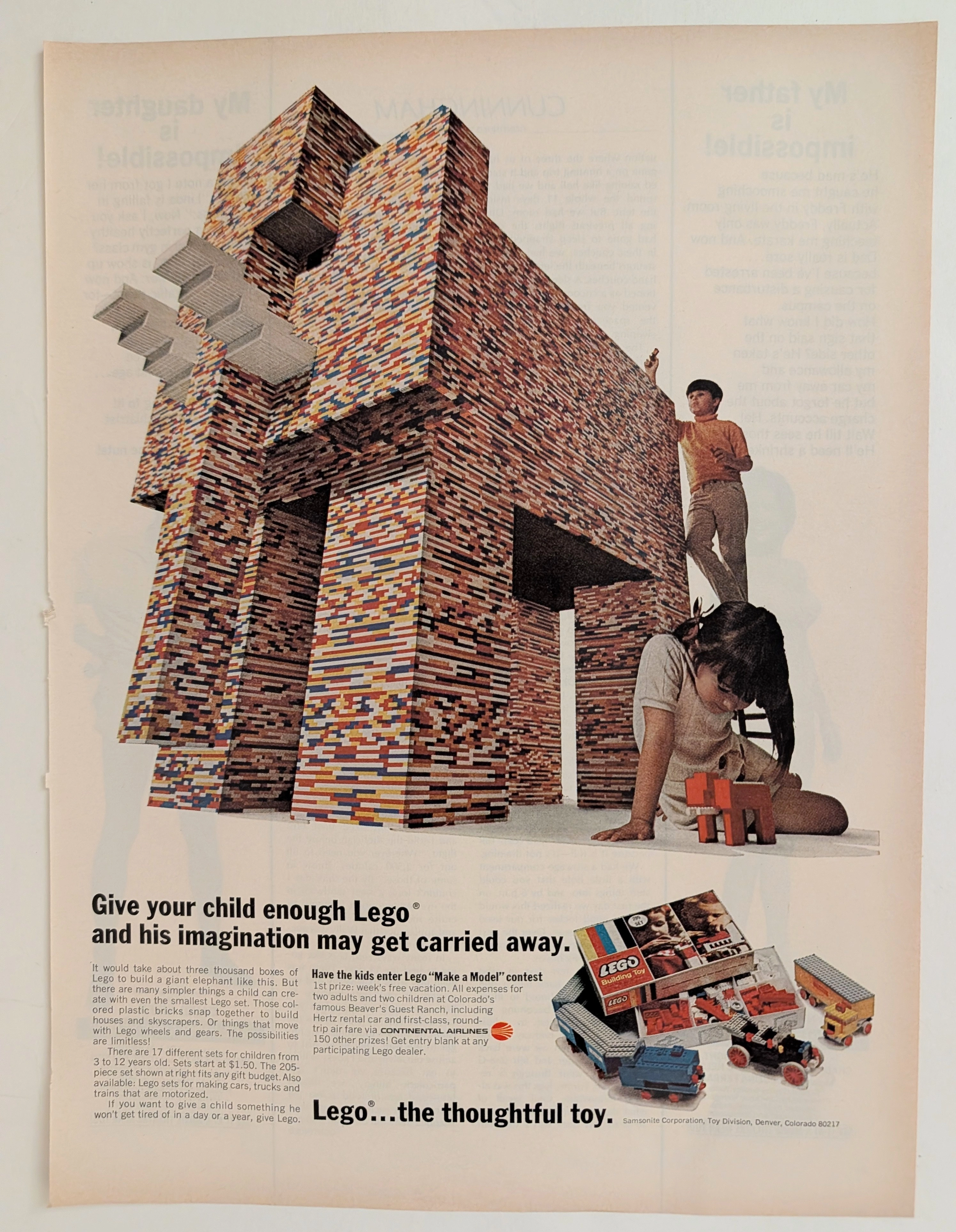
The Time Traveller's Dossier : Samsonite-Era Lego - Engineering the Imagination Shift
The History
The Architecture of Play Before the Brick
To understand the historical shift represented by this document, we must first analyze the baseline of mid-20th-century playmatics. Before the widespread adoption of the interlocking brick, construction toys were constrained by their own structural logic. Erector sets and Meccano utilized metal struts and microscopic screws, demanding fine motor skills and dictating a fundamentally industrial aesthetic. Lincoln Logs and Tinkertoys relied on localized joints, forcing the user into predictable, rustic architectural outcomes. They taught conformity. They taught the child to assemble a pre-determined reality.
The system presented in this advertisement dismantled that reality. It introduced a universal geometry. The patent for the modern Lego brick design, featuring the internal tubes that provide clutch power, was filed in 1958. However, a patent is merely a theoretical framework. The true historical shift occurred when this framework was manufactured at an industrial scale and marketed not as a specific model, but as a volume of raw potential.
The Samsonite Protocol: Injection Molding and Strategic Expansion
The text at the bottom right of this document provides a crucial temporal anchor: "Samsonite Corporation, Toy Division, Denver, Colorado 80217." This connects the artifact to a highly specific, twelve-year window. In 1961, Godtfred Kirk Christiansen, seeking to penetrate the vast North American market without the capital expenditure of building a dedicated overseas factory, executed a licensing agreement with Shwayder Brothers, the parent company of Samsonite.
Why a luggage manufacturer? The answer lies in manufacturing tolerances. Samsonite was a pioneer in industrial plastic injection molding for heavy-duty travel cases. They possessed the machinery and the metallurgical expertise required to cast the molds for the interlocking bricks. From 1961 to 1972, the Lego bricks sold in the United States and Canada were born in the same facilities that produced rigid luggage. This era, known among historians as the Samsonite Era, is characterized by distinct marketing approaches tailored to the American post-war economic boom.
Material Science: The Ascendancy of ABS Plastic
During the timeline this advertisement was printed—firmly placed between 1968 and 1972, as evidenced by the Continental Airlines logo—a silent revolution in material science was solidifying. Early Lego bricks were manufactured using Cellulose Acetate. The material was prone to warping, discoloration, and structural failure over time. The "clutch power"—the precise friction-based coupling that allows the giant elephant in the image to sustain its own weight—was inconsistent.
In 1963, the transition to Acrylonitrile Butadiene Styrene (ABS) began. ABS plastic provided superior dimensional stability. It allowed the molds to maintain tolerances of 1/500th of a millimeter. This exactitude is not a mere trivia point; it is the physical foundation of the psychological shift. Without atomic-level precision in the injection molding process, the bricks do not lock. Without the lock, the structure collapses. Without structural integrity, the child’s imagination is halted by physical reality. The ABS transition ensured that the physical medium could finally keep pace with human cognition.
The Pedagogy of Volume
Observe the primary textual hook: "Give your child enough Lego and his imagination may get carried away." This is a masterclass in consumer psychology. The advertisement is not selling a specific tractor, house, or train, despite the smaller models pictured. It is selling the concept of volume.
The image of the gargantuan, multi-colored elephant dominating the visual frame is an exercise in abstract scale. It communicates a distinct message: the only barrier to creation is the quantity of the medium. The smaller sets, priced at an accessible "$1.50," are positioned merely as entry points into a broader ecosystem. The 205-piece set shown is a localized hub. The objective was to condition the consumer to view the product not as an isolated purchase, but as an ongoing accumulation of infrastructural capital. The more bricks acquired, the higher the resolution of the constructed reality.
Socio-Economic Anchors: The Sweepstakes and the Jet Age
The text details a "Make a Model" contest, offering a first-prize vacation to "Colorado's famous Beaver's Guest Ranch," including a "Hertz rental car" and airfare via "CONTINENTAL AIRLINES." This data matrix firmly anchors the artifact in the economic landscape of late 1960s America.
The inclusion of the Continental Airlines logo—specifically the "meatball" design created by the legendary designer Saul Bass, introduced in 1968—provides our strictest dating parameter. This cross-promotion highlights the zenith of middle-class mobility. Air travel was transitioning from an elite luxury to an accessible, aspirational goal for the nuclear family. Partnering a plastic construction toy with a major airline and a rental car corporation reveals a sophisticated marketing matrix. It aligned the cognitive development of the child with the leisure aspirations of the parents. The toy became a vehicle for upward mobility, both intellectually and geographically.
The Inevitable Conclusion of the Samsonite Era
The Samsonite licensing agreement, while crucial for establishing the brand's foothold in North America, eventually dissolved. As Lego expanded its own global manufacturing infrastructure and standardized its marketing protocols, the localized production by a luggage company became redundant. By 1973, Lego had assumed direct control of its United States operations, opening a dedicated facility in Connecticut.
Therefore, this document is a relic of a transitional state. It represents the specific decade when a European system of universal geometry was translated through the industrial machinery of an American luggage manufacturer, marketed through the aesthetics of the Jet Age, and deployed into the minds of a generation that would eventually build the digital architecture of the 21st century.
The Paper
The substrate is a lightweight, coated magazine stock, typical of mass-circulation periodicals from the late 1960s to early 1970s. The basis weight is likely between 60 to 70 GSM. The printing methodology is a standard four-color continuous-tone lithography (CMYK process).
Upon close inspection of the solid color blocks—particularly the red and blue bricks—the halftoning rosette patterns become distinctly visible. The paper exhibits noticeable oxidation and acid hydrolysis, particularly along the margins, resulting in a yellowing effect known as foxing. This chemical degradation is a result of the residual lignin in the wood pulp. The artifact is not static; it is slowly burning in the presence of oxygen. The paper records the passage of time through its own cellular breakdown, contrasting sharply with the physical immortality of the ABS plastic bricks it advertises.
The Rarity
Class A. Contextual and Cultural Density.
While the physical advertisement itself was mass-produced in millions of periodicals, its survival in a clean, untorn state elevates its physical rarity. However, its true classification lies in its contextual density. The convergence of the Samsonite manufacturing credit, the Saul Bass Continental Airlines logo, and the transitional era of ABS plastic engineering creates an artifact with high historiographical value. It is a vital node for researchers tracking the evolution of industrial design, marketing psychology, and material science in the mid-20th century.
Visual Impact
The composition is an exercise in forced perspective and scale manipulation. The focal point is the monolithic, pixelated elephant, constructed with disregard for uniform color blocking. This chaotic distribution of red, yellow, blue, and white bricks communicates organic, unfiltered creation rather than sterile instruction.
The child scaling the structure provides the necessary biological metric to comprehend the toy's massive scale. The color psychology relies heavily on the saturation of primary colors against a muted, neutral background, forcing the eye to remain trapped within the geometry of the structure. The typography utilizes a stark, heavy sans-serif font for the headline, anchoring the visual weight of the image, while the iconic square-proportioned Lego logo (pre-dating the bubbled, outlined version dominant today) sits quietly in the corner, functioning as a seal of structural guarantee.
Exhibition Halls
Tags
The Archive Continues
Continue the Exploration

Polaroid · Technology
The Time Traveller's Dossier: The Instant Gratification Protocol – The Polaroid Color Pack Camera Exhibitio
The evolution of photography from a delayed, solitary, and highly technical chemical process into an instantaneous, shared, and interactive social event stands as one of the most profound technological and sociological shifts of the twentieth century. The historical artifact securely and elegantly positioned upon the analytical table of The Record Institute today is a majestic, large-format, two-page print advertisement for the Polaroid Color Pack Camera (Automatic 210), originating from the cultural zenith of the late 1960s. This document completely transcends the traditional boundaries of camera marketing and consumer electronics promotion. It operates as a sophisticated, multi-layered declaration of how optical innovation fundamentally altered human interaction, transforming the act of taking a photograph from a mere recording of memory into an active, thrilling focal point of social gatherings and familial bonding. This world-class, comprehensive dossier conducts a meticulous, unyielding, and exceptionally deep examination of the artifact, operating under the absolute most rigorous parameters of historical, sociopolitical, and material science evaluation. We will decode the vibrant, multi-generational suburban scene that perfectly encapsulates the "60-second excitement" phenomenon, analyzing the complex historical lineage of the Polaroid Corporation and the specific cultural impact of the Automatic 210 model. Furthermore, as we venture deeply into the chemical and physical foundations of this analog printed ephemera, we will reveal the precise mechanical fingerprints of the CMYK halftone rosettes and the graceful, natural oxidation of the paper substrate. This precise intersection of visual nostalgia, mid-century commercial artistry, and the immutable chemistry of time cultivates a serene wabi-sabi aesthetic—a natural, irreversible phenomenon that serves as the primary engine driving up its market value exponentially within the elite global spheres of Vintage Photography Ephemera and Americana collecting.

3M · Technology
The Time Traveller's Dossier : 3M Scotch Videocassettes - The Dawn of the Living Room Revolution
We often memorialize the late 1970s and early 1980s through the superficial lenses of neon aesthetics, synth-pop music, and Cold War anxieties. However, strictly through the perspective of consumer technology, this era represents one of the most profound paradigm shifts in human history: "The Living Room Revolution." Prior to the commercial viability of the Video Cassette Recorder (VCR), television viewers were entirely subservient to the broadcast schedules of major networks. If you missed a Thursday night broadcast, that cultural moment was lost to the ether. The consumer was a passive receiver of scheduled programming. This artifact—a print advertisement for 3M Scotch Videocassettes—is a primary historical document capturing the exact moment the consumer was handed the power of "Time-Shifting." This advertisement is not merely selling a plastic cassette filled with magnetic tape. It is selling autonomy. It is selling the democratization of the television screen. Furthermore, hidden within its visual layout is a physical snapshot of the most aggressive corporate battlefield of the late 20th century: the infamous "Format War" between JVC’s VHS and Sony’s Betamax.

The Time Traveller's Dossier : 1944 Hoover Ad - The Gamification of Sacrifice
The front line was everywhere. By the spring of 1944, the theater of war was no longer confined to the bloody atolls of the Pacific or the frozen mud of Eastern Europe. It had systematically relocated to the American driveway. Before this artifact was printed, domestic life was defined by the steady, automated acceleration of convenience. The modern household was a consumerist sanctuary. Then came the absolute logistical mathematics of a global conflict. This advertisement represents a precise psychological mechanism. It addresses a stark present reality: the total depletion of civilian resources and the agonizing psychological burden of waiting for the war to end. Simultaneously, it sells a behavioral solution: the gamification of civic duty. The immediate problem was that The Hoover Company had zero vacuum cleaners to sell; their production lines had been drafted into military service. The proposed solution was to transform the civilian housewife and the suburban father into active tactical assets. By finding the "War-Shorteners," mundane domestic chores were weaponized, trading civilian inconvenience for the accelerated return of their enlisted sons.