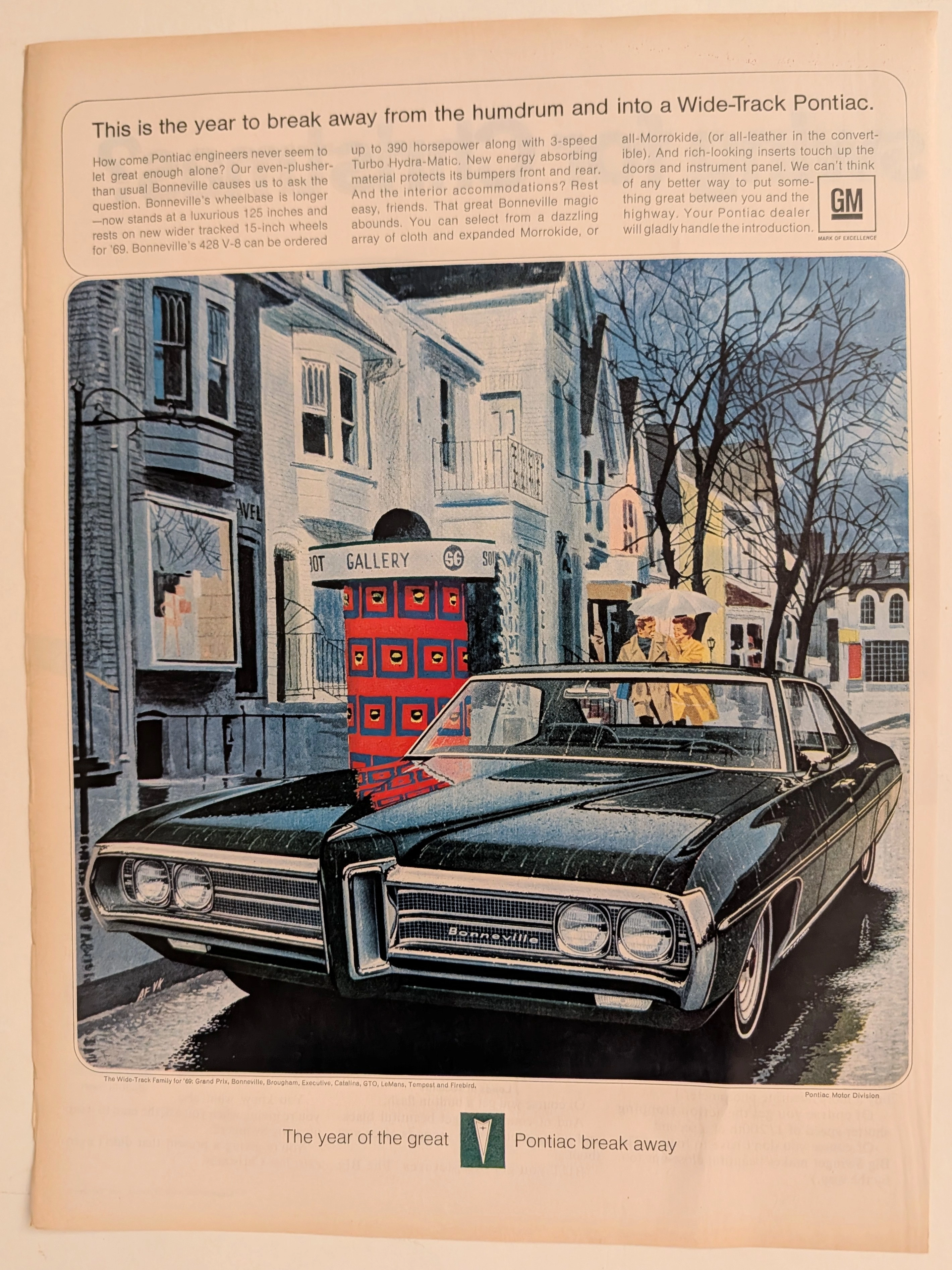
The Time Traveller's Dossier : 1969 Pontiac - The Escape Paradigm
The History
The artifact before us demands a rigorous and exhaustive contextualization.
To truly comprehend this piece of printed commercial art, we must first dissect the socio-political and economic anatomy of the world that engineered it.
The year 1969 is a terminal velocity point in American history.
Humanity is preparing to breach the lunar surface.
Simultaneously, the terrestrial reality is fracturing.
The Vietnam conflict is a relentless, televised trauma.
Cultural revolutions are dismantling the established post-war norms.
Yet, amidst this macro-level chaos, the American middle and upper-middle classes are fighting a quieter, more insidious battle.
They are fighting the crushing weight of routine.
They are fighting the "humdrum."
The humdrum is the repetitive, predictable, and exhausting reality of industrial-era domesticity and corporate life.
It is the commute.
It is the gray, concrete reality of the city.
Pontiac Motor Division, under the umbrella of General Motors, recognized this deep-seated desire for evasion.
They understood that the affluent consumer did not want to merely travel from point A to point B.
The consumer wanted to defect.
They wanted to "break away."
The 1969 Pontiac Bonneville was the physical manifestation of that defection.
To understand the engineering philosophy behind this machine, we must examine the core of Pontiac’s identity: The "Wide-Track" stance.
Introduced a decade earlier under the leadership of Semon "Bunkie" Knudsen, the Wide-Track concept was both a mechanical reality and a marketing masterstroke.
Engineers literally pushed the wheels further out toward the fenders.
Technically, this widened the car's track, lowering the center of gravity and significantly improving cornering stability.
Psychologically, it altered the aggressive geometry of the automobile.
It made the car look planted, predatory, and immensely capable.
By 1969, the Wide-Track paradigm had evolved into an ethos of dimensional dominance.
The text of the artifact explicitly boasts of this physical superiority.
"Bonneville's wheelbase is longer—now stands at a luxurious 125 inches."
In 1969, mass and length were the primary metrics of automotive prestige.
A 125-inch wheelbase is massive.
It dictates a cavernous interior and a ride quality that isolates the occupants from the imperfections of the road.
The vehicle is designed to glide over the fractured American infrastructure, turning potholes into minor, distant vibrations.
It is a mobile sensory deprivation chamber, engineered to filter out the humdrum.
Beneath the long, sculpted hood lies the mechanical heart of this escape paradigm.
The advertisement casually mentions the "428 V-8" and "up to 390 horsepower along with 3-speed Turbo Hydra-Matic."
This is a critical historical marker.
This is the zenith of the muscle car era, but the Bonneville is a full-size luxury cruiser.
Pontiac was taking the brutal, explosive power of the drag strip and refining it for the country club set.
Three hundred and ninety horsepower in a luxury sedan is not about racing; it is about effortless superiority.
It is the power to merge, to overtake, and to leave the mundane traffic in the rearview mirror without a perceptible shift in engine note.
The Turbo Hydra-Matic transmission ensured this violence was delivered with absolute, fluid smoothness.
Power was no longer a tool; it was an invisible, luxurious cushion.
The text also highlights the interior isolation.
"New energy absorbing material protects its bumpers front and rear."
"You can select from a dazzling array of cloth and expanded Morrokide, or all-Morrokide, (or all-leather in the convertible)."
Morrokide was Pontiac’s proprietary name for premium vinyl.
It was designed to be tougher, more durable, and often more visually striking than leather.
The interior of the Bonneville was not just a cabin; it was an impeccably tailored lounge.
When the heavy steel door slammed shut, the outside world ceased to exist.
The driver was surrounded by rich textures, simulated woodgrain, and the muffled, distant hum of a massive V-8 engine.
Consider the competitors of this era.
Ford was marketing the LTD with the "Quiet Man" campaign, famously comparing the interior noise levels of their cars to European gliders.
Chrysler was pushing the Imperial, relying on their reputation for superior torsion-bar engineering and massive interior volumes.
Cadillac and Lincoln owned the traditional, old-money luxury segment.
Pontiac occupied a brilliant, highly specific psychological middle ground.
They did not just sell quietness or sheer size.
They sold aggressive elegance.
The Bonneville was for the executive who had arrived, but who still wanted to be perceived as dynamic, youthful, and slightly dangerous.
It was the luxury car for the driver who still wanted to drive.
The historical shift captured in this artifact is the transition of the automobile from a tool of liberation to a tool of isolation.
In the 1920s and 30s, the car was marketed as a way to access the world.
By 1969, the car was marketed as a way to shut the world out.
The "break away" campaign explicitly positioned the Bonneville as an antidote to reality.
This marketing strategy laid the foundational architecture for the modern luxury SUV market.
Today’s consumers buy massive, heavy, insulated vehicles to sit high above the traffic, surrounded by leather and digital screens, insulated from the reality of the commute.
The psychological blueprint for that modern desire was finalized here, at the Pontiac Motor Division in 1969.
This advertisement is a primary source document proving that we do not buy cars to travel; we buy cars to escape.
The Paper
The physical medium is a prime specimen of mid-twentieth-century commercial offset lithography.
We are analyzing a magazine tear sheet, printed on a high-speed web press.
The paper stock is a lightweight, coated sheet, typical for mass-market publications with multi-million circulation numbers.
The coating is crucial; it prevents the rapid absorption of ink into the cellulose fibers, allowing for the relatively sharp reproduction of the artwork.
Under macro examination, the mechanical truth behind the artistic illusion is laid bare.
In the extreme close-up of the front bumper, we see the initials "AF VK".
More importantly, we see how these initials are physically rendered.
They are not fluid strokes of a brush; they are a rigid, mathematical matrix of Cyan, Magenta, Yellow, and Key (Black) halftone dots.
The smooth, reflective gloss of the "Endura" bumper, the deep, mirror-like black of the hood, and the watery reflections on the pavement are all optical illusions.
They are constructed from thousands of microscopic, pigmented droplets overlapping at precise angles to trick the human eye.
The physical aging of the paper tells an entropic story.
The edges are slightly yellowed and brittle, indicating the presence of lignin in the wood pulp.
As the lignin oxidizes over the decades, it creates an acidic reaction that slowly destroys the paper from within.
The background, which was intended to be a stark, neutral white to frame the typography, has shifted to a warm, antique cream.
This artifact is a temporal recording device.
It was designed to exist for a week in a doctor's waiting room in 1969.
Its survival transforms it into an accidental archive, capturing both the pinnacle of automotive illustration and the slow, inevitable chemical degradation of its own physical body.
The Rarity
Classification: Class B.
In 1969, this advertisement was distributed in massive quantities across national American publications.
The raw material itself, at the time of its inception, was inherently ubiquitous.
However, its current rarity is defined entirely by its survival rate.
Finding a pristine, intact page, free from severe moisture damage, fading, or edge tearing, significantly elevates its archival status.
The true value of this artifact is not found in a financial appraisal.
Its value is contextual, historical, and artistic.
It is an unblemished Rosetta Stone for understanding late-1960s consumer psychology and the visual language of the American automotive golden age.
Its rarity lies in its utility as a flawless mirror, reflecting the exact moment when the desire for psychological escape was successfully commodified into 4,000 pounds of Detroit steel.
Visual Impact
The visual composition is a masterclass in psychological manipulation and forced perspective.
The dominant force is the artwork itself, heavily relying on the interplay of scale and atmosphere.
The car is positioned at a low, dramatic angle.
This is a calculated distortion.
It makes the 1969 Bonneville appear impossibly wide, impossibly low, and aggressively dominant.
The front grille stretches across the frame like the maw of a sophisticated predator.
The color psychology heavily relies on the contrast between the vehicle and its environment.
The Bonneville is rendered in a deep, reflective, almost liquid black.
Black communicates absolute power, formality, and undeniable luxury.
It is the color of limousines and executive authority.
In stark contrast, the background is a moody, impressionistic wash of cool blues, grays, and muted yellows.
It is a rainy, sophisticated urban street scene—an art gallery is clearly visible.
The gloomy, wet environment makes the warm, dry, insulated interior of the Pontiac seem infinitely more desirable.
The typography is deliberate and elegantly restrained.
The headline, "This is the year to break away from the humdrum and into a Wide-Track Pontiac," is set in a clean, modern sans-serif typeface.
It does not scream; it states a confident fact.
The eye is guided from the bold headline, down through the detailed block of copy, into the sweeping lines of the hood, and finally rests on the iconic Pontiac arrowhead logo at the bottom center.
The logo, set against a rich green square, serves as the ultimate visual anchor.
It is a complete, closed-loop narrative: the problem (the humdrum), the environment (the rainy street), the solution (the car), and the signature of the creator (Pontiac).
Exhibition Halls
Tags
The Archive Continues
Continue the Exploration

True Blood of the Trans-Am: The 1970 Ford Mustang Boss 302 Legacy
Experience the raw spirit of an American muscle car legend through an authentic, pre-2000 analog magazine advertisement, carefully extracted as a single sheet.

Guerlain · Fashion
The Time Traveller's Dossier: The Architecture of Desire – Guerlain "Shalimar" Advertisement (Circa Mid-20th Century)
History is not an accidental sequence of events; it is a meticulously engineered illusion crafted by those who command the aesthetic and cultural narratives of their time. Long before digital algorithms could sterilely dictate consumer preferences, the ultimate manifestation of psychological manipulation and corporate alchemy was executed through the calculated precision of the halftone printing press and the absolute mastery of analog darkroom photography. The historical artifact before us is not merely a disposable page torn from a vintage magazine. It is a perfectly weaponized blueprint of exoticism, a visual declaration of extreme luxury, and an unwavering testament to an era where fragrance was sold not as a cosmetic, but as an immortal "Love Song." This museum-grade, academic archival dossier presents an exhaustive, microscopic deconstruction of a mid-20th-century print advertisement for the legendary Guerlain "Shalimar" perfume. Operating on a profound and ruthless binary structure, this document records a calculated paradigm shift within the global luxury industry. It captures the precise historical fracture where a concoction of botanical extracts and synthetic molecules was conceptually transmuted into a literal, physical embodiment of a mythical Eastern romance. Through the highly specialized lens of late-analog commercial artistry and stringent visual forensics, this document serves as a masterclass in psychological marketing. It established the foundational archetype for selling intangible emotions at astronomical markups—an archetype that unconditionally dictates the visual and strategic totems of the modern haute parfumerie industry today.

The Time Traveller’s Dossier: 1980 Imperial Treasury Golden Reliquary Vintage Advertisement — The Weight of Divine Right
Explore the meticulous craftsmanship captured in this 1980 Imperial Treasury Golden Reliquary vintage advertisement, a stunning testament to both medieval goldsmithing and late 20th-century print reproduction. Among vintage ads, pieces that successfully bridge the gap between historical artifact and commercial art hold a unique, exalted position in curatorial archives. This comprehensive dossier examines the exquisite details of the reliquary’s goldwork, the prominent step-cut emeralds, and the intricate enamel eagle, all rendered through the distinct halftone dot matrix characteristic of classic print ads from the era. By analyzing the deep visual chiaroscuro and the material preservation of this specific lithograph, we uncover why old advertisements featuring such opulent antiquities remain highly sought after by archivists, art historians, and dedicated collectors alike. It is not merely a promotional print; it is a paper-bound exhibition of divine right, royal heritage, and institutional prestige, perfectly preserved in the annals of print history and curatorial excellence.