The Time Traveller's Dossier : 1969 Camaro SS & The Centennial Queen - A Societal Intersection — The Record Institute JournalThe Time Traveller's Dossier : 1969 Camaro SS & The Centennial Queen - A Societal Intersection — The Record Institute JournalThe Time Traveller's Dossier : 1969 Camaro SS & The Centennial Queen - A Societal Intersection — The Record Institute JournalThe Time Traveller's Dossier : 1969 Camaro SS & The Centennial Queen - A Societal Intersection — The Record Institute JournalThe Time Traveller's Dossier : 1969 Camaro SS & The Centennial Queen - A Societal Intersection — The Record Institute JournalThe Time Traveller's Dossier : 1969 Camaro SS & The Centennial Queen - A Societal Intersection — The Record Institute JournalThe Time Traveller's Dossier : 1969 Camaro SS & The Centennial Queen - A Societal Intersection — The Record Institute Journal
1 / 7

✦ 7 Photos — Click any image to view in high resolution

May 5, 2026

The Time Traveller's Dossier : 1969 Camaro SS & The Centennial Queen - A Societal Intersection

AutomotiveBrand: Chevrolet
Archive Views: 13

The History

The Centennial Convergence
To understand the immense cultural weight of this artifact, one must analyze the specific intersection of events in 1969.
This was the 100th anniversary of college football, a milestone celebrated with immense national fervor. The NCAA, seeking to elevate the centennial, partnered with the most potent symbol of American industrial might: General Motors, specifically the Chevrolet division.
This was not a mere financial sponsorship; it was a deep, structural integration of brand and event.

Simultaneously, 1969 represented the absolute zenith of the first-generation muscle car era. The Chevrolet Camaro, introduced in 1967 as a direct answer to the Ford Mustang, had undergone a significant and highly aggressive redesign for the '69 model year. It was lower, wider, and visually meaner. It was the mechanical embodiment of youthful aggression and newly minted purchasing power.

The artifact before us captures the precise moment these two distinct cultural currents—the traditional, nostalgic celebration of collegiate sports and the cutting-edge, aggressive marketing of Detroit muscle—were deliberately synthesized into a single, cohesive campaign.

The Engineering of Aspirational Femininity
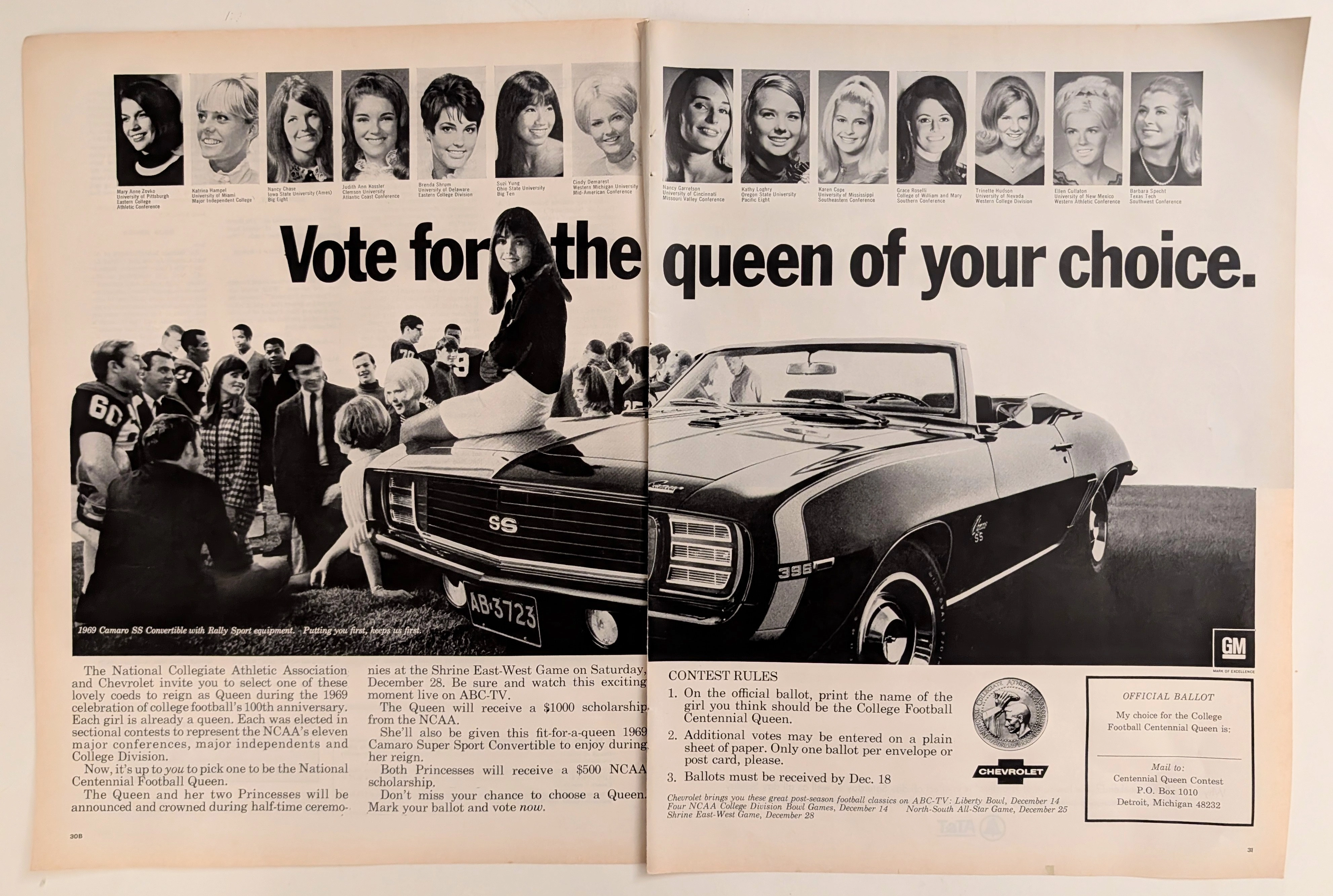
The top third of the artifact is a highly calculated gallery of localized aspirations.
"Vote for the queen of your choice."
Below this command are eleven portraits of young women, each representing a major collegiate conference.
This is a masterclass in demographic targeting. By elevating a representative from the Big Ten, the SEC, the Pac-8, and others, Chevrolet ensured regional investment in a national campaign.

Crucially, the language used to describe these women reflects the rigid social constructs of the late 1960s. The text invites the reader to select one of these "lovely coeds." The term "coed," while technically referring to female students in a coeducational institution, was heavy with societal expectations. It implied a specific type of collegiate woman: wholesome, attractive, supportive, and largely defined by her relationship to the male-dominated sphere of the university—in this case, college football.

The Queen, while celebrated, is fundamentally presented as an accessory to the primary products: the Centennial itself and, more importantly, the Camaro SS on which she sits. She is the humanizing, glamorous hood ornament for Chevrolet's mechanical beast.

The Mechanical Beast: The 1969 Camaro SS 396
The central visual anchor of the artifact is not the Queen herself, but the machine she occupies.
The 1969 Camaro SS Convertible, equipped with the Rally Sport (RS) package (indicated by the hidden headlights), dominates the composition.
The macro details reveal the aggressive engineering cues Chevrolet was eager to highlight.
The "396" badge on the front fender is not merely decorative; it is a vital alphanumeric code. It signals the presence of the massive 396 cubic-inch Big-Block V8 engine. In the horsepower wars of 1969, the 396 was a badge of absolute authority on the street.

Furthermore, the "SS" (Super Sport) emblem on the grille and the subtle "SS" script on the lower front fender reinforced the performance pedigree.
The contrast is deliberate and jarring. The soft, smiling figures of the collegiate Queens are juxtaposed against the aggressive, shark-like gills, the muscular wheel arches, and the dark, imposing grille of the Camaro.
The campaign implicitly promises the young American male voter that participating in the selection of the Queen brings him one step closer to the ultimate prize: the keys to the 396.

The Mechanics of Participatory Marketing
The lower right quadrant of the artifact details the mechanics of the contest, revealing a sophisticated approach to consumer engagement.
The "OFFICIAL BALLOT" requires the participant to physically cut out the form, fill it in, and mail it to a P.O. Box in Detroit, Michigan 48232—the heart of GM's empire.
This was data harvesting before the digital age.
By forcing physical interaction, Chevrolet ensured a level of active engagement far deeper than passive observation. The campaign required effort, a stamp, and a trip to the mailbox.

The rules state that "Additional votes may be entered on a plain sheet of paper," encouraging a high volume of responses, essentially manufacturing a frenzy of participation.
The payoff is heavily broadcasted: The Queen receives a $1000 scholarship, but more crucially for Chevrolet's narrative, she receives "this fit-for-a-queen 1969 Camaro Super Sport Convertible to enjoy during her reign."
The car is positioned as the ultimate reward, elevating the status of both the vehicle and the woman chosen to drive it.

The Corporate Seal of Approval
Two critical emblems authorize this entire spectacle.
First, the NCAA Centennial seal. The macro photograph reveals the stark, almost brutalist design of the seal—a profile of a helmeted player superimposed over a stylized "100". It provides the necessary institutional legitimacy, transforming a car advertisement into a sanctioned collegiate event.
Second, the undeniable "GM Mark of Excellence" square in the bottom right corner.
During this era, GM commanded over 50% of the domestic auto market. This mark was not just a logo; it was a stamp of absolute industrial supremacy.
It grounded the entire frivolous pageantry of the Queen contest in the cold, hard reality of American corporate dominance.

The Paper

The physical substrate of this artifact is a standard, mid-weight magazine stock typical of mass-circulation publications of the late 1960s (likely 60-70 GSM).
It is a two-page spread, indicating a significant financial investment by Chevrolet in media placement.
The printing utilizes a standard web offset process, but the absence of color is striking.
In an era where color advertising was prevalent, the choice of high-contrast black and white (monochrome) serves a specific purpose. It lends a documentary, almost news-like quality to the advertisement, increasing its perceived legitimacy.

Under macro inspection, the halftone dot matrix (the CMYK rosette pattern, though here only utilizing black ink) is clearly visible. This is particularly evident in the gradients of the Camaro's sleek bodywork and the fine details of the NCAA seal.
The paper shows slight signs of natural acidification along the edges, a faint warming of the white space that authenticates its journey through the decades. It is a mass-produced artifact, yet the specific alignment of the halftone dots on this particular page makes it a unique physical record.

The Rarity

Class B.
As a two-page spread in what were likely highly circulated magazines (such as Sports Illustrated, Life, or major collegiate programs) during the fall of 1969, this specific advertisement was printed in the hundreds of thousands, if not millions.
Physical copies of the magazines containing this spread are not exceedingly rare in archival collections or vintage paper markets.

However, its contextual and historical value is extraordinary.
It serves as a pristine primary source document encapsulating the intersection of the muscle car zenith, the commercialization of college sports, and the gender dynamics of the late 1960s.
Its rarity lies not in its physical scarcity, but in its perfect, crystalline articulation of a specific moment in American cultural history—a moment right before the oil crisis and changing social mores would irrevocably alter both Detroit and the American university landscape.

Visual Impact

The visual composition is a triumph of structured hierarchy and engineered desire.
The top band acts as a menu, presenting the eleven Queens in a neat, orderly row. The eye is drawn across the faces, guided by the bold, commanding headline: "Vote for the queen of your choice."
The font is a heavy, authoritative sans-serif, demanding action.

The central image is a study in calculated chaos versus mechanical order. A large group of college students (football players and fans) surrounds the central figure—the current Queen, perched confidently on the hood of the Camaro.
The lighting is dramatic, highlighting the aggressive lines of the car's front end, specifically the Rally Sport grille and the SS badging. The dark paint of the car provides a stark, contrasting base for the light-colored clothing of the students.
The viewer's eye is inevitably pulled toward the gleaming "396" badge and the license plate "AB 3723".
The bottom quadrant is distinctly utilitarian, mimicking an official document with the ballot box and contest rules. The overall visual impact is one of excitement, aspiration, and immediate call to action, seamlessly blending the thrill of a pep rally with the allure of a showroom floor.

Share This Archive

The Archive Continues

Continue the Exploration

The Time Traveller's Dossier: The Semantics of Arrogance – JOY de Jean Patou Advertisement (Circa 1980s)

๋Joy De Jean Patou · Fashion

The Time Traveller's Dossier: The Semantics of Arrogance – JOY de Jean Patou Advertisement (Circa 1980s)

History is not written by the victors; it is printed by the industrialists. Long before digital algorithms began to sterilely dictate human consumption and virtual reality stripped away authentic tactile sensation, societal engineering and consumer psychology were executed through the calculated, mathematical geometry of the four-color offset press and the absolute mastery of analog darkroom photography. The historical artifact before us is not merely a disposable magazine tear sheet meant to peddle a fragrance. It is a perfectly weaponized blueprint of absolute capitalist supremacy, a visual declaration of class warfare, and an unwavering testament to an era of uncompromising, unapologetic ultra-luxury. This museum-grade, academic archival dossier presents an exhaustive deconstruction of a late-analog print advertisement for the legendary fragrance "JOY de Jean Patou," dating from the late 1970s to the early 1980s. Operating on a profound and ruthless binary structure, this document records a calculated paradigm shift within the global luxury goods industry. It captures the precise historical fracture where luxury transitioned conceptually from being a mere indicator of high-quality craftsmanship into a blatant, arrogant weapon of socioeconomic exclusion. Through the highly specialized lens of late-analog commercial artistry and stringent visual forensics, this document serves as a masterclass in psychological marketing. It established the foundational archetype for selling astronomically priced, exclusionary items—an archetype that unconditionally dictates the visual and strategic totems of modern ultra-luxury brands today.

The Time Traveller's Dossier: The Geopolitics of Supreme Power – Cartographic Origins of the 35 U.S. Presidents (Circa Mid-1960s)

The Time Traveller's Dossier: The Geopolitics of Supreme Power – Cartographic Origins of the 35 U.S. Presidents (Circa Mid-1960s)

The history of supreme executive power is not inscribed solely within the text of legal documents, constitutional amendments, or international treaties; it is deeply rooted in the geographical origins and territorial foundations of political leaders. Long before the modern era of complex spatial data analysis or digital infographics, the structural understanding of state power in the United States was conveyed through the meticulous art of cartographic illustration. The historical artifact presented before us for museum-grade forensic analysis is not merely a conventional fold-out extracted from a mid-20th-century educational publication. It is a profound "geopolitical visual encyclopedia," meticulously compiling and categorizing the geographic birthplaces of the thirty-five individuals who had ascended to the highest office in the White House up to that point in history. This academic archival dossier presents an exhaustive, microscopic deconstruction of the historical and aesthetic framework of the diagram titled "The 35 Presidents and the 14 States They Came From." Operating on a profound scholarly narrative structure, this document decodes the shifting tectonic plates of executive power in the United States—from the foundational era concentrated on the Eastern Seaboard, moving steadily into the Midwest, and ultimately expanding toward the Southern and Western frontiers. Through the highly specialized lens of late-analog print analysis, American political history, and rigorous visual forensics, this document serves as a temporal window. It allows us to explore the foundational roots of the "American Dream" as conveyed through the birthplaces of these statesmen, ranging from humble log cabins to opulent estates, all rendered with the mechanical precision of mid-century offset lithography.

The Time Traveller's Dossier: The Oil Baron's Chariot – 1970s "HOU$TON" Editorial Illustration

ROLL ROYCE · Automotive

The Time Traveller's Dossier: The Oil Baron's Chariot – 1970s "HOU$TON" Editorial Illustration

History is not written; it is printed. Before digital algorithms dictated human behavior, societal engineering was executed through the calculated geometry of the four-color offset press. The historical artifact before us is not merely a magazine editorial illustration; it is a weaponized blueprint of American myth-making and a testament to the era of unchecked petro-wealth. This museum-grade archival dossier presents an academic deconstruction of a 1970s print feature on Houston, Texas, brilliantly illustrated by the legendary Eraldo Carugati. Operating on a profound binary structure, it documents a calculated paradigm shift in the global perception of wealth. It illustrates the precise historical fracture where the "Texas Oil Boom" transitioned from a regional economic event into a larger-than-life cultural archetype. Through the lens of late-analog commercial artistry and precise visual forensics, this document serves as a masterclass in psychological semiotics, establishing the visual tropes of the brash, high-rolling American Wildcatter that unconditionally dominates modern pop culture.

Published by

The Record Institute

Taxonomy Match

Related Articles

The Time Traveller's Dossier : Keep America Beautiful - Invention of the Litterbug — related article
Read Article

The Time Traveller's Dossier : Keep America Beautiful - Invention of the Litterbug

Before this artifact. Waste was a systemic reality, largely managed through local, reusable infrastructure. Milk bottles were returned. Soda glass was collected. The burden of packaging remained, to a significant degree, tethered to the producer. Consumption was a cycle, anchored by the economics of material recovery. Then, a shift. The post-war boom dictated an economy of disposability. Convenience required single-use materials. Single-use materials created unprecedented volume. Instead of altering the production model, a masterful psychological pivot was engineered. The introduction of the "Litterbug." The burden of the packaging lifecycle was cleanly, legally, and morally transferred from the corporation that manufactured it to the citizen who consumed it. It was the birth of individualized environmental guilt. A pristine picnic turned into an act of civic betrayal. The artifact does not merely ask the public to clean up. It defines a new moral boundary for the modern American citizen.

The Time Traveller's Dossier: Coca-Cola & The "Sprite Boy" - The Carbonated Utopia of Post-War America — related article
Read Article

The Time Traveller's Dossier: Coca-Cola & The "Sprite Boy" - The Carbonated Utopia of Post-War America

Then, a beverage was simply a flavored liquid used to quench thirst. In 1950s America, it was packaged as a scientifically formulated "lift," a socially sanctioned psychological "pause" in the roaring machinery of the post-war economy. This artifact is a portal. It transports us back to the mid-1950s, an era defined by blind optimism, explosive mass consumerism, and the absolute dawn of television media. Here, we encounter a now-forgotten phantom of pop culture: the Coca-Cola "Sprite Boy." It is a vintage print advertisement, yes. But deeper than that, it is an early blueprint for cross-media corporate synergy. It perfectly captures how Coca-Cola weaponized the sensory metaphors of print (sparks, energy, tang) to herd consumers toward a nascent media format: the corporately sponsored television program. It documents how a carbonated syrup inextricably bound itself to the leisure time of the American middle class.

The Time Traveller's Dossier : 1968 Zippo - The Enduring Flame — related article
Read Article

The Time Traveller's Dossier : 1968 Zippo - The Enduring Flame

The year is 1968. The world is characterized by profound volatility. Societies fracture. Wars escalate. Economies shift toward the disposable. Amidst this era of impermanence, an artifact is presented. It is not complex. It is not digital. It is mechanical, primitive, and entirely absolute. Then, a lighter was merely a tool for combustion. Now, through the lens of this document, we recognize it as a sociological anchor. This advertisement documents a critical industrial shift: the deliberate rejection of planned obsolescence. It highlights a manufacturer promising an eternal relationship with the consumer. "It works or we fix it free." It is the proposition of permanence in a temporary world. The flame is secondary. The true product being sold is reliability.

The Time Traveller's Dossier : 1960s Youthquake - The Weaponization of Nostalgia — related article
Read Article

The Time Traveller's Dossier : 1960s Youthquake - The Weaponization of Nostalgia

Then, beauty was a linear progression toward mature elegance. Now, it is a cyclical, ironic rebellion dictated by the young. The era is the late 1960s. The artifact is a two-page magazine editorial spread. Before this moment, a young woman aspired to look like her mother. She adopted the symbols of adulthood as a rite of passage. Here, we witness the industrial fracturing of the generational continuum. The teenager explicitly rejects the mother. The establishment beauty industry, desperate to survive, pivots to serve the teenager. This document does not merely sell crimson lipstick or a seventy-dollar minismock. It sells the psychological usurpation of the past by the youth. The problem of the late 1960s commercial sector was capturing a demographic that actively despised the establishment. The solution, printed here in stark white and shocking red, was to package history as subversive, pop-art camp, excluding the adults who actually lived it.

The Time Traveller's Dossier : WWII War Bonds - Corporate Conscription — related article
Read Article

The Time Traveller's Dossier : WWII War Bonds - Corporate Conscription

A nation does not wage war with steel alone. It wages war with capital. It fights with belief. Before 1941, the American consumer was a creature of comfort, trained by an emerging advertising industry to desire soda, automobiles, and modern conveniences. Then came the sudden violence of global conflict. The factories pivoted. The supply chains froze. The consumer economy ground to a sudden, devastating halt. Yet, the advertising machinery did not sleep. It was conscripted. The artifacts presented here—fragments of print from 1943, embedded within the commercial messaging of companies like The Seven-Up Co. and Autocar Trucks—represent a monumental shift in human behavior. This was the moment the public was asked to purchase the future instead of the present. The strategy was unprecedented. Convert the civilian into a shareholder of the state. Transform the act of saving into the ultimate act of aggression against an unseen enemy. This is not merely a collection of vintage advertisements. It is the exact inflection point where corporate marketing was weaponized for national survival.

The Time Traveller's Dossier : 1968 Pepsi-Cola - The Thermodynamics of Youth — related article
Read Article

The Time Traveller's Dossier : 1968 Pepsi-Cola - The Thermodynamics of Youth

The year is 1968. The globe is fracturing under the weight of profound social and political upheaval. Then, carbonated beverages were marketed on the gentle merits of family gatherings and nostalgic heritage. Now, the commercial battlefield demands a new, aggressive demographic loyalty. This artifact is a masterclass in the weaponization of temperature and identity. It documents the precise escalation of the Cola Wars, shifting the focus from the liquid itself to the psychographic profile of the consumer. It is the architectural blueprint of the "Pepsi Generation." A manufactured, sun-drenched sanctuary of youth, action, and athletic leisure. It rejects the warm nostalgia of the establishment. It demands a visceral, freezing shock to the system. It is a declaration of absolute thermodynamic supremacy. Taste that beats the others cold.