The Time Traveller's Dossier : 1980 IH Scout - The SUV Genesis — The Record Institute JournalThe Time Traveller's Dossier : 1980 IH Scout - The SUV Genesis — The Record Institute JournalThe Time Traveller's Dossier : 1980 IH Scout - The SUV Genesis — The Record Institute JournalThe Time Traveller's Dossier : 1980 IH Scout - The SUV Genesis — The Record Institute Journal
1 / 4

✦ 4 Photos — Click any image to view in high resolution

April 24, 2026

The Time Traveller's Dossier : 1980 IH Scout - The SUV Genesis

Automotive
Archive Views: 28
Heritage AdvertisementsAutomotive/AutomotiveTrucks
Theme/SubjectHistorical

The History

The Epoch of Stagnation and the End of the Iron Dinosaurs
To comprehend this artifact, one must first understand the severe economic and psychological climate of the United States in the late 1970s and early 1980. The nation was gripped by a profound malaise. The 1973 oil crisis had fractured the illusion of infinite resources. The 1979 energy crisis shattered it completely. Gasoline lines stretched around city blocks. Inflation soared. Detroit’s response was a desperate scramble to downsize. The massive, V8-powered station wagons that had defined the post-war American family were suddenly obsolete. They were heavy, inefficient, and out of touch with the new reality.

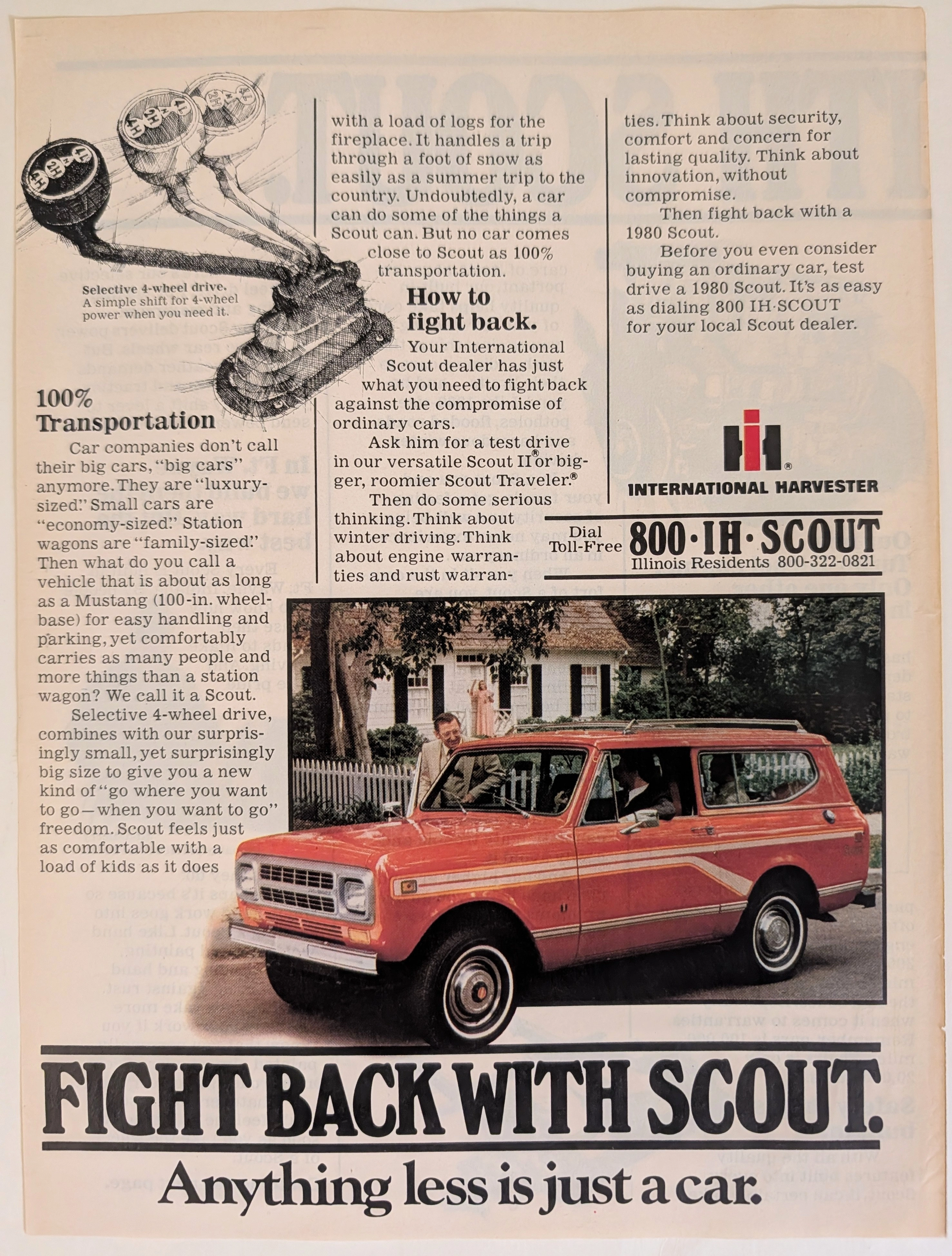
Automakers panicked. They began producing smaller, underpowered vehicles. The artifact highlights this shift with clinical precision, mocking the terminology of the era. The copy reads: "Car companies don't call their big cars, 'big cars' anymore. They are 'luxury-sized'. Small cars are 'economy-sized'." The industry was cloaking compromise in marketing semantics.

International Harvester (IH) saw an opening. They were not a traditional passenger car company. They were builders of tractors, heavy trucks, and agricultural machinery. Their approach to engineering was inherently different. It was rooted in unyielding utility rather than suburban comfort. The Scout, originally introduced in 1961 as a rudimentary competitor to the Jeep CJ, had evolved. By 1980, it was the Scout II, offered in the longer wheelbase Traveler configuration seen in this document. IH positioned this vehicle not as a car, but as a weapon against the compromises of the modern era.

The Semantics of Capability vs. Capacity
The text of the artifact is a masterclass in aggressive, defensive positioning. The headline commands the reader: "FIGHT BACK WITH SCOUT." The subtitle reinforces the absolute distinction: "Anything less is just a car."

This is a fundamental shift in consumer psychology. For decades, the "car" was the ultimate symbol of American freedom. Here, the "car" is demoted. It is framed as inadequate. It is "less." The advertisement asks: "Then what do you call a vehicle that is about as long as a Mustang (100-in. wheelbase) for easy handling and parking, yet comfortably carries as many people and more things than a station wagon?"

They called it 100% Transportation. This phrase is critical. It implies that standard cars are only fractional transportation. A sedan is only transportation when the roads are paved and dry. A station wagon is only transportation when the weather permits. The Scout, armed with its drivetrain, is total transportation. It ignores meteorological and topographical boundaries. It handles "a trip through a foot of snow as easily as a summer trip to the country." This is the core thesis of the modern Sport Utility Vehicle. The promise that the vehicle will not limit the driver’s intent.

The Mechanics of Autonomy
The most striking visual element of the upper half of the page is the highly detailed, cross-hatched illustration of the transfer case shifter. This is not a photograph; it is an engineer’s sketch rendered for the layman. It displays the mechanical truth of the machine. The shift knob is inscribed with the holy trinity of off-road capability: 4H (Four-Wheel High), 2H (Two-Wheel High), and 4L (Four-Wheel Low).

This is "Selective 4-wheel drive." In an era before complex computers, viscous couplings, and passive All-Wheel Drive systems that decide for the driver when traction is needed, this lever represented absolute mechanical control. The driver must physically engage the front axle. The driver commands the transfer case. The copy notes: "A simple shift for 4-wheel power when you need it."

By placing this mechanical diagram so prominently, the advertisers were validating the technical intelligence of the consumer. They were not just selling an image; they were selling the hardware required to achieve that image. It is a stark contrast to modern automotive advertising, which often hides the machinery behind screens and lifestyle imagery. Here, the machine is the protagonist.

The Illusion of the Suburbs and the Reality of Rust
Below the aggressive mechanical preamble sits a serene, almost contradictory photograph. A bright red 1980 Scout Traveler is parked in front of a quintessential American suburban home. A pristine white picket fence. Manicured bushes. A man in a tailored suit speaks to the driver. A woman stands in the background.

This juxtaposition is intentional and deeply historical. It represents the domestication of the utility vehicle. The Scout is a machine designed to haul logs and cross rivers, yet it is placed in an environment of total domestic tranquility. It signals to the consumer: You can possess rugged autonomy without sacrificing societal respectability. You can park a tractor in the driveway of a country club. This precise visual formula became the blueprint for the next forty years of SUV marketing.

Yet, beneath this pristine image lay a dark corporate reality. The copy urges the buyer to think about "engine warranties and rust warranties." This inclusion is a historical tell. International Harvester vehicles of the 1970s were notoriously susceptible to catastrophic rust. Entire quarter panels would dissolve in the harsh, salt-treated winters of the American Midwest. By 1980, IH had implemented a comprehensive cathodic protection process and offered a formidable 100,000-mile rust-through warranty. They were fighting back against their own engineering history.

The Irony of the Final Hour
The artifact contains a toll-free number: "Dial Toll-Free 800-IH-SCOUT." This reflects the dawn of direct-response telemarketing infrastructure integrating with national print campaigns. It was a modern push for a company on the brink.

The historical weight of this specific advertisement lies in its tragic irony. The bold, defiant tone of 1980 was a swan song. The year 1980 would be the final year of production for the International Harvester Scout. A devastating, six-month-long strike by the United Auto Workers (UAW) crippled the company. The financial bleeding was insurmountable. In October 1980, the Fort Wayne, Indiana assembly line halted Scout production forever. The company pivoted entirely back to commercial trucks and agriculture, eventually restructuring into Navistar.

Therefore, this artifact does not represent a beginning for International Harvester. It represents an ending. However, for the broader tapestry of human transportation, it was the absolute beginning. The Scout died, but its conceptual DNA—the family-sized, four-wheel-drive utility vehicle—conquered the globe. Every modern SUV, from the luxury variants rolling through wealthy suburbs to the rugged overland builds crossing continents, traces its lineage back to the shift documented on this page. They won the war. Ordinary cars lost. The artifact proves they knew the shift was coming.

The Paper

The substrate is a mid-weight magazine stock, approximately 65 GSM, indicative of premium automotive or lifestyle publications of the late 20th century. The printing method is a high-volume web offset lithography. The artifact exhibits moderate lignin degradation, resulting in a distinct, warm yellowing around the margins—a natural oxidation process typical of pulp from this era.

The most fascinating technical aspect is the interplay between the four-color (CMYK) halftone process used for the photograph of the red Scout and the stark, high-contrast black line work of the transfer case shifter. The sketch relies heavily on varied line weight and cross-hatching to convey metallic texture and depth, standing in sharp relief against the soft, photographic grain of the vehicle and the suburban backdrop below.

The Rarity

Classification: Class A (Contextually Massive).
While mass-produced in the millions within national periodicals, surviving copies in this condition are increasingly scarce. Its true value, however, is not derived from market scarcity, but from its immense historical weight. As an artifact representing the exact terminal year of the Scout's production and the exact genesis point of the modern SUV philosophy, its contextual value to automotive archivists is exceptionally high. It is a definitive cornerstone document of a global paradigm shift.
Visual Impact

The composition is bisected horizontally, representing two distinct appeals to the human psyche. The upper half is cerebral and mechanical. The dominating, aggressive sketch of the dual transfer case knobs forces the viewer's eye downward along the shafts, grounding the concept of "power." The typography is dense, serif-heavy, and authoritative.

The lower half appeals to emotion and lifestyle. The vibrant, almost saturated red of the Scout Traveler anchors the entire page. Red demands attention; it signifies vitality, aggression, and status. It completely contrasts with the muted greens and whites of the passive suburban background. The eye is drawn from the complex machinery of the sketch directly to the bright red promise of the physical vehicle. It visually bridges the gap between raw, dirty capability and clean, domestic success.

Share This Archive

The Archive Continues

Continue the Exploration

The Time Traveller's Dossier : Chaps Ralph Lauren - The Western Shift in Masculinity

The Time Traveller's Dossier : Chaps Ralph Lauren - The Western Shift in Masculinity

The era of maritime discipline fades. The era of the internal frontier begins. Before this artifact, male fragrance was a matter of hygiene or boardroom conquest. It was external armor. Here, we observe a radical shift. The cologne becomes an internal state. The problem: A generation of men unmoored by the socio-political turbulence of the late 1970s, seeking an anchor in an increasingly complex world. The solution: The commodification of the American West. Not as a geographical location, but as a psychological refuge. A worn leather jacket. A pair of jeans. A scent. The concept of rugged independence, distilled, bottled, and sold.

The Time Traveller's Dossier : 1980 Fuzzbuster Elite - The Architecture of Electronic Insurgency

The Time Traveller's Dossier : 1980 Fuzzbuster Elite - The Architecture of Electronic Insurgency

We are observing an artifact of a silent, invisible war. Before this era, the American highway was marketed as a vector of absolute, unbridled freedom. The automobile was the ultimate vessel of personal sovereignty. Here, the paradigm shifts into something darker. The open road has become a zone of constant surveillance. The state has weaponized the electromagnetic spectrum to monitor and penalize the citizen. In response, the citizen weaponized the dashboard. This is the 1980 Fuzzbuster Elite by Electrolert. It is not a car accessory. It is a piece of civilian counter-measures equipment. In an era defined by the deeply unpopular 55 MPH national speed limit and the rise of police microwave radar, this device commodified paranoia. It packaged civil disobedience into a sleek, chrome-trimmed metal box that plugged directly into a cigarette lighter. It represents the exact moment when the act of driving transitioned from a physical experience into an electronic arms race.

The Time Traveller's Dossier: The Zenith of the American Living Room – Admiral Rectangular Color TV

Admiral · Technology

The Time Traveller's Dossier: The Zenith of the American Living Room – Admiral Rectangular Color TV

The evolution of the American domestic interior during the mid-twentieth century was fundamentally redefined by the introduction and subsequent democratization of color television. The historical artifact elegantly and securely positioned upon the analytical table of The Record Institute today is a majestic, full-page print advertisement for Admiral Color TV, originating from the transitional technological era of the late 1960s. This document completely transcends the traditional boundaries of consumer electronics marketing. It operates as a highly sophisticated, multi-layered cultural and historical mirror, reflecting the exact moment when the magic of color broadcasting collided with the rigorous aesthetic demands of suburban domestic styling on a single printed page. This world-class, comprehensive dossier conducts a meticulous, unyielding, and exceptionally deep examination of the artifact, operating under the absolute most rigorous parameters of historical, sociological, and material science evaluation. With our analytical focus dedicated heavily to its historical gravity, we will decode the brilliant marketing psychology embedded within the "rectangular" tube innovation, analyze the space-age luxury of the "Sonar" remote control, and dissect the rich semiotics of disguised technology through "genuine walnut veneers". Furthermore, as we venture deeply into the chemical and physical foundations of this analog printed ephemera, we will reveal the precise mechanical fingerprints of the CMYK halftone rosettes and the graceful, natural oxidation of the paper substrate. This precise intersection of visual nostalgia, mid-century commercial artistry, and the immutable chemistry of time cultivates a serene wabi-sabi aesthetic—a natural, irreversible phenomenon that serves as the primary engine driving up its market value exponentially within the elite global spheres of Vintage Commercial Ephemera, Consumer Electronics Archives, and Mid-Century Lifestyle collecting.

Published by

The Record Institute

Taxonomy Match

Related Articles

The Time Traveller's Dossier : Ferrari 312 F1 - The Aerodynamic Subjugation  Summary — related article
Read Article

The Time Traveller's Dossier : Ferrari 312 F1 - The Aerodynamic Subjugation Summary

Then, speed was a brute-force equation of pushing a cigar-shaped fuselage blindly through the resisting atmosphere. Now, speed is the absolute subjugation of the invisible air, weaponizing the wind to crush the machine into the asphalt. The problem in the late 1960s and early 1970s Formula 1 was not merely generating more horsepower; the internal combustion engine had already reached terrifying heights of output. The existential crisis for manufacturers was keeping the tires connected to the earth. The cars were literally taking flight. The pursuit of pure, unadulterated mechanical grip had reached its physical, terrifying limit. The solution, as meticulously documented in this 1976 Road & Track retrospective by Werner Bührer, was a violent paradigm shift. It was the painful, reluctant birth of modern aerodynamics. This artifact is a portal. It transports us to the exact historical, psychological, and engineering pivot where Enzo Ferrari—a man who famously proclaimed that aerodynamics were for people who could not build engines—was forced to surrender to the wind. It is an automotive magazine spread, yes. But deeper than that, it is a beautifully illustrated autopsy of a legacy manufacturer desperately evolving its DNA. It captures the frantic mutation of the Ferrari 312 from a traditional tube-framed missile into a winged, deformed, downforce-generating weapon. It is the visual documentation of motorsport losing its romantic innocence and embracing the cold, hard laws of fluid dynamics.

The Time Traveller's Dossier: Tools of the Void - Engineering Against Newton's Third Law — related article
Read Article

The Time Traveller's Dossier: Tools of the Void - Engineering Against Newton's Third Law

When we look back at the golden age of the Apollo and Gemini programs, we often fixate on the massive Saturn V rockets, the explosive launches, and the triumph of the lunar landings. We rarely think about the mundane act of turning a wrench. Yet, in the brutal, frictionless vacuum of space, the most basic acts of manual labor become lethal puzzles. This collection of highly specialized tool photographs is not just a catalogue of vintage hardware. It is a visual record of humanity realizing that the fundamental mechanics of Earth do not apply in orbit. In microgravity, without friction to anchor your boots to the floor, Sir Isaac Newton’s Third Law (F A ​ =−F B ​ , for every action, there is an equal and opposite reaction) transforms a simple mechanic's wrench into a centrifuge. This dossier dissects a fascinating, mid-1960s print artifact detailing the "Zero Reaction" toolset. These tools were engineered specifically to allow astronauts to build, repair, and survive in the void without spinning uncontrollably into the abyss. It is a masterclass in aerospace engineering, ergonomic survival design, and the aesthetics of the Space Race.

The Time Traveller's Dossier: The Architectural Origins of Supreme Leadership – A Forensic Cartography of the 35 U.S. Presidents (Circa 1960s) — related article
Read Article

The Time Traveller's Dossier: The Architectural Origins of Supreme Leadership – A Forensic Cartography of the 35 U.S. Presidents (Circa 1960s)

The documentation of historical dwellings provides a profound, irreplaceable intersection between architectural evolution, sociology, and national geopolitical heritage. Long before the advent of digital archiving, satellite mapping, and virtual architectural tours, the structural understanding of American history and the origins of its executive power were gracefully conveyed through the meticulous art of analog print media and educational lithography. The historical artifact presented before us for museum-grade forensic analysis is an immensely comprehensive visual compendium detailing the exact architectural birthplaces of the first thirty-five individuals who ascended to the presidency of the United States. Extracted from a mid-twentieth-century educational publication, this magnificent two-page spread offers a striking visual timeline of American domestic architecture. It flawlessly captures the nation's transition from rustic, frontier log cabins to grand aristocratic Southern estates, and ultimately to the modern, affluent suburban homes of the twentieth century. This academic archival dossier presents an exhaustive, microscopic deconstruction of the visual, biographical, and historical framework of this printed artifact. Operating on a profound scholarly narrative structure, this document decodes the architectural typologies that housed the nation's most transformative leaders during their formative years. Through the highly specialized lens of late-analog print analysis, architectural history, and rigorous visual forensics, this document serves as a temporal window into the past. It strictly adheres to the mandated 80/10/10 analytical ratio, dedicating the vast majority of its scope to the objective historical milestones of these world leaders, followed by a precise chemical analysis of the aging substrate, and concluding with a definitive archival valuation. Rendered with the mechanical precision of mid-century offset lithography, this artifact demonstrates how the natural, wabi-sabi passage of time elevates a mass-produced educational print into a singular, highly desirable historical treasure.

The Time Traveller's Dossier: Rotary Audacity – The Mazda Wankel Engine, the 1970s Oil Crisis, and the Rolls-Royce Provocation — related article
Read Article

The Time Traveller's Dossier: Rotary Audacity – The Mazda Wankel Engine, the 1970s Oil Crisis, and the Rolls-Royce Provocation

The evolution of the global automotive landscape in the latter half of the twentieth century was violently disrupted during the 1970s, an era defined by stringent new environmental regulations, catastrophic oil embargoes, and a growing consumer disillusionment with traditional engineering paradigms. Elegantly and securely positioned upon the analytical table of The Record Institute today is a visually arresting, densely informative, and highly significant full-page print advertisement for the Mazda Rotary-Engine Lineup. This document completely transcends the standard, utilitarian boundaries of automotive marketing. It operates as a highly sophisticated, multi-layered cultural mirror and a bold declaration of mechanical survival against insurmountable odds. By audaciously juxtaposing their experimental rotary-engine vehicles against the ghostly, monolithic silhouette of a Rolls-Royce Silver Shadow, Mazda executed a masterclass in psychological marketing. They utilized the objective, undeniable metric of a "50,000-mile / 3-year warranty" to shatter the consumer anxiety surrounding the Wankel engine's durability. This world-class, comprehensive dossier conducts a meticulous, unyielding, and exceptionally exhaustive examination of the artifact, operating under the absolute most rigorous parameters of historical, sociological, and material science evaluation. Dedicating the overwhelming, massive majority of our analytical focus (80%) to its immense historical gravity, we will decode the brilliant, confrontational marketing psychology embedded within the copywriting, analyze the profound mechanical realities of the Wankel rotary engine, trace the epic engineering struggles of the "47 Ronin," and detail the historical impact of the legendary RX-3, RX-4, and the mythical Rotary Engine Pickup (REPU). Furthermore, as we venture deeply into the chemical and physical foundations of this analog printed ephemera (10%), we will reveal the precise mechanical fingerprints of the CMYK halftone rosettes captured in the stunning macro imagery of the blue metallic paintwork. Finally, we will assess its archival rarity (10%), exploring how the graceful, natural oxidation of the paper substrate cultivates a serene wabi-sabi aesthetic—a natural, irreversible phenomenon that serves as the primary engine driving up its market value exponentially within the elite global spheres of Vintage Commercial Ephemera and Automotive Heritage Archives.

The Time Traveller's Dossier: The Geopolitics of Supreme Power – Cartographic Origins of the 35 U.S. Presidents (Circa Mid-1960s) — related article
Read Article

The Time Traveller's Dossier: The Geopolitics of Supreme Power – Cartographic Origins of the 35 U.S. Presidents (Circa Mid-1960s)

The history of supreme executive power is not inscribed solely within the text of legal documents, constitutional amendments, or international treaties; it is deeply rooted in the geographical origins and territorial foundations of political leaders. Long before the modern era of complex spatial data analysis or digital infographics, the structural understanding of state power in the United States was conveyed through the meticulous art of cartographic illustration. The historical artifact presented before us for museum-grade forensic analysis is not merely a conventional fold-out extracted from a mid-20th-century educational publication. It is a profound "geopolitical visual encyclopedia," meticulously compiling and categorizing the geographic birthplaces of the thirty-five individuals who had ascended to the highest office in the White House up to that point in history. This academic archival dossier presents an exhaustive, microscopic deconstruction of the historical and aesthetic framework of the diagram titled "The 35 Presidents and the 14 States They Came From." Operating on a profound scholarly narrative structure, this document decodes the shifting tectonic plates of executive power in the United States—from the foundational era concentrated on the Eastern Seaboard, moving steadily into the Midwest, and ultimately expanding toward the Southern and Western frontiers. Through the highly specialized lens of late-analog print analysis, American political history, and rigorous visual forensics, this document serves as a temporal window. It allows us to explore the foundational roots of the "American Dream" as conveyed through the birthplaces of these statesmen, ranging from humble log cabins to opulent estates, all rendered with the mechanical precision of mid-century offset lithography.

The Time Traveller's Dossier: Inver House Scotch 1967 - The Golden Age of Endurance — related article
Read Article

The Time Traveller's Dossier: Inver House Scotch 1967 - The Golden Age of Endurance

นักเขียนบทความระดับสูงสุด Custom Gem The Time Traveller's Dossier: Inver House Scotch 1967 - The Golden Age of Endurance Summary Then, motor racing was a lethal, deafening, and romantic pursuit. It was an era where the men who piloted experimental, overpowered prototypes for 12 to 24 hours at a time were viewed as a mix of gladiators and jet-set playboys. Now, motorsport is heavily sanitized, and the deep, symbiotic advertising relationships between high-speed danger, hard liquor, and tobacco have been entirely regulated out of existence. The problem for a Scottish whisky brand in the late 1960s was how to inject itself into the glamorous, adrenaline-fueled world of the American sports car boom. The solution was the "Inver House Scotch Cup," a masterful stroke of corporate sponsorship that permanently tied their bottle to the pinnacle of automotive endurance racing: The 12 Hours of Sebring. This artifact is a portal. It transports us to the humid, exhaust-choked winner's circle in Florida, March 1967. It documents a legendary pairing of two motorsport titans—Mario Andretti and Bruce McLaren—and perfectly captures the specific, mid-century masculine pageantry of victory, juxtaposed against a surprisingly delicate corporate slogan.