The Time Traveller's Dossier: Budd Rail - The 2¢ Revolution
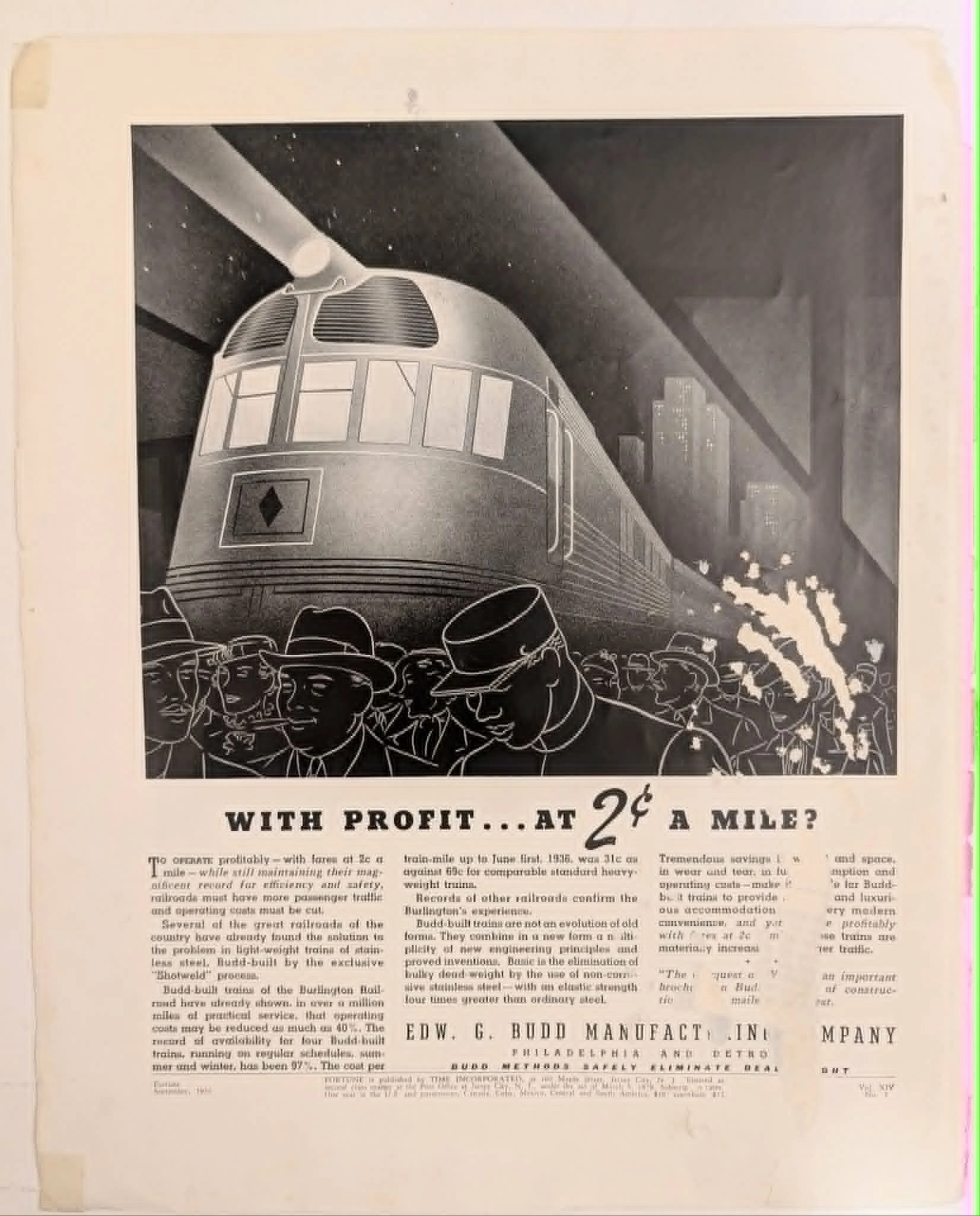
The year is 1936. America is trapped in the grip of the Great Depression. The railroads, once the absolute monarchs of American infrastructure, are bleeding cash. Heavy, coal-fired steam locomotives pull massive steel cars across the continent. They are majestic, but they are economically unsustainable. The public is fleeing to the cheap flexibility of the automobile and the newly emerging interstate bus lines. Enter the Edward G. Budd Manufacturing Company. This artifact, an original advertisement from Fortune magazine in September 1936, documents a critical mutation in industrial design. It poses a radical economic challenge to the status quo: "WITH PROFIT... AT 2¢ A MILE?" It is not merely a sales pitch for a new train. It is an obituary for the Gilded Age of heavy rail, and a birth certificate for the modern era of lightweight, high-speed mass transit.
Category: Technology
The History
The Economic Abyss of 1930s Railroading To understand the significance of this artifact, one must first look at the financial ruins of the mid-1930s American railroad system. The stock market crash of 1929 had decimated passenger volumes. By 1933, passenger revenues across the United States had plummeted by nearly 50% compared to their 1920s peaks. The traditional strategy of the railroads was based on mass and momentum. Heavy Pullman cars, constructed of heavyweight carbon steel, required immense energy to move. A standard steam-powered passenger train could easily weigh over 1,000 tons, yet carry only a few hundred passengers. The operational cost per train-mile was staggering, often hovering around 69 cents. Charging passengers the standard ICC (Interstate Commerce Commission) rate of 2 to 3 cents per mile meant that unless a train was packed to maximum capacity, it ran at a net loss. The railroads were trapped in a vicious cycle: high operating costs forced high ticket prices, which drove passengers into the arms of competitors, leading to further revenue declines. The Stainless Steel Salvation and Shotweld Technology The Edward G. Budd Manufacturing Company of Philadelphia approached this crisis from an entirely different industrial lineage. Budd was not a traditional locomotive builder like Baldwin or American Locomotive Company (Alco). Budd’s expertise lay in automotive stamping and metallurgy. They understood sheet metal, structural efficiency, and above all, they understood stainless steel. The core technological breakthrough mentioned in the text of this advertisement is the exclusive "Shotweld" process. Standard welding techniques destroyed the metallurgical properties of stainless steel, rendering it brittle and susceptible to corrosion at the weld points. Edward G. Budd, along with his chief engineer Earl J. Ragsdale, invented a method of controlled electrical resistance welding. By precisely timing the electrical current—applying it for only a fraction of a second (a "shot")—they could fuse thin sheets of stainless steel without altering its crystalline structure or reducing its corrosion resistance. This metallurgical leap allowed Budd to construct trains using high-tensile stainless steel that possessed four times the elastic strength of ordinary structural steel. Because the material was inherently rust-proof, it did not require the heavy layers of protective paint used on carbon steel. More importantly, it allowed for incredibly thin-walled, monocoque structural designs. The train ceased to be a heavy chassis supporting a box; the entire body became a load-bearing, lightweight tube. The Burlington Zephyr Paradigm Shift The advertisement references the real-world performance data gathered up to June 1st, 1936. It notes that Budd-built trains for the Burlington Railroad (specifically the famous Pioneer Zephyr and its successors) had achieved over a million miles of practical service. The numbers provided in the copy represent an industrial triumph: Traditional Heavyweight Train Cost: Approximately 69 cents per train-mile. Budd Lightweight Stainless Steel Train Cost: 31 cents per train-mile. This was a cost reduction of over 55%. Suddenly, operating a train at a passenger fare of 2 cents a mile was no longer a recipe for bankruptcy; it was a highly profitable venture. Furthermore, the advertisement boasts a 97% availability record for these trains across both summer and winter conditions, proving that lightweight did not mean fragile. The Competitive Landscape: Budd vs. Pullman and ALCO The mid-1930s witnessed a fierce technological battle for the future of rail speed and efficiency. Budd’s primary competitor in the lightweight revolution was the Pullman-Standard Car Manufacturing Company, which favored aluminum alloys for its early streamliners, such as the Union Pacific's M-10000. While aluminum offered comparable weight savings, it lacked the immense tensile strength and crash-survivability of Budd’s shot-welded stainless steel. Simultaneously, the traditional steam locomotive manufacturers attempted to fight back by streamlining conventional steam engines, wrapping them in aerodynamic shrouds. However, these shrouded steam giants still suffered from high maintenance costs, track wear caused by heavy reciprocating parts, and low thermal efficiency. Budd's integration of lightweight stainless steel bodies with advanced internal combustion engines—primarily partnering with General Motors' Electro-Motive Corporation (EMC) for two-stroke diesel engines—created an integrated system that rendered steam-driven regional transit obsolete.
The Paper
As a physical object, this page from the September 1936 issue of Fortune magazine serves as a material witness to the era of its creation. Fortune, founded by Henry Luce in 1930, was famous for its uncompromising production values, meant to reflect the power of American industry even during the Depression. The illustration is executed using a high-density, oil-based carbon black ink. Under microscopic examination, the print exhibits the characteristic ink-pooling and rich tonal depth associated with sheet-fed gravure printing, a method Fortune utilized to give its illustrations an artistic, photographic quality. The text portions utilize sharp letterpress printing, evidenced by a slight debossing effect into the paper fiber, creating a tactile boundary around each character. Degradation and Textural Character The paper displays a beautiful, uniform patination. The edges show a shift toward a warm, cream-ivory hue, caused by the slow, natural oxidation of trace lignins within the wood pulp over a span of nine decades. The surface retains a smooth, semi-matte coated texture, which has protected the ink from significant fading or flaking. The specific localized burning or tearing visible on the right edge of the artifact tells a stories of survival—a remnant of handling, storage in non-climate-controlled environments, and the eventual rescue of the page from a discarded volume.
The Rarity
This artifact is classified under Class S (Significant Contextual Value). While pages from Fortune magazine are not entirely unique, individual advertisements of this caliber—representing a definitive pivot point in industrial technology—are increasingly scarce. Most copies of these magazines were broken down by collectors for the cover art or lost to wartime paper drives in the 1940s. The historical value of this specific piece rests in its complete preservation of the data-heavy copy. It records the precise operational costs ($0.31 vs. $0.69) that convinced the financial boards of American railroads to abandon steam and embrace the lightweight diesel age. It is a foundational document of American industrial design history.
Cite this article
- MLA
- Naodhinsuk, Ronin. “The Time Traveller's Dossier: Budd Rail - The 2¢ Revolution.” The Record Institute, 17 May 2026, https://therecord.institute/journal/the-time-travellers-dossier-budd-rail-the-2-revolution.
- APA
- Naodhinsuk, R. (2026, May 17). The Time Traveller's Dossier: Budd Rail - The 2¢ Revolution. The Record Institute. https://therecord.institute/journal/the-time-travellers-dossier-budd-rail-the-2-revolution
- CHICAGO
- Naodhinsuk, Ronin. 2026. “The Time Traveller's Dossier: Budd Rail - The 2¢ Revolution.” The Record Institute, May 17, 2026. https://therecord.institute/journal/the-time-travellers-dossier-budd-rail-the-2-revolution.