The Time Traveller's Dossier : Norge - Automating the Home Front — The Record Institute JournalThe Time Traveller's Dossier : Norge - Automating the Home Front — The Record Institute JournalThe Time Traveller's Dossier : Norge - Automating the Home Front — The Record Institute JournalThe Time Traveller's Dossier : Norge - Automating the Home Front — The Record Institute JournalThe Time Traveller's Dossier : Norge - Automating the Home Front — The Record Institute JournalThe Time Traveller's Dossier : Norge - Automating the Home Front — The Record Institute Journal
1 / 6

✦ 6 Photos — Click any image to view in high resolution

May 12, 2026

The Time Traveller's Dossier : Norge - Automating the Home Front

TechnologyBrand: Norge
Archive Views: 4

The History

The Epoch of Mechanism and Movement
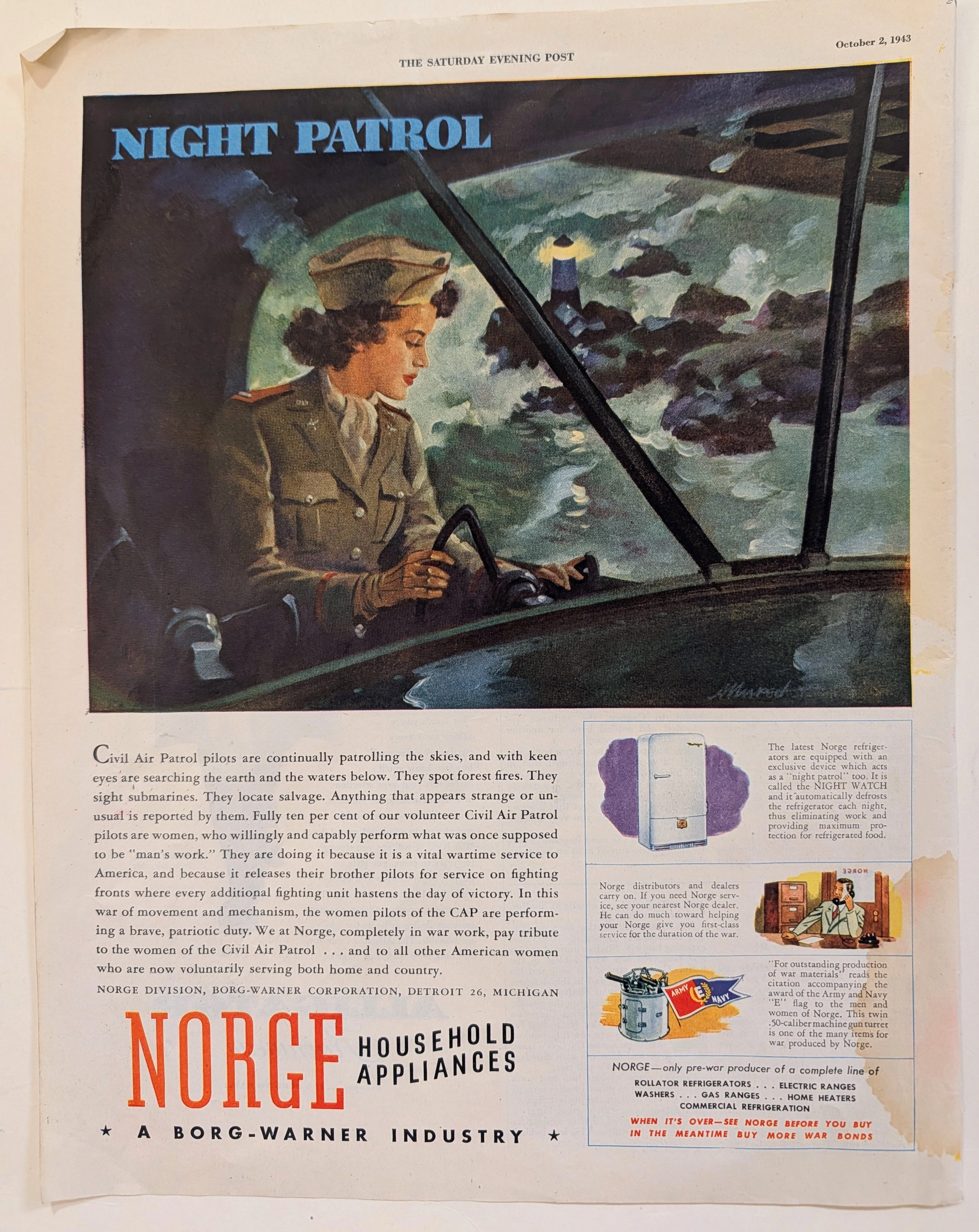
To observe this artifact is to observe an industrial society operating at the absolute, vibrating peak of mass mobilization. By the final quarter of 1943, the United States was entirely subsumed by what the advertising copy accurately describes as a "war of movement and mechanism". Every single kilowatt of electrical power, every metric ton of rolled steel, and every quantifiable minute of human labor had been converted into a critical strategic asset. The margins for domestic inefficiency had been violently erased by the realities of a multi-theater war.

The text of the advertisement explicitly references the Civil Air Patrol. It notes with statistical pride that "fully ten per cent of our volunteer Civil Air Patrol pilots are women". These individuals were not engaged in passive, supportive observation. They were actively searching the earth and coastal waters below in an official military capacity. The copy dictates: "They spot forest fires. They sight submarines".

This represents the defining, tectonic "Shift" of the era. The rigid, highly stratified gender roles that heavily defined the 1930s were dissolving rapidly under the immense thermal pressure of global conflict. Women were no longer merely keeping the domestic infrastructure intact; they were actively securing the national perimeter. The narrative of the human "Night Patrol" in the darkened skies was strategically deployed to contextualize and elevate the mechanical "Night Watch" in the illuminated kitchen.

Thermodynamics and Domestic Labor
In the early 1940s, mechanical refrigeration was established as a modern marvel, but it remained a highly unrefined, physically demanding manual process. The core mechanical issue was fundamental thermodynamics. As the compressor cooled the interior cabinet, ambient moisture from the air and the food condensed and froze directly onto the cooling coils. This frost acted as a highly effective thermal insulator, working entirely against the machine's primary function. As the ice layer thickened, the compressor—referred to by the Norge division as the "Rollator"—was forced into longer, hotter, and vastly less efficient cycles just to maintain safe internal temperatures.

Periodically, the human operator was required to intervene to save the machine. The appliance had to be physically powered down. The perishable food was removed and placed at high risk of spoilage on countertops. The ice was allowed to melt over several hours, and the resulting liquid was manually collected in drip trays and discarded. It was a chore of pure physical friction that demanded constant attention and stole valuable human time.

The Norge "Night Watch," visualized as a specialized mechanical dial on the pristine white cabinet, represented a significant leap forward in mechanical logic. It was an early, critical iteration of the automatic defrost timer. By claiming to "automatically defrost the refrigerator each night," Norge was offering a profound mechanical concession to the exhausted populace. They were attempting to permanently eliminate work while simultaneously providing "maximum protection for refrigerated food" through mathematically sustained thermal efficiency.

The Invention of the Autonomous Guardian
Competitors like Frigidaire, heavily backed by the engineering might of General Motors, and Kelvinator were also aggressively pursuing automated defrosting solutions during this epoch. However, Norge’s specific, poetic branding of this feature is what elevates this artifact's historical vitality. They did not market a simple electrical timer. They marketed a "Night Patrol".

This was a highly calculated act of psychological engineering. It reframed a simple, unthinking mechanical switch into a sentient, watchful guardian. It proposed a silent, vigilant entity tasked with protecting the household's vulnerable, tightly rationed food supplies while the human occupants slept.

This marks a definitive threshold in the history of consumer technology. Before this shift, a home was essentially a collection of passive machines that required constant, active human intervention and physical supervision to function safely. Post-1943, through campaigns exactly like this one, we observe the deliberate genesis of the "set it and forget it" paradigm. The "Night Watch" was the direct conceptual ancestor of the modern smart home. It was an initial, highly successful attempt to bestow an appliance with its own rudimentary intelligence and operational vigilance, entirely decoupled from human oversight.

Economic Paradox: Selling Abstinence
At the bottom right quadrant of the artifact, there exists a sobering, stark indicator of wartime economics. The text commands the reader: "WHEN IT'S OVER—SEE NORGE BEFORE YOU BUY... IN THE MEANTIME BUY MORE WAR BONDS".

Norge, operating as a heavy industrial division of the Borg-Warner Corporation out of Detroit, Michigan, was no longer manufacturing refrigerators for the civilian market. Their massive, sprawling industrial capacity had been entirely repurposed by government mandate. They were exclusively engaged in the production of "war materials," which specifically included ".50-caliber machine gun turrets" as noted with pride in the smaller inset graphic featuring the prestigious Army-Navy "E" Award flag.

This creates a fascinating, almost surreal marketing paradox. Norge was spending vast amounts of corporate capital to advertise a consumer product that was legally impossible for the public to purchase. Their objective was not immediate sales conversion, but long-term brand preservation. They were securing vital mental real estate for the highly anticipated post-war economic boom. The advertisement is a calculated investment in future desire, subsidized by the grim reality of current, mandatory civilian sacrifice.

The Societal Reconfiguration of Duty
The text weaves a complex, somewhat contradictory tapestry of duty. It loudly positions the work of the female CAP pilot as a "vital wartime service to America". Furthermore, it attempts to justify her bold presence in the cockpit by stating her service "releases their brother pilots for service on fighting fronts".

This framing is highly specific to the sociological confines of the 1940s. Female empowerment and capability are acknowledged and visually celebrated with striking artwork, but it is textually anchored to the ultimate benefit of the male combatant. The machine in the kitchen releases the woman from domestic labor; the woman in the sky releases the man for kinetic warfare. It is a perfect, unbroken chain of delegated responsibility, engineered by Borg-Warner and implicitly sanctioned by the state.

The Enduring Philosophical Shift
The philosophical implication thoroughly documented here is profound, structural, and entirely irreversible. As the machine becomes increasingly watchful, the human operator is permitted to become increasingly detached from the basic mechanics of survival. By liberating the woman pilot from both the previously designated "man's work" of dangerous aerial reconnaissance and the "woman's work" of thermal kitchen management, technology initiated its long, unbroken project to erase the friction of daily human existence.

This artifact serves as hard proof that the modern concept of "automation" was not initially sold to the public purely as a postwar luxury. It was initially introduced and sold as a vital, morally necessary component of national defense and human endurance.

The Paper

The physical specimen functions as a highly objective, tactile record of time.

The primary substrate is likely a 60 to 70 GSM semi-gloss paper stock. This was the mandated standard issue for mass-market publications during the strict material rationing years of the Second World War. Due to harsh wartime pulp quotas, the structural quality of commercial paper was often compromised, utilizing higher acid content. Yet, this specific piece retains a remarkable degree of tensile integrity.

Upon close microscopic inspection of the pilot illustration, the mechanical reproduction technique is starkly evident. The characteristic four-color rotogravure or high-speed offset lithography patterns are clearly discernible. The CMYK "rosettes"—the microscopic, overlapping halftone dots that combine to create the optical illusion of continuous tone—form a structural, mathematical honeycomb of history.

The natural aging process has not destroyed the artifact; it has authenticated it. The margins exhibit a warm, deep patina, which is the inevitable chemical result of lignin oxidation within the wood pulp reacting with ultraviolet light over eighty years. Looking closely at the aged paper texture, one can trace the physical scars of time. The slight foxing marks and the gentle, organic creases at the borders confirm this paper is a survivor. It is not merely a representation of history; it is the physical materialization of that exact moment.

The Rarity

Classification: Class S (Superior Historical Pivot)

Within the strict taxonomy of historical archives, this specific artifact is definitively designated as Class S. While individual, random issues of mid-century magazines were printed in the millions and generally possess a relatively low intrinsic financial market value, this specific Norge "Night Patrol" advertisement holds exceptional contextual density.

It achieves this elite classification due to its perfect, seamless synchronization of state-sanctioned wartime propaganda and the very first introductions of autonomous consumer technology. It is a "High-Context" relic. It does not simply attempt to sell a localized product; it successfully encapsulates a macro-level worldview where the domestic theater and the military theater are mechanically, socially, and philosophically fused into one continuous narrative.
Visual Impact

The visual composition is a masterclass in cinematic lighting, psychological direction, and rigid narrative hierarchy.

The primary subject, the female Civil Air Patrol pilot, is firmly positioned in the role of the ultimate, unwavering observer. Her gaze is angled sharply downward, focused intently on the unseen mechanical controls of her aircraft and the dark, turbulent waters of the coast below. This human vigilance perfectly mirrors the mechanical "Night Watch" device's internal, hidden focus on the frost within the refrigerator. Both entities are engaged in the unending act of patrolling the unseen.

The execution relies heavily on a distinct flat illustration style, preserving a masterful hand-drawn stroke quality that defines the golden era of mid-century commercial art. The dominant color palette is constructed of heavy, saturated tones: "Midnight Blue," "Storm Green," and deep charcoal shadows. These colors engineer a visceral sense of isolation, danger, and solemn duty. This heavy atmospheric tension is sharply and deliberately interrupted by the warm, glowing "Safety Orange" emanating from the lighthouse in the background. The lighthouse serves as a secondary, universally understood symbol of unwavering vigilance. Looking at the composition, one can almost sense the era-appropriate background atmosphere—a crackling radio reporting war news over the drone of a radial engine.

In the primary layout, the grand, sweeping illustration of the pilot completely dominates the visual hierarchy, purposely dwarfing the actual product. The sterile, white Norge refrigerator is relegated to a small, isolated quadrant in the lower right. By visually minimizing the appliance, the agency brilliantly associates the refrigerator with the vast, heroic undertaking of the war effort, successfully elevating a mundane kitchen tool to the revered status of war-adjacent technology.

Share This Archive

The Archive Continues

Continue the Exploration

The Time Traveller’s Dossier: 1980 Imperial Treasury Golden Reliquary Vintage Advertisement — The Weight of Divine Right

The Time Traveller’s Dossier: 1980 Imperial Treasury Golden Reliquary Vintage Advertisement — The Weight of Divine Right

Explore the meticulous craftsmanship captured in this 1980 Imperial Treasury Golden Reliquary vintage advertisement, a stunning testament to both medieval goldsmithing and late 20th-century print reproduction. Among vintage ads, pieces that successfully bridge the gap between historical artifact and commercial art hold a unique, exalted position in curatorial archives. This comprehensive dossier examines the exquisite details of the reliquary’s goldwork, the prominent step-cut emeralds, and the intricate enamel eagle, all rendered through the distinct halftone dot matrix characteristic of classic print ads from the era. By analyzing the deep visual chiaroscuro and the material preservation of this specific lithograph, we uncover why old advertisements featuring such opulent antiquities remain highly sought after by archivists, art historians, and dedicated collectors alike. It is not merely a promotional print; it is a paper-bound exhibition of divine right, royal heritage, and institutional prestige, perfectly preserved in the annals of print history and curatorial excellence.

The Time Traveller’s Dossier: 1983 Delco-GM/Bose Music System Vintage Advertisement — The Anthropomorphic Architecture of Sound

Bose · Automotive

The Time Traveller’s Dossier: 1983 Delco-GM/Bose Music System Vintage Advertisement — The Anthropomorphic Architecture of Sound

Within the expansive, carefully curated archive of vintage ads, the 1983 Delco-GM/Bose Music System vintage advertisement stands as a profound testament to the intersection of automotive engineering and early psychoacoustics. This executive dossier examines a pivotal moment in consumer technology marketing, highlighted by the enigmatic figure of "Morgan," an acoustic computer brain developed at M.I.T. As a cornerstone among old advertisements, this piece transcends mere commercial promotion; it offers a fascinating, tactile glimpse into algorithmic audio design before the digital era fully matured. Collectors, audiophiles, and historians of classic print ads will recognize the profound cultural shift this campaign represents: the definitive transition from basic, aftermarket car radios to custom-tuned, acoustically mapped vehicular auditoriums. By merging General Motors' formidable industrial might with Bose's avant-garde acoustic science, this document captures a true revolution in high-fidelity sound. Explore the physical preservation, deep historical context, and striking visual rhetoric of an artifact that permanently altered how society perceives the driving experience, turning the automobile interior into a meticulously calculated chamber of sonic perfection.

THE TIME TRAVELER'S DOSSIER: THE AUTOMOTIVE ARISTOCRACY AND THE AESTHETICS OF RUIN

THE TIME TRAVELER'S DOSSIER: THE AUTOMOTIVE ARISTOCRACY AND THE AESTHETICS OF RUIN

The artifact under rigorous, museum-grade analysis is an exceptionally preserved Historical Relic originating from the golden age of American automotive supremacy. Sourced from a vintage issue of The Saturday Evening Post, this Primary Art Document features a commanding, full-page advertisement for Packard, one of the most prestigious luxury automobile manufacturers in world history. Visually dominated by a striking, head-on illustration of a New Series Packard, the piece explicitly highlights the legendary corporate slogan: "Ask the man who owns one". Published during the turbulent economic landscape of the early 1930s Great Depression, this advertisement is a profound sociological marker. It boldly markets uncompromising luxury—boasting features like a four-speed synchro-mesh transmission and "Ride Control" shock absorbers—to an elite aristocracy largely insulated from the era's financial collapse. Physically, this pre-2000s analog artifact is a breathtaking embodiment of wabi-sabi. It exhibits a violently torn left binding edge, significant moisture blooming along the bottom margin, and deep amber lignin oxidation. This natural chemical and environmental degradation transforms a mass-produced commercial print into an irreplaceable, ready-to-frame Primary Art Document, forever capturing the magnificent mortality of the analog age.

Published by

The Record Institute

Taxonomy Match

Related Articles

The Time Traveller's Dossier: Tools of the Void - Engineering Against Newton's Third Law — related article
Read Article

The Time Traveller's Dossier: Tools of the Void - Engineering Against Newton's Third Law

When we look back at the golden age of the Apollo and Gemini programs, we often fixate on the massive Saturn V rockets, the explosive launches, and the triumph of the lunar landings. We rarely think about the mundane act of turning a wrench. Yet, in the brutal, frictionless vacuum of space, the most basic acts of manual labor become lethal puzzles. This collection of highly specialized tool photographs is not just a catalogue of vintage hardware. It is a visual record of humanity realizing that the fundamental mechanics of Earth do not apply in orbit. In microgravity, without friction to anchor your boots to the floor, Sir Isaac Newton’s Third Law (F A ​ =−F B ​ , for every action, there is an equal and opposite reaction) transforms a simple mechanic's wrench into a centrifuge. This dossier dissects a fascinating, mid-1960s print artifact detailing the "Zero Reaction" toolset. These tools were engineered specifically to allow astronauts to build, repair, and survive in the void without spinning uncontrollably into the abyss. It is a masterclass in aerospace engineering, ergonomic survival design, and the aesthetics of the Space Race.

The Time Traveller's Dossier : WWII War Bonds - Corporate Conscription — related article
Read Article

The Time Traveller's Dossier : WWII War Bonds - Corporate Conscription

A nation does not wage war with steel alone. It wages war with capital. It fights with belief. Before 1941, the American consumer was a creature of comfort, trained by an emerging advertising industry to desire soda, automobiles, and modern conveniences. Then came the sudden violence of global conflict. The factories pivoted. The supply chains froze. The consumer economy ground to a sudden, devastating halt. Yet, the advertising machinery did not sleep. It was conscripted. The artifacts presented here—fragments of print from 1943, embedded within the commercial messaging of companies like The Seven-Up Co. and Autocar Trucks—represent a monumental shift in human behavior. This was the moment the public was asked to purchase the future instead of the present. The strategy was unprecedented. Convert the civilian into a shareholder of the state. Transform the act of saving into the ultimate act of aggression against an unseen enemy. This is not merely a collection of vintage advertisements. It is the exact inflection point where corporate marketing was weaponized for national survival.

The Time Traveller's Dossier : Ansco Color Ad - WWII Delayed Gratification — related article
Read Article

The Time Traveller's Dossier : Ansco Color Ad - WWII Delayed Gratification

The world was entirely grey. Or so the civilian population was led to believe. Before this artifact, color photography existed as a delicate novelty. A fragile, complex luxury reserved for controlled environments. Then came the mechanized velocity of a global war. This advertisement represents a precise sociological pivot. It openly acknowledges a stark present reality: the total militarization of emerging technology. Simultaneously, it sells a calculated future promise: the inevitable democratization of color. The immediate problem was total resource scarcity. Every frame of manufactured film was drafted into federal service. The proposed solution was societal patience. A collective civilian sacrifice, traded for the eventual, post-war delivery of a hyper-vivid, color-accurate reality.

The Time Traveller's Dossier : Nash-Kelvinator - Weapons Above the Battlefield and a Blood-Stained Promise — related article
Read Article

The Time Traveller's Dossier : Nash-Kelvinator - Weapons Above the Battlefield and a Blood-Stained Promise

Before this specific artifact was pulled from the printing press. The American assembly line was the ultimate, undisputed symbol of domestic prosperity and peacetime innovation. Vast, sprawling factories across the United States produced gleaming automobiles for family road trips and humming refrigerators to preserve food in the modern, electrified kitchen. But then, the devastating attack on Pearl Harbor and the subsequent, all-consuming inferno of the Second World War brought that domestic utopia to a violently abrupt halt. The assembly lines for civilian goods were completely, unconditionally suspended by federal mandate. Then, the greatest, most rapid industrial metamorphosis in human history occurred. America transitioned almost overnight into the "Arsenal of Democracy." The Nash-Kelvinator Corporation, a massive industrial conglomerate renowned for producing top-tier automobiles and household refrigerators, was forced to entirely abandon its consumer goods. Instead, they pivoted their massive manufacturing capabilities to produce the raw, beating hearts of aerial behemoths: the 2,000-horsepower Pratt & Whitney supercharged engines destined for the legendary Vought F4U Corsair fighter plane. This advertisement was not printed to "sell" a product to the reader, because the company literally had no products left for the civilian market to buy. Rather, it was meticulously engineered to sell an "ideology," a "justification," and a profound "hope." It is the stark, jarring integration of the brutal, unvarnished violence of aerial combat against the Axis powers, intricately woven into the idealized, suburban dream of a brand-new car and a pristine refrigerator. This is a promise forged in blood: We will build the terrifying weapons necessary to secure victory today, so that we may return to building the prosperous, consumer-driven America you deserve... on the glorious day our brave boys finally come home.

The Time Traveller's Dossier: The Architect of the Great Society – Lyndon B. Johnson — related article
Read Article

The Time Traveller's Dossier: The Architect of the Great Society – Lyndon B. Johnson

The presidency of the United States during the mid-twentieth century was an office defined by epochal challenges, sweeping domestic transformations, and the profound weight of global leadership. The historical artifact elegantly and securely positioned upon the analytical table of The Record Institute today is a majestic, large-format political lithograph portraying Lyndon Baines Johnson, the 36th President of the United States. Originating from the transformative core of the 1960s, this document completely transcends the traditional boundaries of political memorabilia. It operates as a highly sophisticated, multi-layered cultural and historical mirror, reflecting the exact moment when unparalleled legislative ambition intersected with the intricate realities of the geopolitical landscape on a single printed page. This world-class, comprehensive dossier conducts a meticulous, profound, and historically objective examination of the artifact, operating under the absolute most rigorous parameters of sociological and material science evaluation. We will decode the brilliant iconographic strategy embedded within this portrait, analyze the legendary political machinery of a statesman who mastered the United States Senate, and dissect the rich, aspirational semiotics surrounding the Great Society initiatives alongside the challenging context of the Cold War era. Furthermore, as we venture deeply into the chemical and physical foundations of this analog printed ephemera, we will reveal the precise mechanical fingerprints of the CMYK halftone rosettes and the graceful, natural oxidation of the paper substrate. This precise intersection of visual nostalgia, mid-century commercial artistry, and the immutable chemistry of time cultivates a serene wabi-sabi aesthetic—a natural, irreversible phenomenon that serves as the primary engine driving up its market value exponentially within the elite global spheres of Vintage Political Ephemera and Presidential Archives collecting.

The Time Traveller's Dossier: Coca-Cola 1944 - The Weaponization of Morale — related article
Read Article

The Time Traveller's Dossier: Coca-Cola 1944 - The Weaponization of Morale

Then, sugar and carbonated water were not merely ingredients for a domestic treat; they were classified as essential psychological logistics for a global war. Now, a soda is just a soda. The problem for the United States military in 1944 was not just arming its young men with rifles and artillery; it was the monumental task of maintaining the human spirit under the soul-crushing weight of total war. The boys being trained in the muggy, moss-draped camps of the American South were destined for the meat grinders of Europe and the Pacific. They needed a tether to the homes they were leaving behind. The solution, brilliantly engineered and ruthlessly promoted by The Coca-Cola Company, was the weaponization of nostalgia. This artifact is a portal. It transports us to a sweltering training camp in 1944. It documents the exact historical moment when a private beverage corporation successfully intertwined its product with the very fabric of American patriotism, military logistics, and the linguistic evolution of its own brand identity.