THE RECORD · ARCHIVE PLAYER
MP4
■ PAUSED
1940s Spud Imperials Menthol Cigarettes Vintage AdvertisementANALOG ARCHIVE
1940s Spud Imperials Menthol Cigarettes Vintage Advertisement (1940) — Class A vintage Lifestyle & Vice
CLASS A
1 of 7

1940s Spud Imperials Menthol Cigarettes Vintage Advertisement

Category|Lifestyle & Vice
Subcategory|Tobacco
Year|1940
Rarity Class|CLASS A
Archive Views|54

Last updated: 13 May 2026

Historical Context

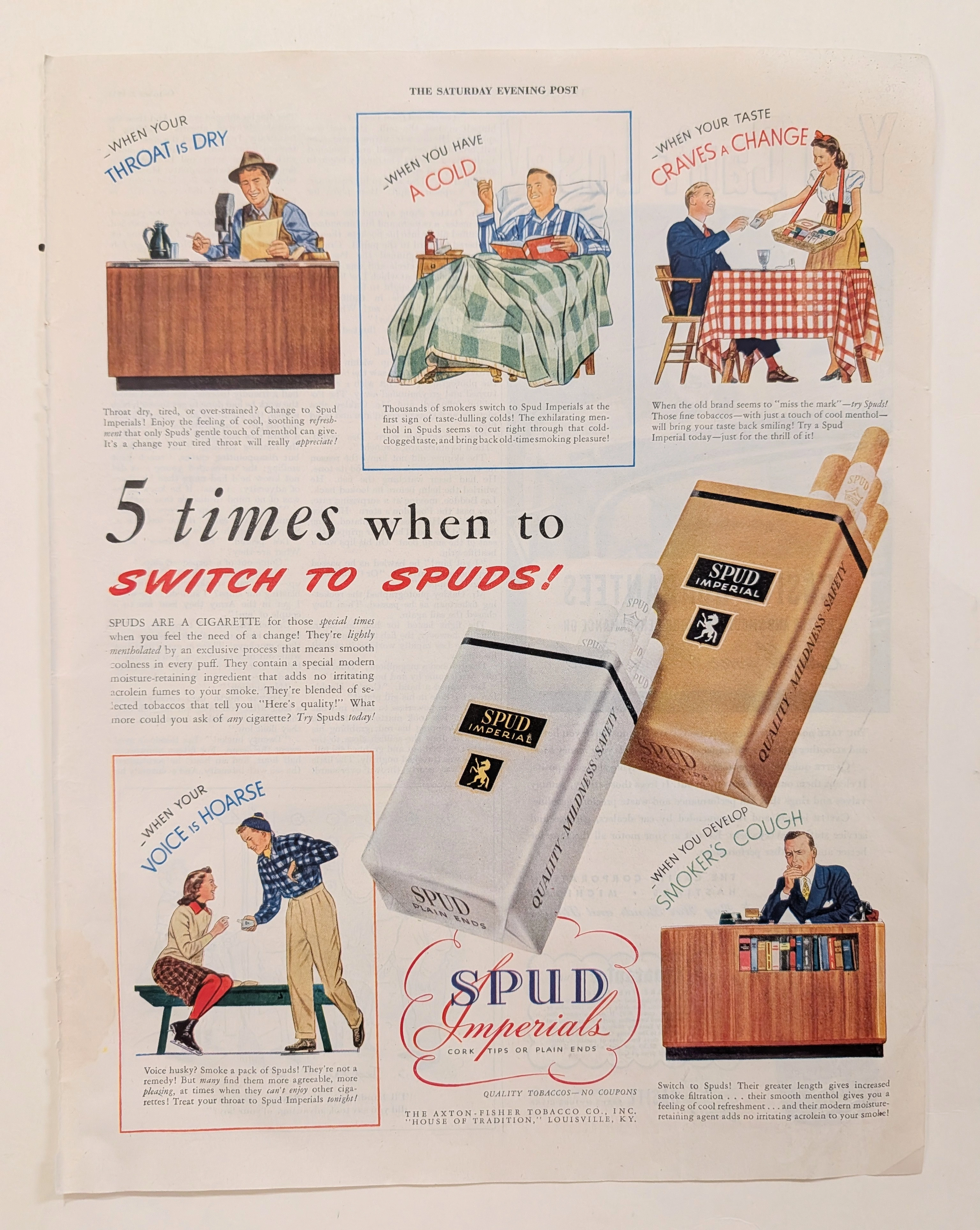
1940s Spud Imperials "5 Times When to Switch" Vintage Advertisement Spud holds a unique place in commercial history as the first successfully mass-marketed menthol cigarette in the United States, originally patented by Lloyd "Spud" Hughes in the 1920s and later acquired by the Axton-Fisher Tobacco Company. By the late 1930s and early 1940s, when this advertisement was published, the novelty of menthol was being aggressively marketed not merely as a flavor, but as a therapeutic agent. This campaign highlights five specific scenarios to "Switch to Spuds," including when suffering from a cold, a dry throat, a hoarse voice, or—most paradoxically to modern sensibilities—when developing a "smoker's cough." The ad represents the zenith of mid-century tobacco "health-washing." Before definitive medical consensus linked smoking to severe health crises, tobacco companies frequently employed pseudo-medical terminology to differentiate their brands. Spud claims its product contains a "special modern moisture-retaining ingredient" (eschewing "irritating acrolein") and emphasizes that the "greater length" of the Imperial size "gives increased smoke filtration." The cooling sensation of menthol masked the harshness of the smoke, allowing advertisers to frame it as "cool, soothing refreshment." The five beautifully illustrated vignettes capture distinct slices of mid-century Americana—the radio broadcaster, the ice-skating couple, the businessman—normalizing the presence of cigarettes in every facet of daily life, even during illness.

Paper & Print Condition

This artifact is printed on standard uncoated magazine stock, typical of mid-century mass-circulation periodicals like The Saturday Evening Post. The advertisement showcases high-quality four-color (CMYK) offset lithography. Archival inspection reveals crisp halftone rosettes, particularly effective in rendering the nuanced shading of the illustrative vignettes and the bright, eye-catching primary colors of the typography and packaging. The ink registration is precise, allowing the intricate serif fonts and script logos to remain highly legible. The paper exhibits a mild, uniform natural toning (oxidation) consistent with its age, but lacks severe creasing, moisture damage, or disruptive foxing.

Provenance & Rarity

Extracted from The Saturday Evening Post, this piece represents the pinnacle of American mass-media advertising during the mid-20th century. While the magazine itself was printed in the millions, preserving individual pages in museum-exhibition quality is uncommon due to the ephemeral nature of highly acidic newsprint-grade paper. Advertisements specifically related to tobacco health claims from this era are highly sought after by sociological researchers and historians.

Rarity & Condition Summary

Rarity Classification: Class A (Rare / Highly Collectible) This artifact is an exceptionally well-preserved primary document of a contentious era in advertising history. Earning a Class A rating, it survives not merely as an ad, but as a sociological time capsule showcasing the audacious "health-washing" tactics used by the tobacco industry prior to modern regulations. Its vibrant, intact color lithography and lack of severe degradation make it an invaluable resource for archivists and medical historians studying mid-century consumer deception and graphic design.

Share This Archive

From the Journal

Related Articles

The Time Traveller's Dossier : 1968 Zippo - The Enduring Flame — related article
Read Article

The Time Traveller's Dossier : 1968 Zippo - The Enduring Flame

The year is 1968. The world is characterized by profound volatility. Societies fracture. Wars escalate. Economies shift toward the disposable. Amidst this era of impermanence, an artifact is presented. It is not complex. It is not digital. It is mechanical, primitive, and entirely absolute. Then, a lighter was merely a tool for combustion. Now, through the lens of this document, we recognize it as a sociological anchor. This advertisement documents a critical industrial shift: the deliberate rejection of planned obsolescence. It highlights a manufacturer promising an eternal relationship with the consumer. "It works or we fix it free." It is the proposition of permanence in a temporary world. The flame is secondary. The true product being sold is reliability.

The Time Traveller’s Dossier: 1978 Camel Lights Vintage Advertisement — The Golden Illusion of Diminished Harm — related article
Read Article

The Time Traveller’s Dossier: 1978 Camel Lights Vintage Advertisement — The Golden Illusion of Diminished Harm

This archival dossier provides a comprehensive examination of the 1978 Camel Lights vintage advertisement, a defining artifact from an era when the global tobacco industry fiercely pivoted toward "low tar" alternatives in response to escalating public health mandates. As medical consensus shifted consumer habits in the late twentieth century, R.J. Reynolds introduced Camel Lights as "the solution" to the purported low tar and low taste dilemma. This document stands as a masterful exemplar of classic print ads, leveraging high-contrast macro photography and rugged, masculine aesthetics to retain fierce brand loyalty while navigating an increasingly regulated landscape. For archivists, cultural historians, and collectors of vintage ads and old advertisements, this artifact offers profound insight into the psychological marketing tactics of the 1970s. The visual centerpiece—a glowing golden camel illuminated by a struck match—demonstrates exceptional commercial print execution and art direction, cementing its status as a vital cultural document within the broader taxonomy of commercial advertising history.

The Time Traveller's Dossier : 1943 Kaywoodie Pipes Vintage Ad | WWII Briar History — related article
Read Article

The Time Traveller's Dossier : 1943 Kaywoodie Pipes Vintage Ad | WWII Briar History

Then, a smoking pipe was an extension of a man's persona—a tool for quiet reflection, a marker of sophistication, and a comforting, tactile ritual amidst the anxieties of a world at war. Now, it is largely an anachronism, a niche hobby relegated to the fringes of modern tobacco consumption. The problem for pipe manufacturers in 1943 was not a lack of demand, but a catastrophic lack of supply. The global conflict of World War II had completely severed the United States from the Mediterranean—the geographic heartland of the world's finest briar wood. To own a high-quality pipe during this era was to hold a piece of inaccessible European soil in your hand. The solution, proudly touted by the Kaywoodie Company, was the weaponization of foresight. They had stockpiled the good stuff. This artifact is a portal. It transports us to the American home front in 1943. It documents exactly how a luxury brand leveraged its pre-war inventory to signify ultimate status, seamlessly blending high-end consumerism with the stark, unavoidable realities of the wartime economy.

Viceroy: Al Unser and the "Taste of Excitement" — related article
Read Article

Viceroy: Al Unser and the "Taste of Excitement"

A legendary artifact linking Al Unser's racing dominance to the golden age of tobacco advertising, a style now permanently banned. The value of this original page will appreciate significantly as pre-2000 analog media naturally decays and vanishes forever.