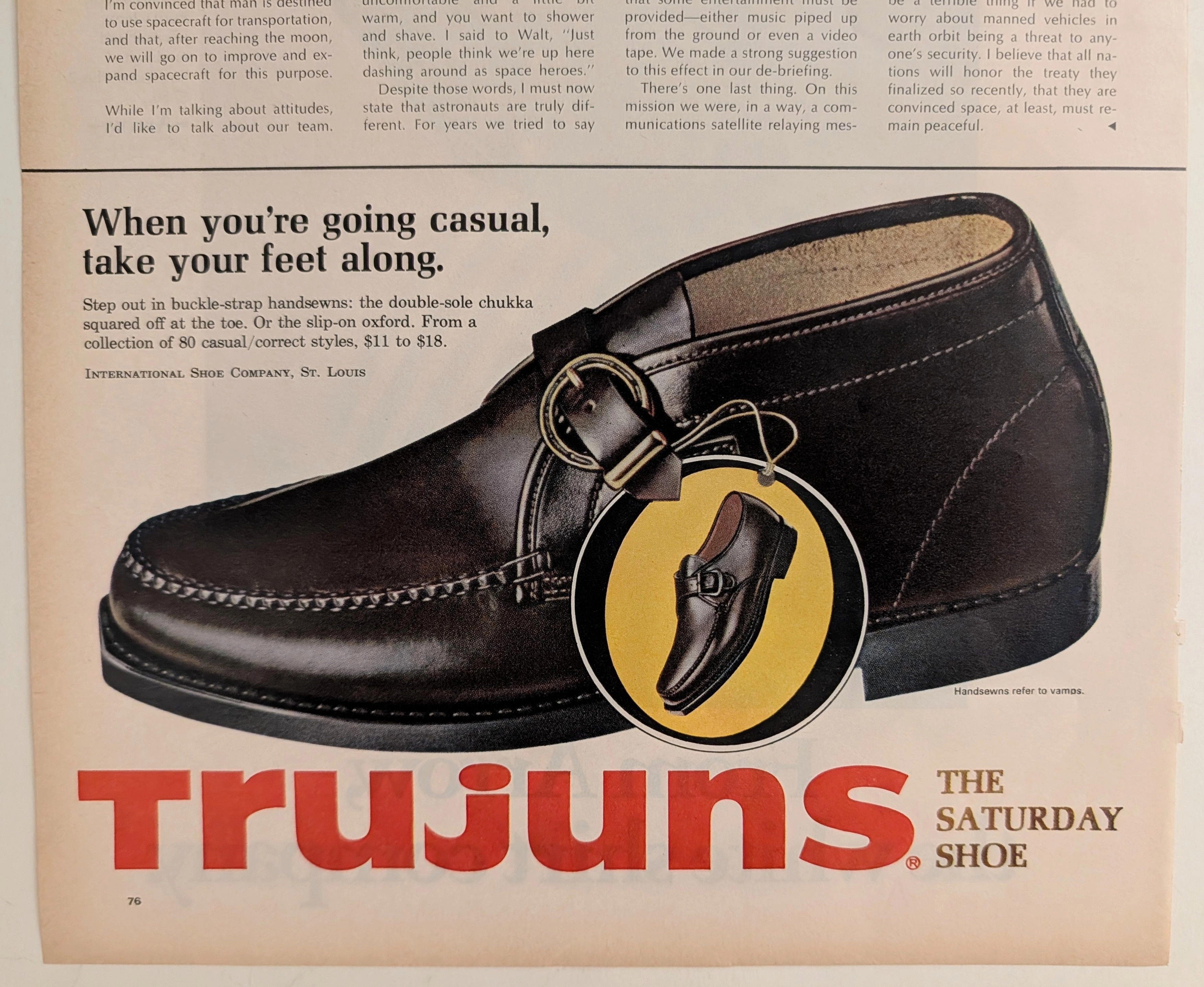
1960s Trujuns "The Saturday Shoe" Vintage Advertisement
Last updated: 15 May 2026
Historical Context
Paper & Print Condition
Provenance & Rarity
Rarity & Condition Summary
Related Archives from the Collection
Related by Classification

1981 HipOppoTamus "Hop" Leather Shoe Vintage Advertisement

1943 Mallory Hats "The Ranger" Vintage Advertisement

1957 Arrow "Air-Conditioned" Colorama & Coolerama Vintage Advertisement

1970 Fruit of the Loom Men's Underwear & Shirts Vintage Advertisement

1981 Red Wings Pecos Western Work Boots Vintage Advertisement

1970 Admiral Playmate 14" Color Portable TV Vintage Advertisement
Related Articles

The Time Traveller's Dossier: Terrestrial Navigation – The Timberland Boat Shoe and the Evolution of Amphibious Footwear
The evolution of twentieth-century American apparel is deeply intertwined with the adaptation of specialized, utilitarian gear for mainstream, terrestrial use. The historical artifact elegantly positioned upon the analytical table of The Record Institute today is a visually detailed and highly informative full-page print advertisement for The Timberland Boat Shoe. This document gracefully transcends the standard boundaries of footwear marketing. It operates as a highly sophisticated, multi-layered cultural mirror, reflecting a precise era in consumer sociology where the American public began integrating specialized sporting garments into their daily wardrobes. By utilizing a methodical, point-by-point comparative analysis against the established market leader, Sperry Topsider, The Timberland Company presented a scholarly and persuasive argument for superior material construction. This comprehensive dossier conducts a meticulous, nuanced, and exceptionally detailed examination of the artifact, operating under the most rigorous parameters of historical, sociological, and material science evaluation. Dedicating the overwhelming majority of our analytical focus (80%) to its immense historical gravity, we will decode the thoughtful marketing psychology embedded within the "land and sea" narrative, analyze the profound engineering differences highlighted in the construction of the shoe, and explore the sociological shift of maritime fashion into the suburban environment. Furthermore, as we venture deeply into the chemical and physical foundations of this analog printed ephemera (10%), we will reveal the precise mechanical fingerprints of the CMYK halftone rosettes captured in the macro imagery of the embossed leather. Finally, we will assess its archival rarity (10%), exploring how the graceful, natural oxidation of the paper substrate cultivates a serene wabi-sabi aesthetic—a natural, irreversible phenomenon that serves as the primary engine increasing its market value exponentially within the elite global spheres of Vintage Commercial Ephemera and Fashion Archives.

The Time Traveller's Dossier: The Aesthetics of Gifting and Consumer Hypnosis – Skyway Luggage Advertisement (Circa 1950s)
The history of commercial marketing is rarely driven by cold, rational logic; it is forged, molded, and dictated through the weaponization of emotion, manufactured desire, and the carefully engineered magic of the holiday season. Long before digital algorithms were deployed to predict and manipulate our purchasing behaviors, social engineering and consumer psychology were executed with devastating precision through the tip of a master illustrator’s brush on the pages of glossy magazines. The historical artifact standing before us is not merely a run-of-the-mill mid-century holiday campaign for a luggage brand. It is an absolute visual "Trojan Horse"—one of the most cunningly designed blueprints ever utilized to bypass the consumer's psychological defenses. It serves as an unwavering testament to an era when the stark, industrial rigidity of manufactured goods was brilliantly concealed beneath the irresistible wrapping paper of festive innocence. This museum-grade academic archival dossier presents an exhaustive, uncompromising deconstruction of a late-analog print advertisement from Skyway Luggage. Operating on a ruthlessly calculated, gender-segregated binary narrative structure, this campaign captures a critical paradigm shift: the exact historical moment when luggage transcended its utilitarian status as a mere "storage box" and was conceptually elevated into a highly coveted "dream Christmas gift." Through the highly specialized lens of mid-century commercial artistry and stringent visual forensics, this document serves as a masterclass in the psychological marketing of manufactured desire. It established the foundational archetype for the holiday retail economy—an archetype that unconditionally dictates the global lifestyle merchandising strategies of today.

The Time Traveller's Dossier : 1960s Youthquake - The Weaponization of Nostalgia
Then, beauty was a linear progression toward mature elegance. Now, it is a cyclical, ironic rebellion dictated by the young. The era is the late 1960s. The artifact is a two-page magazine editorial spread. Before this moment, a young woman aspired to look like her mother. She adopted the symbols of adulthood as a rite of passage. Here, we witness the industrial fracturing of the generational continuum. The teenager explicitly rejects the mother. The establishment beauty industry, desperate to survive, pivots to serve the teenager. This document does not merely sell crimson lipstick or a seventy-dollar minismock. It sells the psychological usurpation of the past by the youth. The problem of the late 1960s commercial sector was capturing a demographic that actively despised the establishment. The solution, printed here in stark white and shocking red, was to package history as subversive, pop-art camp, excluding the adults who actually lived it.

The Time Traveller's Dossier: The Sartorial Armor of Terence Stamp – A Foster Grant Exhibition
The metamorphosis of sunglasses from a purely utilitarian device designed to protect the human cornea into a profound instrument of psychological transformation and sartorial armor is one of the most fascinating narratives in the history of modern fashion. The historical artifact elegantly and securely positioned upon the analytical table of The Record Institute today is a majestic, large-format print advertisement for Foster Grant Sunglasses, featuring the internationally renowned British actor Terence Stamp, originating from approximately 1968. This document completely transcends the traditional boundaries of optical equipment marketing. It operates as a highly sophisticated, multi-layered cultural mirror, reflecting the exact moment when celebrity mystique, mass-market manufacturing, and the volatile sociopolitical crosscurrents of the late 1960s converged on a single printed page. This world-class, comprehensive dossier conducts a meticulous, unyielding, and exceptionally deep examination of the artifact, operating under the absolute most rigorous parameters of historical, sociological, and material science evaluation. We will decode the brilliant advertising strategy that successfully elevated injection-molded plastics to the realm of high fashion, analyze the complex biographical and cultural significance of Terence Stamp as the chosen emissary of this campaign, and dissect the rich, era-defining semiotics embedded within the six distinct personas he portrays. Furthermore, as we venture deeply into the chemical and physical foundations of this analog printed ephemera, we will reveal the precise mechanical fingerprints of the CMYK halftone rosettes and the graceful, natural oxidation of the paper substrate. This precise intersection of visual nostalgia, mid-century commercial artistry, and the immutable chemistry of time cultivates a serene wabi-sabi aesthetic—a natural, irreversible phenomenon that serves as the primary engine driving up its market value exponentially within the elite global spheres of Vintage Fashion Ephemera and Cinematic Memorabilia collecting.