The Time Traveller's Dossier : 1916 Willys-Overland - The Democratization of Leisure — The Record Institute JournalThe Time Traveller's Dossier : 1916 Willys-Overland - The Democratization of Leisure — The Record Institute JournalThe Time Traveller's Dossier : 1916 Willys-Overland - The Democratization of Leisure — The Record Institute JournalThe Time Traveller's Dossier : 1916 Willys-Overland - The Democratization of Leisure — The Record Institute JournalThe Time Traveller's Dossier : 1916 Willys-Overland - The Democratization of Leisure — The Record Institute Journal
1 / 5

✦ 5 Photos — Click any image to view in high resolution

May 11, 2026

The Time Traveller's Dossier : 1916 Willys-Overland - The Democratization of Leisure

AutomotiveBrand: Willys
Archive Views: 27

The History

The Utilitarian Monolith and the Fordist Reality
To decode the immense historical gravity of this artifact, published on December 23, 1916, one must first map the vehicular landscape of the era. By the mid-1910s, the American road was overwhelmingly dominated by the Ford Model T. Ford’s industrial philosophy was one of absolute, unyielding utilitarianism. The Model T was essentially an agricultural implement retrofitted for the newly paved avenues of expanding cities. It was cheap, it was reliably rugged, and it was entirely devoid of aesthetic ambition. Black paint was mandated not for style, but for the rapid drying times required by the ruthless pace of the assembly line. The working class had been granted mobility, but it was a mobility characterized by austere functionality. The automobile was a machine for labor, for necessary transit, and for overcoming the tyranny of distance. It was not, for the average citizen, a mechanism of leisure or self-expression.

The Willys-Overland Counter-Offensive
Operating directly in the shadow of the Ford monolith was The Willys-Overland Company of Toledo, Ohio. Under the aggressive direction of John North Willys, the company had clawed its way up the industrial ladder to become the second-largest automobile manufacturer in the United States. Willys understood a fundamental, psychological flaw in the Fordist doctrine: once basic mobility is achieved, the human consumer immediately desires visual differentiation. Willys-Overland could not compete with Ford on sheer volume or rock-bottom pricing. Therefore, they competed on the psychological battlefield of aspiration. This printed artifact is the architectural blueprint of that counter-offensive. At $695, the "Country-Club" model was significantly more expensive than a basic Model T (which hovered around $345 in 1916), yet it remained vastly cheaper than the bespoke luxury carriages of Packard or Pierce-Arrow, which commanded thousands of dollars. It occupied the crucial, newly emerging middle ground. It was the birth of the attainable premium tier in American consumerism.

The Architecture of Aspiration: The "Country-Club" Nomenclature
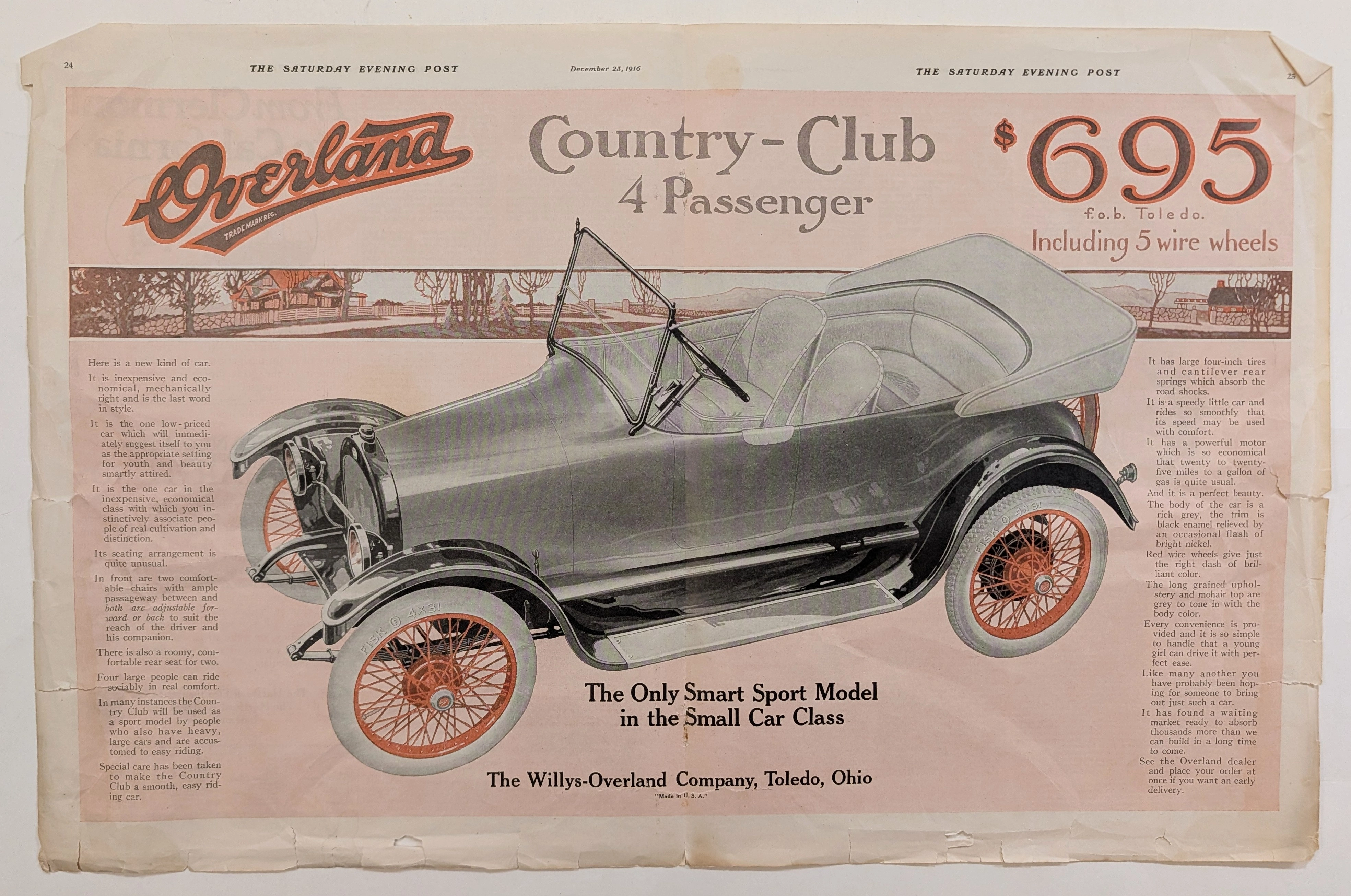
The most potent weapon deployed in this advertisement is not a mechanical specification, but the name itself: "Country-Club." In 1916, the American country club was an exclusionary, highly gated bastion of extreme wealth, old lineage, and elite culture. It was a private paradise of golf, tennis, and leisure, entirely inaccessible to the factory manager, the mid-level accountant, or the rural merchant. By naming a $695 mass-produced vehicle the "Country-Club," Willys-Overland engaged in a masterstroke of psychological transference. They weaponized class aspiration. The advertisement explicitly states it instinctively associates people of "real cultivation and distinction." It allowed the middle-class consumer to purchase a metallic simulation of aristocratic leisure. The car itself became a mobile country club, a gateway to a lifestyle that the driver likely could not afford in physical reality, but could inhabit aesthetically while sitting behind the steering wheel. It was selling the pure illusion of arrival.

Mechanical Aesthetics: The Red Wire Wheel
The visual and textual focus on the wheels represents a definitive, permanent shift in automotive marketing strategy. "Including 5 wire wheels... Red wire wheels give just the right dash of brilliant color." In the early 20th century, wooden artillery wheels were the absolute standard for affordable cars. They were heavy, prone to rot, and visually cumbersome. Wire wheels, conversely, were the undisputed hallmark of European racing machines and high-end luxury sports cars. They were lighter, aided in brake cooling, and conveyed a visual lightness and speed. By equipping a $695 car with wire wheels—and specifically painting them a flamboyant, aggressive red against a "rich grey" body—Willys-Overland democratized the visual language of the elite sports car. The inclusion of the fifth wheel (the spare) as standard equipment was also a significant value proposition and a visual flex of preparedness. The red wheel was not about mechanical superiority; it was an aesthetic rebellion against the sea of standardized black Model Ts. It was a loud declaration of individuality in an era defined by mass standardization.

The Illusion of the "Sport Model"
The copy boldly claims this as "The Only Smart Sport Model in the Small Car Class." It is crucial to properly contextualize the word "Sport" in 1916. It did not denote high horsepower, aerodynamic downforce, or track-ready suspension tuning. The vehicle possessed a "speedy little car" motor, but its primary, heavily advertised virtues were listed as riding "smoothly" and being highly "economical" (twenty to twenty-five miles to a gallon). "Sport," in this specific era, referred to the activity of sporting—leisure, grand touring, and driving for the sheer, unadulterated pleasure of being seen by others. It was the absolute opposite of driving for labor. The cantilever rear springs, designed to "absorb the road shocks," were engineered not for cornering speed, but for preserving the physical comfort of passengers dressed in their Sunday best while navigating unpaved, rutted country roads. It was a machine engineered for the aesthetics of velocity rather than the actual physics of it.

The Gendered Mechanics of 1916
Buried deeply within the exhaustive advertising copy is a sentence of profound sociological significance: "Every convenience is provided and it is so simple to handle that a young girl can drive it with perfect ease." In 1916, the automobile was still largely a male-dominated, physically hostile domain. Hand-cranking a cold engine was dangerous and physically demanding; heavy non-synchronized gearboxes required significant upper body strength. By explicitly marketing the vehicle's ease of use to women ("a young girl"), Willys-Overland was participating in the quiet, ongoing revolution of female mobility. It signaled the transition of the automobile from a dangerous mechanical beast that required a dedicated mechanic-chauffeur, to an accessible consumer appliance. This subtle inclusion reflects the rapidly changing societal dynamics on the eve of the American entry into World War I and the impending, unstoppable suffrage movement. Female mobility was expanding, and the market was finally recognizing it not just as a novelty, but as a crucial, highly lucrative demographic.

The Cadence of the Hard Sell in the Gilded Twilight
The textual layout of the advertisement operates as a relentless, itemized justification for luxury. The left-hand column functions as a litany of aesthetic promises ("last word in style," "smartly attired," "real cultivation"). The right-hand column rapidly pivots to pragmatic, mechanical reassurances (four-inch tires, cantilever springs, fuel economy). This dual-pronged psychological assault was entirely necessary because spending $695 on a machine designed primarily for joy was still a radical, somewhat irresponsible concept for the American middle class in 1916. The consumer required logical, economic justifications to excuse the emotional, aesthetic purchase. The advertisement serves as a historical record of the precise moment the American consumer was being trained to buy a vehicle not for what it could do, but for how it made them feel. It is the architectural blueprint of modern automotive marketing, frozen in the fading twilight of the Gilded Age, just months before the nation would be plunged into global war.

The Paper

The physical substrate of this artifact is a classic, untouched example of early 20th-century periodical printing. Extracted from The Saturday Evening Post on December 23, 1916, it is printed on a thin, high-wood-pulp machine-made paper. The tactile reality is extremely fragile; the paper is highly acidic, leading to the distinct, uniform warming and yellowing visible across the entire expanse of the page. The printing method is an early rotary relief printing process, utilizing a striking duotone technique. The juxtaposition of the stark black ink against the vibrant, almost burnt-orange/red ink is a testament to the technical limitations and the evolving artistry of the era. The halftone rendering of the vehicle itself relies on a coarse dot matrix, giving the metal bodywork a soft, almost hand-illustrated quality rather than the hyper-realism of modern photography. The edges show signs of micro-tears and brittleness, a slow, inevitable oxidation process that turns the historical document into a ticking clock of organic decay.

The Rarity

Class SS.
While The Saturday Evening Post boasted a massive, nationwide circulation in 1916, reaching millions of American households, the survival rate of full, intact, two-color, two-page center spreads from over a century ago is infinitesimally low, bordering on miraculous. Magazine paper from this specific era was inherently self-destructive; its high acid content meant it was destined to crumble. Most copies of this specific issue were read, discarded, used to light domestic winter fires, stuff into walls for cheap insulation, or line the bottoms of birdcages.

Its extreme physical rarity is heavily compounded by its monumental contextual value. It is not merely an old advertisement; it is a "Rosetta Stone" documenting the definitive turning point in global consumer psychology regarding the automobile. It is the exact, verifiable moment the "sport model" became attainable for the masses. Finding this specific artifact, as a complete horizontal spread, without severe structural compromise or vertical tearing down the center fold, elevates it immediately from a vintage curiosity to a museum-grade archival masterwork. It is a true Class SS artifact, a gallery-window centerpiece that has defied the mathematical odds of its own material decomposition.
Visual Impact

The visual composition is a triumph of horizontal dominance, specifically designed to visually exaggerate the length, sleekness, and elegance of the machine. The car is angled carefully to present a dynamic three-quarter view, suggesting forward momentum and latent kinetic energy even while static. The color psychology is aggressively binary and highly effective. The vast expanse of the text and the car body are rendered in muted, serious greys and blacks, representing mechanical reliability and industrial heft. Piercing violently through this solemnity is the sudden application of the red/orange ink—the "Overland" script, the massive price tag "$695", and crucially, the five wire wheels. This directs the viewer's eye in a specific, highly engineered path: Brand, Price, Aesthetic feature. The typography of the word "Overland" is a flowing, confident script, implying speed and grace, contrasting sharply with the rigid, serif typefaces used for the dense informational copy. It is a visual representation of the car itself: highly practical foundations crowned with an undeniable aesthetic flourish.

Share This Archive

The Archive Continues

Continue the Exploration

The Time Traveller's Dossier: Terrestrial Navigation – The Timberland Boat Shoe and the Evolution of Amphibious Footwear

Timberland · Fashion

The Time Traveller's Dossier: Terrestrial Navigation – The Timberland Boat Shoe and the Evolution of Amphibious Footwear

The evolution of twentieth-century American apparel is deeply intertwined with the adaptation of specialized, utilitarian gear for mainstream, terrestrial use. The historical artifact elegantly positioned upon the analytical table of The Record Institute today is a visually detailed and highly informative full-page print advertisement for The Timberland Boat Shoe. This document gracefully transcends the standard boundaries of footwear marketing. It operates as a highly sophisticated, multi-layered cultural mirror, reflecting a precise era in consumer sociology where the American public began integrating specialized sporting garments into their daily wardrobes. By utilizing a methodical, point-by-point comparative analysis against the established market leader, Sperry Topsider, The Timberland Company presented a scholarly and persuasive argument for superior material construction. This comprehensive dossier conducts a meticulous, nuanced, and exceptionally detailed examination of the artifact, operating under the most rigorous parameters of historical, sociological, and material science evaluation. Dedicating the overwhelming majority of our analytical focus (80%) to its immense historical gravity, we will decode the thoughtful marketing psychology embedded within the "land and sea" narrative, analyze the profound engineering differences highlighted in the construction of the shoe, and explore the sociological shift of maritime fashion into the suburban environment. Furthermore, as we venture deeply into the chemical and physical foundations of this analog printed ephemera (10%), we will reveal the precise mechanical fingerprints of the CMYK halftone rosettes captured in the macro imagery of the embossed leather. Finally, we will assess its archival rarity (10%), exploring how the graceful, natural oxidation of the paper substrate cultivates a serene wabi-sabi aesthetic—a natural, irreversible phenomenon that serves as the primary engine increasing its market value exponentially within the elite global spheres of Vintage Commercial Ephemera and Fashion Archives.

The Time Traveller's Dossier: The Martial Authority of the Brew – An Academic Archival Analysis of the 1968 Ballantine Ale Advertisement

Ballantine · Beverage

The Time Traveller's Dossier: The Martial Authority of the Brew – An Academic Archival Analysis of the 1968 Ballantine Ale Advertisement

The cultivation of brand identity through visual symbolism is a profound psychological discipline, acting as a mirror to the cultural aspirations of its era. The historical artifact elegantly positioned upon the analytical table of The Record Institute today is a majestic two-page print advertisement for Ballantine Ale, originating from approximately 1968. This document completely transcends the boundaries of conventional beverage promotion; it stands as a masterclass in the semiotics of mid-twentieth-century American masculinity. By seamlessly aligning the consumption of a traditional ale with the disciplined, formidable imagery of a martial arts master, the advertisement constructs a compelling narrative of strength, boldness, and unyielding character. This world-class, comprehensive academic archival dossier will conduct a meticulous and deep examination of the artifact, operating under the most rigorous parameters of historical and material science evaluation. We will decode the strategic copywriting that challenges the consumer to embrace a "stronger, bolder taste," and illuminate the profound historical lineage of the P. Ballantine & Sons brewing empire. Furthermore, as we venture into the chemical and physical foundations of this analog offset lithography, we will reveal the mechanical fingerprints of the halftone rosettes and the graceful, natural oxidation of the paper substrate. This precise intersection of visual nostalgia, mid-century commercial artistry, and the chemistry of time cultivates a serene wabi-sabi aesthetic—a natural phenomenon that serves as the primary engine driving up its market value exponentially within the elite global spheres of Vintage Breweriana collecting.

The Time Traveller's Dossier : 1980 IH Scout - The SUV Genesis

The Time Traveller's Dossier : 1980 IH Scout - The SUV Genesis

Classic SUV The year is 1980. The American automotive landscape is fracturing. Then, the highway was ruled by bloated steel monoliths. Land yachts built for endless, cheap fuel. Now, the market dictates severe compromise. The "economy-sized" concession born of geopolitical oil shocks. The International Harvester Scout refuses both paradigms. It offers a third trajectory. The concept of "100% Transportation." This artifact documents a pivotal pivot in mechanical history. It captures the precise moment the utilitarian agricultural workhorse mutated into the suburban family carriage. It is the dawn of the Sport Utility Vehicle, recorded in offset ink and degrading pulp. A mechanical declaration of independence against the ordinary passenger car. It is an invitation to reject the passive commute. To fight back. With selective four-wheel drive.

Published by

The Record Institute

Taxonomy Match

Related Articles

The Time Traveller's Dossier : 1968 Equitable - The Security Shift — related article
Read Article

The Time Traveller's Dossier : 1968 Equitable - The Security Shift

The year is 1968. The American societal fabric is actively tearing. The streets are defined by protests, riots, and profound uncertainty. The evening news broadcasts a daily ledger of casualties and assassinations. Then, a deliberate counter-narrative is printed. The Equitable Life Assurance Society of the United States deploys an image of absolute, unshakable stability. They do not sell a financial policy. They sell a psychological fortress. They sell "The Protectors". This is not merely an advertisement for life insurance. It is a documented shift in the architecture of institutional trust. A calculated movement away from the morbid reality of death benefits, toward the manufactured concept of "Living Insurance". The problem was a middle class terrified of losing its grip on the American Dream. The solution was two men in dark suits, standing guard on Main Street.

The Time Traveller's Dossier: The Geopolitics of Supreme Power – Cartographic Origins of the 35 U.S. Presidents (Circa Mid-1960s) — related article
Read Article

The Time Traveller's Dossier: The Geopolitics of Supreme Power – Cartographic Origins of the 35 U.S. Presidents (Circa Mid-1960s)

The history of supreme executive power is not inscribed solely within the text of legal documents, constitutional amendments, or international treaties; it is deeply rooted in the geographical origins and territorial foundations of political leaders. Long before the modern era of complex spatial data analysis or digital infographics, the structural understanding of state power in the United States was conveyed through the meticulous art of cartographic illustration. The historical artifact presented before us for museum-grade forensic analysis is not merely a conventional fold-out extracted from a mid-20th-century educational publication. It is a profound "geopolitical visual encyclopedia," meticulously compiling and categorizing the geographic birthplaces of the thirty-five individuals who had ascended to the highest office in the White House up to that point in history. This academic archival dossier presents an exhaustive, microscopic deconstruction of the historical and aesthetic framework of the diagram titled "The 35 Presidents and the 14 States They Came From." Operating on a profound scholarly narrative structure, this document decodes the shifting tectonic plates of executive power in the United States—from the foundational era concentrated on the Eastern Seaboard, moving steadily into the Midwest, and ultimately expanding toward the Southern and Western frontiers. Through the highly specialized lens of late-analog print analysis, American political history, and rigorous visual forensics, this document serves as a temporal window. It allows us to explore the foundational roots of the "American Dream" as conveyed through the birthplaces of these statesmen, ranging from humble log cabins to opulent estates, all rendered with the mechanical precision of mid-century offset lithography.

The Time Traveller's Dossier : Keep America Beautiful - Invention of the Litterbug — related article
Read Article

The Time Traveller's Dossier : Keep America Beautiful - Invention of the Litterbug

Before this artifact. Waste was a systemic reality, largely managed through local, reusable infrastructure. Milk bottles were returned. Soda glass was collected. The burden of packaging remained, to a significant degree, tethered to the producer. Consumption was a cycle, anchored by the economics of material recovery. Then, a shift. The post-war boom dictated an economy of disposability. Convenience required single-use materials. Single-use materials created unprecedented volume. Instead of altering the production model, a masterful psychological pivot was engineered. The introduction of the "Litterbug." The burden of the packaging lifecycle was cleanly, legally, and morally transferred from the corporation that manufactured it to the citizen who consumed it. It was the birth of individualized environmental guilt. A pristine picnic turned into an act of civic betrayal. The artifact does not merely ask the public to clean up. It defines a new moral boundary for the modern American citizen.

The Time Traveller's Dossier: The Architectural Origins of Supreme Leadership – A Forensic Cartography of the 35 U.S. Presidents (Circa 1960s) — related article
Read Article

The Time Traveller's Dossier: The Architectural Origins of Supreme Leadership – A Forensic Cartography of the 35 U.S. Presidents (Circa 1960s)

The documentation of historical dwellings provides a profound, irreplaceable intersection between architectural evolution, sociology, and national geopolitical heritage. Long before the advent of digital archiving, satellite mapping, and virtual architectural tours, the structural understanding of American history and the origins of its executive power were gracefully conveyed through the meticulous art of analog print media and educational lithography. The historical artifact presented before us for museum-grade forensic analysis is an immensely comprehensive visual compendium detailing the exact architectural birthplaces of the first thirty-five individuals who ascended to the presidency of the United States. Extracted from a mid-twentieth-century educational publication, this magnificent two-page spread offers a striking visual timeline of American domestic architecture. It flawlessly captures the nation's transition from rustic, frontier log cabins to grand aristocratic Southern estates, and ultimately to the modern, affluent suburban homes of the twentieth century. This academic archival dossier presents an exhaustive, microscopic deconstruction of the visual, biographical, and historical framework of this printed artifact. Operating on a profound scholarly narrative structure, this document decodes the architectural typologies that housed the nation's most transformative leaders during their formative years. Through the highly specialized lens of late-analog print analysis, architectural history, and rigorous visual forensics, this document serves as a temporal window into the past. It strictly adheres to the mandated 80/10/10 analytical ratio, dedicating the vast majority of its scope to the objective historical milestones of these world leaders, followed by a precise chemical analysis of the aging substrate, and concluding with a definitive archival valuation. Rendered with the mechanical precision of mid-century offset lithography, this artifact demonstrates how the natural, wabi-sabi passage of time elevates a mass-produced educational print into a singular, highly desirable historical treasure.

The Time Traveller's Dossier : 1969 Pontiac - The Escape Paradigm — related article
Read Article

The Time Traveller's Dossier : 1969 Pontiac - The Escape Paradigm

The year is 1969. The American societal engine is redlining. The reality of the daily commute has become a grinding, predictable loop. General Motors observes this collective psychological fatigue. They identify the disease as "the humdrum." They engineer the cure in Detroit. Pontiac does not merely sell a mode of transportation. They sell a heavily armored, 390-horsepower escape pod. This is not a simple automobile advertisement. It is a documented shift in automotive marketing psychology. A deliberate movement from selling mechanical utility to commodifying dimensional dominance and psychological isolation. The problem was a society trapped in the mundane. The solution was a 125-inch wheelbase, the illusion of infinite width, and a Wide-Track getaway vehicle.

The Time Traveller's Dossier : Goodyear Album 8 - Vinyl Retail Synergy — related article
Read Article

The Time Traveller's Dossier : Goodyear Album 8 - Vinyl Retail Synergy

Then, the automobile was a mechanical island. The home was a separate fortress of domesticity. Between them lay a vast commercial disconnect. Rubber companies needed drivers to prepare for winter, yet drivers resisted the necessary maintenance. Now, we recognize the psychological bridge of cross-industry promotion. Goodyear did not sell tires in this artifact. They sold a soundtrack to American family life. They identified a deficit in retail foot traffic. They engineered a solution using high-fidelity vinyl. A single dollar became the bait. The record player became the retail hook. The artifact before us is not merely an advertisement. It is a masterclass in behavioral economics, perfectly preserved on paper.