THE RECORD · ARCHIVE PLAYER
MP4
■ PAUSED
1958 Renault Dauphine Vintage Advertisement - "Le Car Hot"ANALOG ARCHIVE
1958 Renault Dauphine Vintage Advertisement - "Le Car Hot" (1958) — Class A vintage Automotive
CLASS A
1 of 4

1958 Renault Dauphine Vintage Advertisement - "Le Car Hot"

Category|Automotive
Subcategory|European
Year|1958
Rarity Class|CLASS A
Archive Views|1
Heritage AdvertisementsAutomotiveCars
Ad Content TypeProduct Showcase

Last updated: 16 May 2026

Historical Context

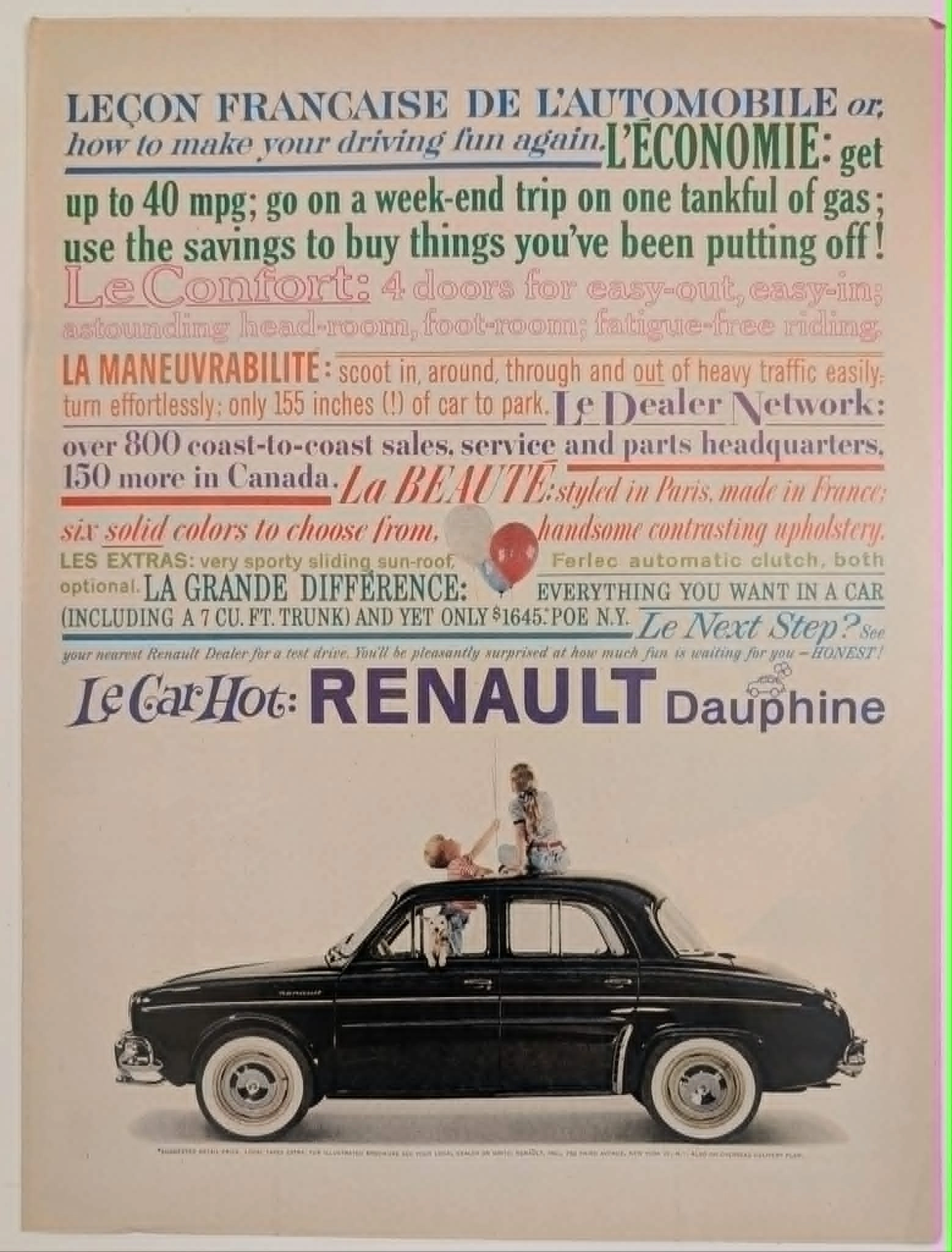
During the late 1950s, the American automotive landscape was dominated by large, chrome-laden, fuel-heavy vehicles. However, a quiet revolution was beginning as European imports, most notably the Volkswagen Beetle, started gaining traction among pragmatic buyers. Renault capitalized on this shifting market dynamic by aggressively promoting the Dauphine as the elegant, four-door alternative to both domestic gas-guzzlers and its German rival. This specific advertisement is a masterclass in cross-cultural marketing. The copy utilizes a brilliant "Franglais" strategy—mixing English with highly accessible French vocabulary (L'Économie, Le Confort, La Maneuvrabilité, La Beauté)—to evoke a sense of continental sophistication while remaining perfectly intelligible to the American consumer. By branding the vehicle as "Le Car Hot," Renault infused the campaign with a playful, energetic tone. The advertisement strategically dismantles the perceived drawbacks of imported cars. It highlights a robust "Dealer Network" of over 800 coast-to-coast locations, addressing the common fear of unavailing service and parts. Furthermore, the ad zeroes in on concrete financial benefits: up to 40 miles per gallon and an incredibly competitive port-of-entry price of $1,645 in New York. Visually, the layout prioritizes typographic hierarchy over grand illustration. The text serves as the primary visual texture, drawing the eye down to the sleek, black Dauphine profile. The inclusion of a child and a dog holding balloons atop the car subtly reinforces the themes of family, lightness, and the joy of driving ("how to make your driving fun again"). This artifact beautifully encapsulates Renault's ambitious—and initially highly successful—push into the mid-century American market.

Paper & Print Condition

Printed on standard mid-century commercial magazine stock. The typography remains remarkably sharp. The contrast between the deep black ink of the vehicle illustration and the pastel red, blue, and green typographic blocks creates a striking visual hierarchy. There is slight, even age-toning typical of the acidic paper formulations of this era, adding to its vintage authenticity.

Provenance & Rarity

Sourced from a mainstream American periodical of the late 1950s. While the "Le Car Hot" campaign was widely circulated in magazines like LIFE and The Saturday Evening Post, surviving examples that have not succumbed to significant tearing, moisture damage, or severe fading are prized by automotive ephemera collectors and mid-century design enthusiasts.

Rarity & Condition Summary

Rarity Class A: A well-preserved artifact representing the golden age of imported car advertising. It maintains excellent structural integrity and strong display qualities, making it a highly representative piece of transatlantic commercial history.
Share This Archive

From the Journal

Related Articles

The Time Traveller's Dossier : VW Type 3 Automatic - The Compromise of Engineering — related article
Read Article

The Time Traveller's Dossier : VW Type 3 Automatic - The Compromise of Engineering

We often remember early Volkswagen history through the lens of simplicity, air-cooled engines, and rugged manual transmissions. But as the American market matured, the demand for comfort began to clash with the brand's original philosophy. This document is historical evidence capturing that moment of compromise. It is not just a car advertisement; it is an engineering confession and a declaration. After a decade of hesitation, Volkswagen of America introduced a fully automatic transmission for the 1969 models. It is a turning point showing that even the most stubborn brand had to adapt to the American consumerism trend that sought ultimate convenience.

The Time Traveller's Dossier : Alfa Romeo 8C 2900B Touring Berlinetta - The Apex of Pre-War Velocity — related article
Read Article

The Time Traveller's Dossier : Alfa Romeo 8C 2900B Touring Berlinetta - The Apex of Pre-War Velocity

We categorize automotive history into the eras before and after aerodynamics. Prior to the late 1930s, luxury meant upright, carriage-like monuments of steel. Speed was achieved through brute force, pushing flat radiators and exposed fenders through the atmosphere. Then came the marriage of Vittorio Jano's Grand Prix engineering and Carrozzeria Touring's wind-cheating architecture. This artifact is a meticulous dissection of that paradigm shift. It is a photographic autopsy of the Alfa Romeo 8C 2900B Touring Berlinetta. The problem was the physics of atmospheric drag at high speeds. The solution was "Superleggera"—super-light aluminum stretched over thin steel tubes, shaped not by tradition, but by the wind itself.

The Time Traveller's Dossier : Datsun 280-ZX - The GT Shift — related article
Read Article

The Time Traveller's Dossier : Datsun 280-ZX - The GT Shift

Then. The sports car was a visceral punishment. A machine of raw mechanical feedback. Loud. Uncomfortable. Temperamental. It demanded physical sacrifice in exchange for kinetic velocity. It was a weekend indulgence, entirely divorced from daily comfort. Now. The sports car is an isolated, luxurious capsule. It is a computational network rolling on synthetic rubber. It prioritizes atmospheric control, acoustic perfection, and passenger comfort alongside acceleration. It is a sanctuary of speed. The artifact before us documents the precise architectural bridge between these two eras. The year is 1980. The vehicle is the Datsun 280-ZX 10th Anniversary "Black Gold" edition. This is not merely a piece of automotive marketing collateral. It is the obituary of the raw, analog sports car. It is the birth certificate of the modern Personal Luxury Grand Tourer. It is the definitive moment Japanese manufacturing stopped apologizing and claimed absolute supremacy over the American highway.

The Time Traveller's Dossier : 1964 Studebaker - The Final Defiance of the Independent Automaker — related article
Read Article

The Time Traveller's Dossier : 1964 Studebaker - The Final Defiance of the Independent Automaker

Then, it was a declaration of survival. A corporate manifesto masked as a product introduction. In late 1963, as this advertisement went to press, the American automotive landscape was consolidating into an impenetrable oligopoly. The Big Three—General Motors, Ford, and Chrysler—dictated the market. Studebaker, an independent manufacturer with roots dating back to wagon-building in the 19th century, was bleeding capital. This document represents their final, logical plea to the rational consumer. It highlights safety before safety was mandated. It promises performance, economy, and structural integrity. It carries the personal signature of a dying president, Sherwood H. Egbert. Now, it is an artifact of extinction. A perfectly preserved record of a company attempting to logic its way out of an emotional marketplace. It stands as a testament to the brutal reality of industrial capitalism: superior engineering and honest value cannot always overcome the sheer inertia of massive corporate scale. The shift here is not technological. It is structural. It marks the closing of the era where an independent automaker could survive purely on the merit of being "Different… by Design."