The Time Traveller's Dossier : 1940 Hennessy - The Scarcity Shift
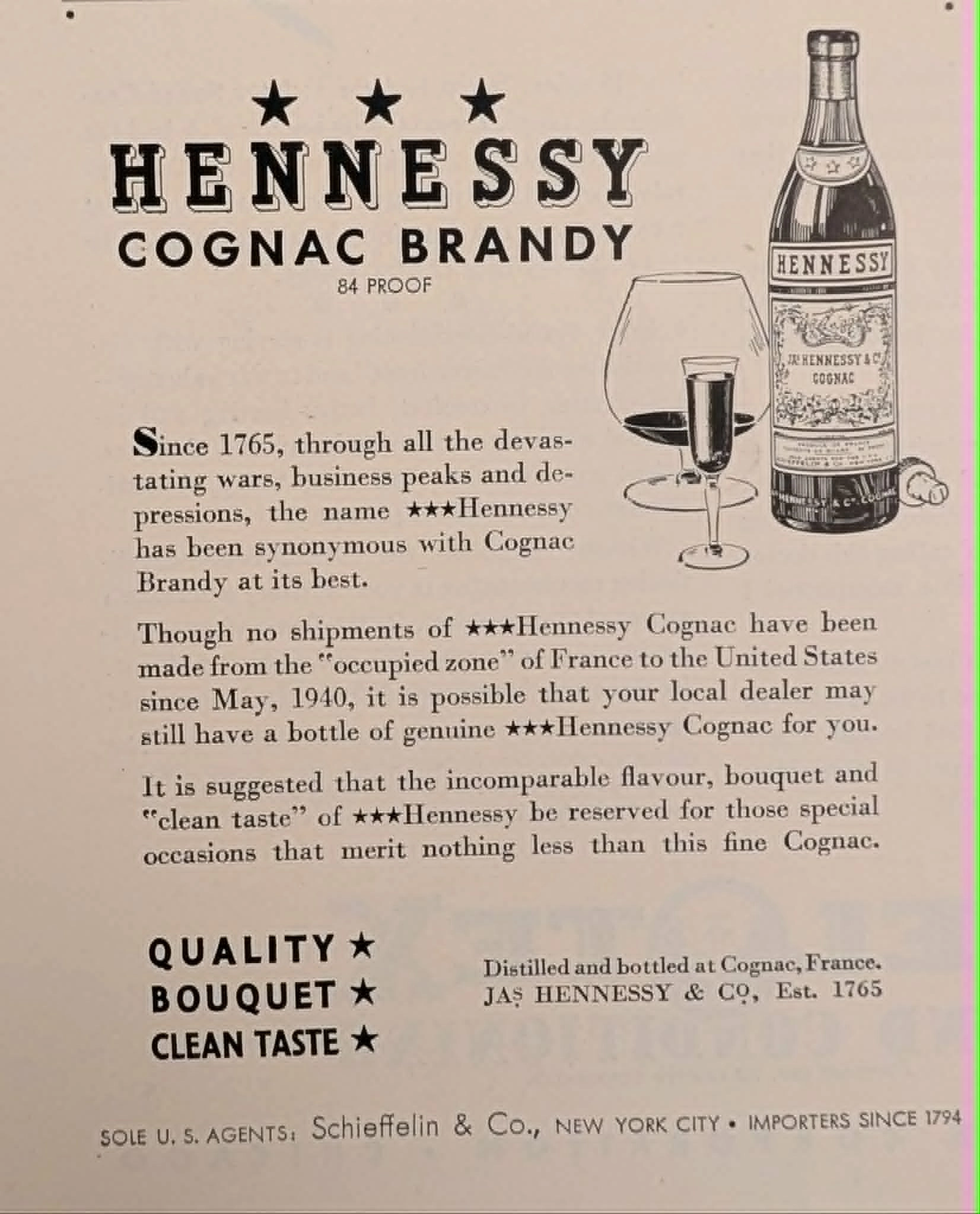
The artifact before us is not merely an advertisement. It is a geopolitical distress signal disguised as a luxury pitch. Published in the precarious window following the fall of France in the spring of 1940, this document captures a fundamental inversion of capitalist logic. Before this precise historical moment, the concept of luxury relied heavily on continuous, visible consumption. Abundance was the engine of status. However, the sudden, violent imposition of the German "occupied zone" abruptly severed the transatlantic arteries of trade. The importer, Schieffelin & Co., found themselves holding a finite, irreplaceable inventory of French heritage. Their solution was a masterful strategic pivot from abundance to archival preservation. They instructed the American consumer not to consume, but to hoard. They effectively transformed a commercial alcoholic beverage into a historical relic. This document records the exact moment when a mass-market commodity became a testament to a world suspended in geopolitical paralysis, weaponizing scarcity to ensure brand survival.
Category: Beverage
Brand: Hennessy
The History
The Geopolitical Fracture of 1940 To understand the profound weight of this artifact, one must fully comprehend the precise geopolitical fracture that occurred in the spring of 1940. The German blitzkrieg effectively dismantled the French Republic within a matter of weeks, a shock that reverberated violently through every sector of global commerce. The resulting armistice partitioned the nation into highly regulated zones. The northern and western regions, which crucially included the entire Atlantic coastline, were placed under direct German military administration. This was the "occupied zone" explicitly and ominously referenced in the second paragraph of the text. The Cognac region, situated in the Charente department, fell squarely within this newly occupied territory. The ramifications for transatlantic trade were instantaneous and absolute. For over a century, the deep cellars of Jas Hennessy & Co. had dispatched their heavily aged eaux-de-vie across the Atlantic without interruption, surviving previous continental conflicts. However, the 1940 occupation transformed commercial ports into fortified military zones. The merchant marine networks were either requisitioned by occupying forces, blockaded by opposing navies, or destroyed in transit. This advertisement operates in a highly specific, liminal temporal window. It addresses an American populace that was, at the time of publication, technically neutral. The United States had not yet entered the conflict. However, the American consumer was acutely aware that the European continent was being systematically sealed off behind a wall of steel and ideology. The phrase "since May, 1940" is not merely a logistical date; it is an epitaph for an era of free trade. It signals to the reader that the old world order has completely collapsed, and the physical link to European heritage has been severed. The Architecture of the Severed Supply Chain The mechanics of the transatlantic luxury trade were highly complex and profoundly vulnerable to such disruptions. Importers like Schieffelin & Co., operating out of New York City as sole agents since 1794, relied on a continuous, rolling inventory to maintain market dominance. Cognac is not simply manufactured on demand; it is carefully cultivated, distilled, and aged over decades in oak barrels. The "Three Star" designation—equivalent to the modern VS (Very Special)—indicated a carefully blended product that relied on vast reserves in French cellars to maintain strict flavor consistency year after year. When the maritime supply line was severed, the fundamental architecture of the business changed overnight. The finite inventory currently resting in American bonded warehouses and on local dealers' shelves was entirely all that remained. There was no possibility of pivoting to domestic production. The specific terroir, climate, and chalky soil of the Cognac region cannot be replicated in the distilleries of Kentucky, Pennsylvania, or New York. The importer faced a critical, existential dilemma: how to manage a dwindling, irreplaceable stock without losing brand relevance and market share. If they remained silent, the brand would simply vanish from the public consciousness as the remaining bottles were quietly sold out. If they promoted consumption as usual, they would rapidly accelerate their own obsolescence. The strategy they deployed, as evidenced by this archival text, was to lean heavily into the geopolitical tragedy. They utilized the completely severed supply chain not as a point of weakness, but as the ultimate, undeniable proof of exclusivity. The Weight of 1765: A Legacy in the Balance The opening text anchors the brand to a deep historical timeline: "Since 1765, through all the devastating wars, business peaks and depressions, the name ★★★Hennessy has been synonymous with Cognac Brandy at its best." This is a highly calculated rhetorical maneuver. By invoking 1765, the year Richard Hennessy founded the trading house, the copywriter contextualizes the current World War as merely another obstacle in a centuries-long narrative of survival. It reminds the reader that the brand has survived the French Revolution, the Napoleonic Wars, the Franco-Prussian War, and the First World War. It projects an aura of historical invincibility. In a moment of extreme global anxiety, this assertion of permanence is deeply comforting. It subtly suggests that while governments may fall and borders may be redrawn, the quality of a meticulously distilled 84 Proof brandy remains an immutable truth. This appeal to legacy transforms the bottle from a mere consumer good into a resilient anchor of Western civilization. Competitive Dynamics in the Shadow of Isolation In the pre-war North American market, imported European spirits engaged in fierce, constant combat with domestic distillers. Following the repeal of Prohibition in 1933, American bourbon and rye whiskey producers had spent seven grueling years aggressively rebuilding their operations, aging their stocks, and recapturing the domestic palate. By 1940, domestic spirits were abundant, aggressive in their marketing, and entirely unimpeded by U-boats, naval blockades, or foreign occupations. Hennessy's primary competitors in this specific window were no longer just rival French houses like Martell or Courvoisier, whose supply lines were equally paralyzed. Their primary existential threats were the accessible, unaffected domestic brands that could guarantee steady supply. To counter this massive logistical disadvantage, Schieffelin & Co. elevated the discourse. They positioned domestic abundance as pedestrian and ordinary. By highlighting their own supply chain failure—caused directly by the "occupied zone"—they imbued their remaining bottles with an aura of tragic nobility and irreplaceable value. They told the consumer that buying a domestic whiskey is a simple financial transaction, but securing a bottle of Three Star Hennessy is an act of preserving a piece of European heritage before the darkness falls completely. The Psychological Pivot from Consumption to Conservation The most profoundly significant element of this artifact is its psychological manipulation of the target consumer. Traditional capitalist advertising operates on a singular, driving imperative: consume the product quickly, and purchase it again as soon as possible. This advertisement completely inverts that standard economic model. The final paragraph reads: "It is suggested that the incomparable flavour, bouquet and 'clean taste' of ★★★Hennessy be reserved for those special occasions that merit nothing less than this fine Cognac." This is an explicit anti-consumption mandate. The importer is actively and intentionally instructing the loyal customer to stop drinking the product on a regular basis. In doing so, they achieve two highly strategic goals. First, by encouraging rationing, they mathematically ensure that the physical bottle remains in the consumer's home for a much longer duration, serving as a persistent, physical billboard for the brand throughout the duration of the war. Second, they fundamentally alter the psychological relationship between the owner and the object. The bottle is elevated from a casual beverage to a sacred, finite vessel. It requires discipline. It demands reverence. The act of opening the bottle is transformed into a highly selective ritual. In an era where everyday life was becoming increasingly fraught with helplessness and anxiety, the personal rationing of a luxury good provided the consumer with a small, manageable micro-narrative of control. The Semantics of "Clean Taste" in a Contaminated World The typographic hierarchy at the bottom of the page heavily emphasizes three foundational attributes: QUALITY, BOUQUET, and CLEAN TASTE. The repetitive focus on "clean taste" is a remarkable and revealing semantic choice by the copywriter. In the early 1940s, the world felt fundamentally unclean. Global conflict is inherently dirty. It involves the contamination of sovereign borders, the corruption of political systems, the spread of propaganda, and the physical, violent destruction of cities. In this grim context, the marketing of a "clean" product takes on an almost moral, spiritual dimension. The text promises clarity, purity, and an uncorrupted sensory experience. It offers a fleeting escape from the murky, terrifying realities of the era. The heavy, unyielding typography used for these three pillars reinforces this idea of absolute, unshakeable stability. The consumer is being sold certainty in an age of utter, terrifying uncertainty. Ultimately, this artifact stands as a masterclass in reactionary, crisis-driven marketing. It does not attempt to ignore the war; rather, it absorbs the geopolitical reality of the war entirely into its brand identity. It acknowledges the catastrophic rupture in the global timeline and strategically positions its product as a surviving, pristine fragment of the unbroken past. The bottle becomes a physical anchor. As long as it remains sealed on the shelf, a small, tangible piece of the world before May 1940 continues to exist in defiance of the occupied zone.
The Paper
This document is manifested on standard periodic pulp stock. The material reality of the artifact deeply reflects the constraints of the era. It is engineered for high-volume rotary letterpress machines, lacking the heavy gloss or cotton rag content of peacetime luxury monographs. The aging process has resulted in a deep, oxidative lignin decay. The groundwood pulp, high in organic impurities, has reacted with ambient ultraviolet light and oxygen over eight decades to produce a rich amber patina. This discoloration is not a flaw; it is the physical recording of time embedded within the cellular structure of the paper. The print methodology relies entirely on a single-pass monochromatic carbon black application. There is absolutely no modern CMYK halftone pattern present. The letterpress technique forces the metal type directly into the fibrous substrate with immense pressure. Under magnification, one can observe the microscopic displacement of paper fibers at the edges of the serif fonts—a tactile, three-dimensional bite that modern offset printing cannot replicate.
The Rarity
Classification: Class B (High Contextual Significance) While mass-produced for national circulation in American periodicals, the survival rate of unmodified, intact ephemera from this specific 1940-1941 liminal window is remarkably low. Its rarity does not command exorbitant financial premiums at auction, but its "contextual value" is exceptional. It is a highly specific historical marker. It documents the exact intersection of consumer capitalism and geopolitical collapse, capturing a momentary paralysis before the total mobilization of the American war economy following Pearl Harbor. It is a piece of history hiding in plain sight.
Cite this article
- MLA
- Naodhinsuk, Ronin. “The Time Traveller's Dossier : 1940 Hennessy - The Scarcity Shift.” The Record Institute, 20 May 2026, https://therecord.institute/journal/the-time-travellers-dossier-1940-hennessy-the-scarcity-shift.
- APA
- Naodhinsuk, R. (2026, May 20). The Time Traveller's Dossier : 1940 Hennessy - The Scarcity Shift. The Record Institute. https://therecord.institute/journal/the-time-travellers-dossier-1940-hennessy-the-scarcity-shift
- CHICAGO
- Naodhinsuk, Ronin. 2026. “The Time Traveller's Dossier : 1940 Hennessy - The Scarcity Shift.” The Record Institute, May 20, 2026. https://therecord.institute/journal/the-time-travellers-dossier-1940-hennessy-the-scarcity-shift.