The Time Traveller's Dossier : 1959 GE Range - The Automation of Domesticity
The History
The Blueprint of an Era
To understand the 1959 General Electric Range, one must understand the socio-economic architecture of post-war America.
The nation was gripped by a dual narrative.
On a macro level, the Cold War demanded technological supremacy.
On a micro level, this supremacy had to be reflected in the home.
The kitchen became the ultimate metric of progress.
It was the localized frontier of the American dream.
The suburban migration created a new archetype.
The homemaker.
Her duties were immense, yet culturally undervalued.
She was the manager of a localized supply chain.
Cooking, cleaning, child-rearing, and social entertaining.
Time was her most scarce commodity.
Industry recognized this deficit.
They saw a vacuum waiting to be filled by engineering.
The narrative shifted from "labor-saving" to "time-liberating."
This advertisement does not sell a stove.
It sells autonomy.
The Epistemology of Heat
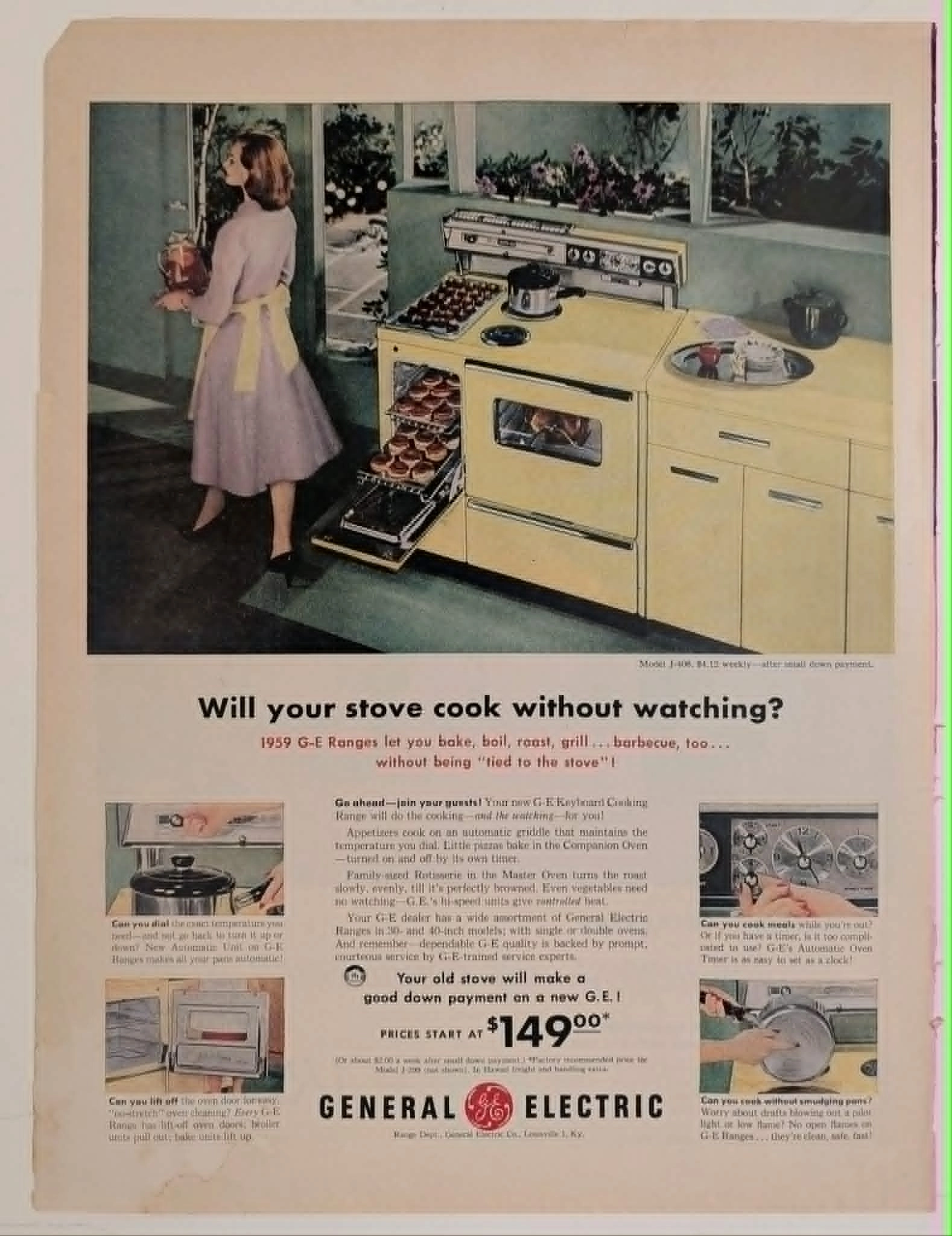
"Will your stove cook without watching?"
This is not merely a marketing hook.
It is a profound philosophical question regarding trust.
For millennia, cooking was an act of constant observation.
Wood, coal, and early gas required a human feedback loop.
You watch the flame. You watch the water. You intervene.
General Electric sought to sever this loop.
The shift relied on a quiet marvel of engineering: the thermostat.
Specifically, the bimetallic strip and the capillary tube sensor.
The "New Automatic Unit" promised exact temperature dials.
Not "High, Medium, Low."
But precise numerical values.
This was the industrialization of the recipe.
It replaced instinct with mathematics.
The advertisement proudly states: "not go back to turn it up or down."
The machine reads its own environment.
It adjusts its own output.
The human is removed from the equation of maintenance.
This marked a critical transition from active cooking to passive processing.
The Architecture of Time Management
Observe the control panel.
It does not look like traditional kitchen equipment.
It resembles the dashboard of an aircraft.
Or the face of a complex Swiss chronograph.
Three distinct dials command the fascia.
The Automatic Oven Timer.
"Can you cook meals while you're out?"
This was a revolutionary proposition.
The manipulation of time itself.
Before this, time was absolute.
You cook when you are present.
The GE timer introduced asynchronous domesticity.
The operator prepares the raw materials.
The operator programs the temporal parameters.
The operator leaves the premises.
The machine executes the sequence in a void of human presence.
"As easy to set as a clock!"
This normalized the programming of machines by civilians.
It was the earliest iteration of smart home logic.
Input variables. Establish conditions. Walk away.
The psychological barrier of leaving an active heating element unattended had to be dismantled.
GE used the authority of the clock face to establish safety and trust.
The Ergonomics of Maintenance
The artifact highlights physical labor alongside temporal labor.
"Can you lift off the oven door for easy, 'no-stretch' oven cleaning?"
This addresses the hidden toll of the kitchen.
Cooking is the primary function.
Cleaning is the inevitable tax.
Ovens were historically dark, inaccessible caverns.
Cleaning them required physical contortion.
It was punishing, degrading work.
General Electric engineered modularity into the chassis.
Lift-off doors. Pull-out broiler units. Lift-up bake units.
This is a principle borrowed from heavy industry and automotive repair.
If a component is difficult to service, make it detachable.
By applying this logic to the domestic sphere, GE acknowledged the physical strain of the homemaker.
They quantified human effort and sought to minimize the required kinetic energy.
The machine was designed to yield to the human body, rather than forcing the human body to yield to the machine.
The Economics of Aspiration
At the bottom of the artifact lies the fulcrum of the 1950s economy.
"Model J-408. $4.12 weekly—after small down payment."
This is the financialization of the American kitchen.
The total price is listed as starting at $149.00.
But the anchor is the weekly payment.
Consumer credit was the true engine of the post-war boom.
It democratized access to technological liberation.
You did not need the capital upfront.
You only needed the capacity to service the debt.
This transformed luxury into a standard expectation.
The working class and the emerging middle class could purchase time.
They could purchase safety.
They could purchase status.
For four dollars and twelve cents a week, a household could cross the threshold into modernity.
The credit system locked the consumer into the labor force to pay for the machines that freed them from domestic labor.
A perfect, self-sustaining economic loop.
The Battleground of Elements: Electric vs. Gas
The advertisement employs subtle, calculated warfare against its primary competitor: gas.
"Worry about drafts blowing out a pilot light or low flame? No open flames on G-E Ranges... they're clean, safe, fast!"
This is a masterclass in shifting risk perception.
Gas was traditional. It was visual. People trusted fire because they could see it.
Electricity was invisible. It was abstract.
To counter the comfort of the visible flame, GE weaponized the vulnerabilities of gas.
The pilot light was framed as a fragile liability.
A draft—a simple gust of wind—could sever the heat source.
Worse, it could leak volatile gas into the home.
Electric heating elements were marketed as immutable.
They do not require oxygen.
They cannot be blown out.
They do not produce soot ("smudging pans").
This was a paradigm shift in the definition of a "safe" home.
Cleanliness was equated with electrical purity.
Combustion was relegated to the past.
Electrons were the future.
The Lasting Implications of the Shift
The 1959 GE Range was highly successful.
But did it truly create leisure?
Sociological data from the era suggests a paradox.
As appliances automated individual tasks, the overarching standards of domesticity rose.
If the oven cleans easily, it must be kept perpetually spotless.
If the stove can cook complex meals unattended, the meals expected by the family became more complex.
The time saved was rarely converted into pure rest.
It was reallocated into higher standards of living.
Yet, the technological leap remains undeniable.
This artifact represents the moment the home began to think for itself.
It is the ancestor of every automated system we rely on today.
From programmable thermostats to algorithmic slow cookers.
The concept of delegating critical thermal processes to a machine began here.
The Model J-408 did not just cook the meat.
It conditioned the human race to trust the machine.
The Paper
The artifact survives on standard mid-century magazine stock.
Estimated at 70 to 80 GSM.
The printing method is a high-volume commercial offset lithography.
Observation of the surface reveals a distinct CMYK halftone dot pattern, typical of mass-circulation periodicals of the late 1950s.
The paper is highly susceptible to acidic degradation.
The edges show clear signs of yellowing, a result of lignin oxidation over six decades.
The texture is smooth, slightly calendared, designed to hold ink with minimal bleed to preserve the sharpness of the technical photographs.
It is a transient medium, engineered to be discarded after a month, now locked in an unintended permanence.
The Rarity
Classification: Class A.
Physically, pages from 1950s magazines are abundant in antique circuits.
However, its contextual value is exceedingly high.
This specific layout acts as a Rosetta Stone for mid-century consumer psychology.
It is an artifact of transition.
It perfectly encapsulates the intersection of engineering, gender roles, consumer debt, and technological optimism.
Its value lies not in its scarcity, but in its absolute clarity as a historical document.
It is a museum-grade example of the automation narrative.
Visual Impact
The visual strategy relies on the psychology of compartmentalization.
The primary image is a wide, pastel-hued tableau of domestic success.
The woman is well-dressed, relaxed, turning away from the appliance.
Her posture indicates trust. She is moving outward, toward the dining area.
The machine is bathed in soft, natural light, integrating it into the living space.
Below the primary image, the layout fractures into an instructional grid.
Four distinct macro-photographs isolate specific features.
The dial. The door. The timer. The pan.
This directs the viewer's eye from the emotional promise (freedom) to the logical justification (technical features).
The typography uses a bold, authoritative sans-serif for questions ("Can you..."), immediately answered by the steady, serifed body copy.
The GE logo anchors the bottom, acting as the seal of industrial authority.
Tags
The Archive Continues
Continue the Exploration

Schenley · Beverage
The Time Traveller's Dossier : Schenley '43 - The Distiller's War
Once, the distillation of spirits was a pursuit of leisure. A craft dedicated to the quiet moments of peace. Then came the total war. This artifact represents the absolute inversion of purpose. It is a portal to 1943, a moment when the machinery of pleasure was forcefully repurposed into the machinery of survival. The product is no longer the whiskey. The product is sacrifice. The brand is selling the very act of not consuming. It is the birth of the corporate wartime conscience—a masterclass in preserving brand equity while the factory lines churned out the fuel for global conflict.

Chanel · Fashion
The Time Traveller's Dossier : Chanel No. 5 - The Architecture of Absolute Desire
The exact year is obscured by a deliberate, calculated timelessness. It is anchored in the late mid-century transition of luxury commerce. Then, fragrance was marketed through elaborate, painted fictions. Scenarios of Parisian romance. Whispered promises in twilight gardens. Now, the market dictates a brutal, elegant minimalism. This artifact discards the narrative entirely. It presents a monolith. This document captures the exact historical pivot where luxury advertising abandoned the art of seduction in favor of undeniable decree. It is the distillation of brand identity into stark geometry and declarative syntax. A psychological absolute, rendered in high-contrast black and white. It is not an invitation to dream. It is an instruction to conform.

Gilbert · Other
The Time Traveller's Dossier : Gilbert Paper - The Cotton Front Line
Then. A world gripped by total global conflict. Resources were not merely commodities; they were tactical assets. Cotton was the fiber of the soldier—the twill of the uniform, the canvas of the tent, and the cord of the parachute. Respect was earned through the rigidity of one's stance and the quality of one's equipment. Communication was a heavy, physical burden. Letters were the only lifelines between corporate command and distant markets, or a soldier and the home front. Now. A digital void. "Appearance" is a curated pixel on a liquid crystal display. The tactile authority of cotton-fibre paper has been relegated to a luxury niche. We have forgotten that for a century, the authority of a decree was determined by the "snap" and weight of the page. This artifact captures the precise moment when industrial manufacturing married patriotic fervor. It redefined the concept of "Respect" within the American psyche through the lens of material science.